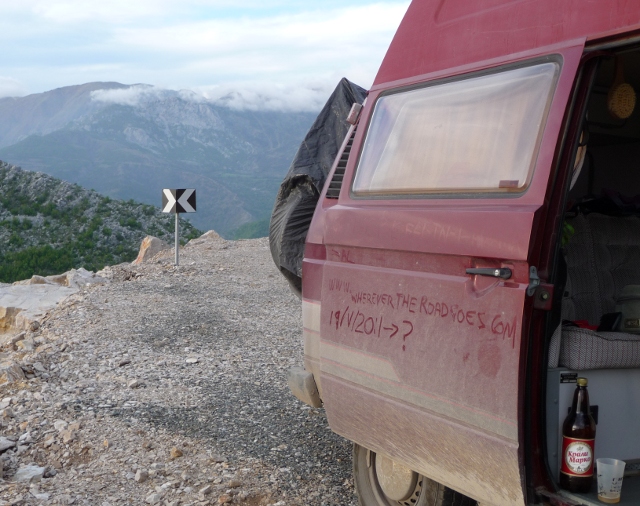
Colourboration – going round in circles

Click to see larger image (1280×1710, 1.6Mb)

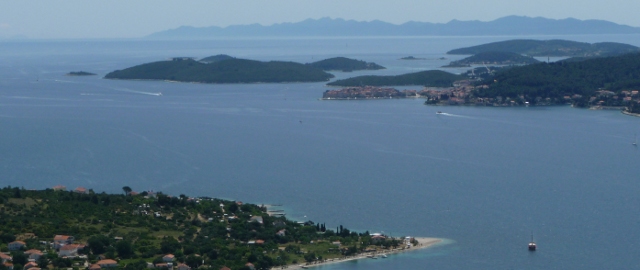
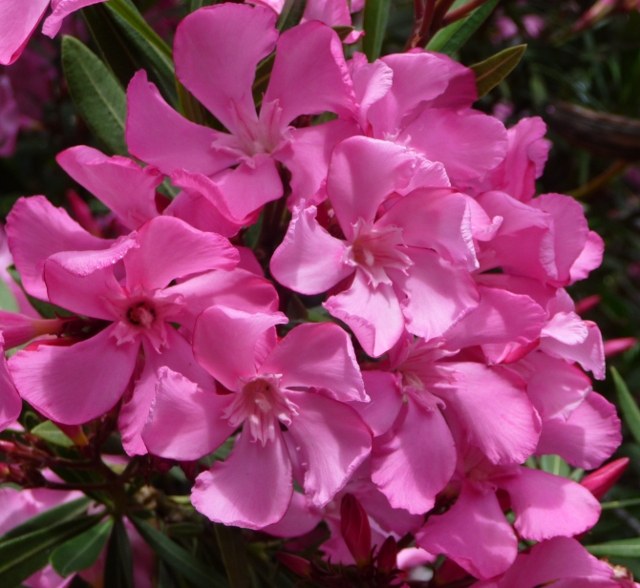
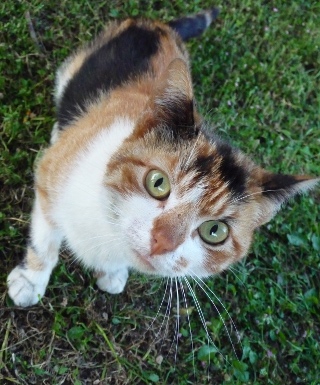
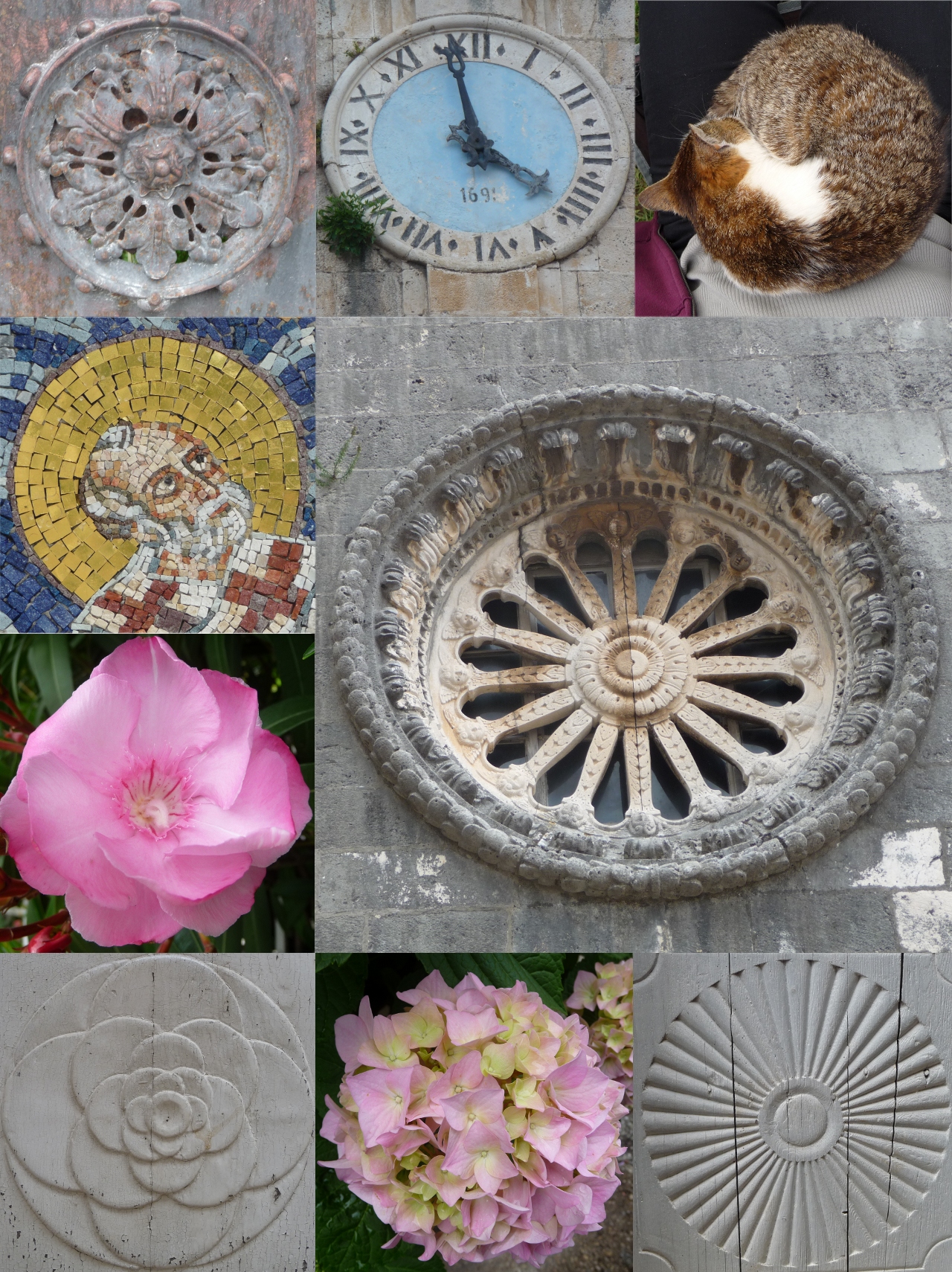
This time Lynne at Dovegreyreader and I decided on a circles theme for our ‘Colourboration’. I thought I’d be able to spot lots of circle patterns, but it was the individual circles that stood out while we were exploring the small town of Perast near Kotor in Montenegro.  I’m always attracted by doors and their details and the floral motifs inspired me to look at flowers too. The church clock and church window are also from Perast. The saint comes from Ostrog monastery. While thinking about circles I was wondering whether I’d spot a cat asleep in circle formation on my travels. I was delighted when at our campsite in Durmitor National Park, our friendly cat settled on my lap.

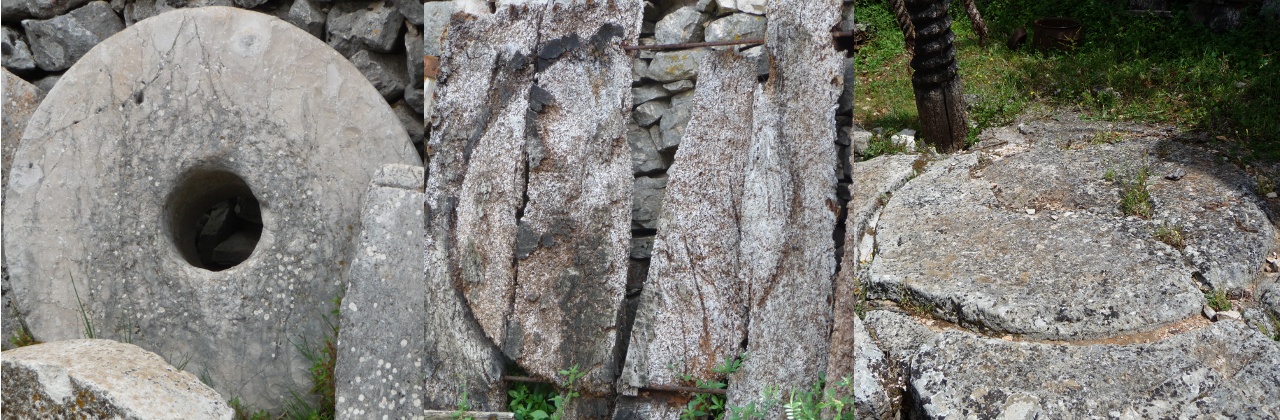
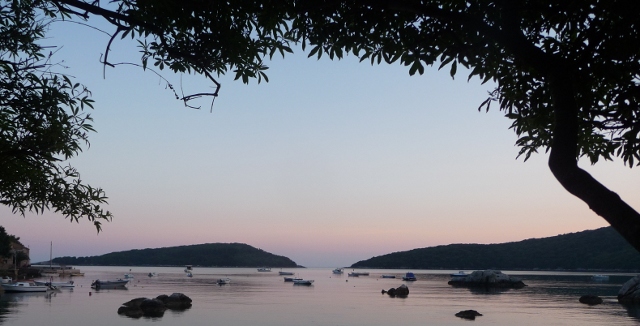
I took many more circles photos, and I just couldn’t include them all otherwise this would be a whole blog just about circles. However, I was particularly inspired by the following circles spotted at the abandoned village of Humac on the island of Hvar, Croatia. They evoke a vanished way of life, the remnants of food and drink production from years gone by.  There is a circle in the tale too – so many people have moved to cities supposedly for a better life in all the countries we’ve visited. In the end many of them lose the connection with their origins and seek again the simpler ways of life.

Click to see larger image (1280×420, 350Kb)

I wonder what Lynne saw on her travels to Orkney?

Posted in Art & Culture stuff, By Country - Croatia, By Country - Montenegro, Colourboration | 5 Comments

Out on a limb

Before leaving Dubrovnik, we’d managed to knock off the elusive items from our shopping list – and the tyre pump was most certainly needed, since we’ve managed to pick up a lively slow puncture on one front tyre. Sod’s law, of course, says that this is the first country we’ve been in for a few that’s had good enough roads not to need an extensive national network of dirt cheap little roadside tyre-fixing shacks. And so, with arms aching from using the bicycle-style “track pump” (it might be manual, but it’s a lot quicker than a little ciggy-lighter powered compressor!), we headed northwards. Croatia’s a funny country, in that the top and bottom of the country don’t actually meet in the middle. There’s the Bosnian seaside acting as a belt – all 15 miles of it. There’s an agreement in place between the two countries to enable easy transit across, but a googling on the subject of our old friend, insurance green cards, didn’t exactly settle our minds on the subject.

We would probably be able to cross easily, with minimal border controls. Just sit back, and bimble along from border to border. But what if something went wrong? We’d be technically uninsured. Would it be an issue or not?

Of course, it all becomes academic rapidly once you look at a map, since Croatia’s got a lot of offshore bits. There’s a sizable peninsula, Pelješac, sitting alongside the Bosnian corridor, with a ferry back to the mainland on the northern side. And, even better, Pelješac is a nice place, whilst it sounds as if Neum (the Bosnian seaside town) is somewhat less so. Why even worry about it?

The first place you come to on Pelješac is a little town called Ston. Actually, it’s two. Ston and Mali Ston (Little Ston). They used to form part of the northern boundaries of the Dubrovnik Republic, many moons ago. As part of the fortifications, there was a wall built across the neck of the peninsula, between the two villages, and it’s still there, snaking across the mountainside between them. The tourist board make proud claims of it being the second largest wall in the world, after – of course – the Chinese Great Wall. Clearly, they’ve not heard of Hadrian, but that’s a side issue – it’s still a vaguely amusing claim. I noticed something on the BBC news earlier that the Chinese wall’s now reckoned to be 21,000km long. The Ston one’s 5km. Bless.

From there, we snaked up the peninsula, with some great views alternating from coast to coast whenever the damp low cloud permitted, across to the islands or back to the mainland, before arriving at Orebić. Just after Orebić, we found something that we’ve not seen for many months – campsite row. As the single-track road wound along the waterfront, a misplaced tyre to the left would have put you in the water. A misplaced tyre to the right, on the other hand, would have seen you registered as a camper in any one of a dozen sites. Some were big. Some were small. Some were full. Some were probably closed. Some looked awful. We found one that was basically a small meadow, and pitched under an olive tree, with just enough space in front to give us separation from the road, but leave us with the splash of waves against the rocks all night. Idyllic.

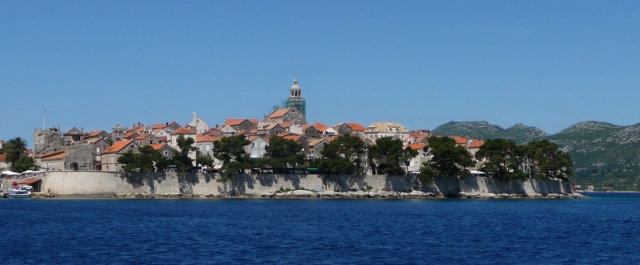
We decided not to take advantage of the myriad opportunities to learn to windsurf (re-learn, for me) or kitesurf along this stretch, tempting though they were. Instead, we found ourselves cycling back into Orebić and getting the foot passenger ferry over to Korčula town. We could have taken the van on the car ferry, but the ferry prices aren’t cheap. Given the amount of islands we’d love to hop between, they could start to add up scarily. Korčula town, alleged to be the birthplace of Marco Polo, is a small pimple on the coast of the island, which over the centuries has been turned into a little fortified outcrop.

More recently, of course, this has turned into a little tourist haven. We realised just how much when we got onto the ferry, sat down – and shortly after it cast off, the crew started looking baffled and double-checking passenger headcounts. Eventually, the question was asked – “Are you all part of the group?” Umm, no, what group? We’d managed to gatecrash a tour-group of Germans, nicking two seats on their privately chartered boat. Ooops. Still, they were kind enough not to throw us overboard (as some were suggesting… Proof that Germans do have a sense of humour. I hope.) and only charged us the same price as the ferry would have done.

The old town is, of course, beautiful. The streets are laid out in a kind of slightly herring-boned grid, allegedly to provide maximum shade from the sun and cooling effect from the breeze. Most of the streets are still residential, but – of course – with many small restaurants, bars and shops dotted in amongst. We chose one of the small restaurants as a place to prove the shade and cooling breeze theory. It worked, too. Oh, yes, and they served some really rather wonderful lunch – we just grazed, a couple of bowls of fish soup, a couple of portions of fish pate, and then a single shared main course – prawns in an utterly delicious soy, garlic and cognac glaze.  After a wander, during which we realised that the chuffin’ great big cruise liner moored all along one side of the town was one of the ones we’d seen in Kotor a week or so previously, it was time to reluctantly head back to the (right) boat to Orebić.

Finally, we headed up to the top end of the peninsula – climbing, climbing, climbing up and over the tops again, to a small harbour village, before winding our way back, almost to Ston, and turning towards the ferry back to the mainland. It wasn’t long before we came across the little town of Drvenik, and a ferry that we’d thought didn’t exist – over to the island of Hvar.

Posted in By Country - Croatia, Food stuff, Travel stuff, Van stuff | Leave a comment

Oleander time on the Dalmatian Coast

And so finally, only around seven months later than in our original vague plans, we have reached Croatia. As it was late afternoon when we crossed the border, we went straight to Molunat, only a few kilometres up the coast. It is a tiny place with a pretty harbour and we had been recommended to visit by Ros who we met way back in Siena. It also has more than its fair share of campsites. The campsite Ros had mentioned – ‘Monika’s’ – didn’t look as inviting as it perhaps had when she visited, but we found a less busy and very picturesque one with a pitch right on the water in the centre of the village.

We had singularly failed to hit a cashpoint on the way, so we had to call on the good nature of the local shopkeeper as well as the campsite owner to accept our Euros. I don’t think we’ll be the first or last people to do this. Dinner was cooked and eaten to the accompaniment of the persistent miaows of a very skinny patchwork kitten, who inevitably won our hearts as well as some of our meal.

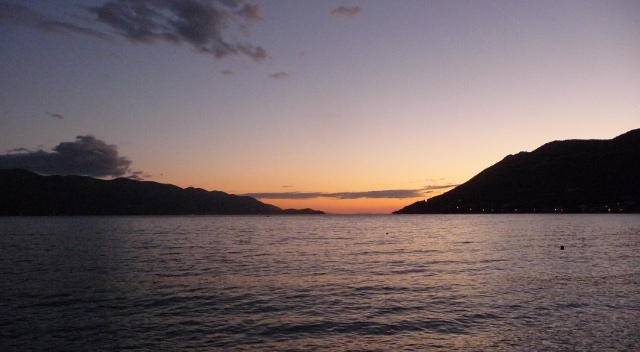
We relaxed into the feel of our ninth country as the lilac hues of dusk faded into night across the water, which was visibly and audibly teeming with fish.

Although tempted to stay at Molunat longer, we had to go in search of money and food supplies, so headed on up the coast towards Dubrovnik, calling into the larger and very scenic town of Cavtat for a wander round and cashpoint on our way. On our first full day on the road in Croatia, we were immediately struck by the number of tourists en route. Every other vehicle seemed to be a German, French or Belgian campervan or a Dutch registered car towing a caravan. We topped the brow of a hill and pulled into the layby there to gaze out over the city of Dubrovnik below us – its terracotta roofs luminous through the rather hazy light. We picniced on our newly bought crusty bread and ham.

After months of navigating by very few official campsites in the last few countries we’ve visited, and never seeing more than a handful of fellow campers at any of them, suddenly it’s June,  and we are spoiled for choice with campsites all along the Dalmatian Coast, and some of them are already very busy. We wanted to allow a few days to see Dubrovnik and decided to check out the main city campsite, Camping Solitudo in a nearby suburb. We drove around the port area to get there, past the biggest cruise ships you can imagine moored alongside the road. So it was with the campsite – it was the biggest campsite we’ve seen for a while, it was also the most expensive at around 33 Euros a night. It’s rather misnamed too with more campers turning up every few minutes it seemed. The facilities looked top notch though which isn’t always the case for a city campsite and they also had expensive printed items providing the information and rules of use for the site. We said we’d think about it.

One of the must-see sights given in our Rough Guide to Croatia is a gardens and arboretum at Trsteno around 10km north of the city, it also mentioned that there was an idyllic campsite next door. We thought this sounded closer to what we were after, although it meant being further out of the city with poorer connections. We fell in love with the site from the word go, it was like an extension of the gardens with tiered lawns, olive and fig trees, and oleander blooming, and a view across the tops of the trees to the sea and the island of Šipan. As we settled into our lovely pitch, we scared a snake away. There were plenty of blackbirds, goats on the other side of the fence and it turned out later on that night that there was a family of rats that scampered in the bushes rather unnervingly too. No camping cats in sight though. With very few other campers there, it was enchanting and at less than half the price of the Dubrovnik campsite, it had at least double the solitude!

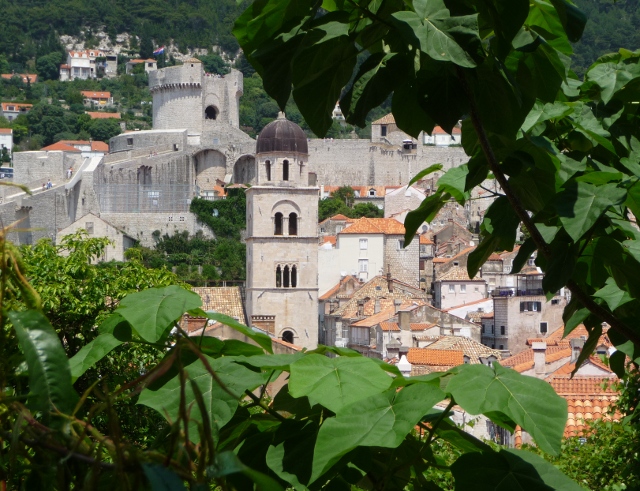
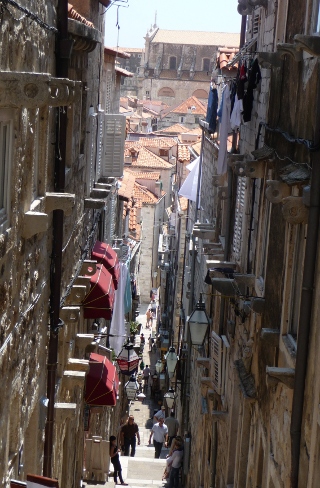
The buses into town were not particularly frequent but were quick and surprisingly good value – not exceeding the in-city fare we would have paid if we’d stayed in the city. We strolled from the top of the hill, where the bus dropped us off, into the old town, entering through the busy Pile gate. We were engulfed by tour groups from the various cruises, and sucked along in their wake. The main drag, the Stradun, is elegant, the pale stone of the city giving a feeling of space, narrow steep passages leading off uphill, monasteries, churches and fountains at every turn.

We had errands as well as sightseeing to do, firstly to buy a road map of the country, and then to see about an ankle support for Adrian who has been suffering with a recurring dodgy ankle for a few days, find a sim for our mobile wifi, and get a tyre pump for our slow puncture. We got the map, but as with so many tourist oriented old towns, there were few practical shops in evidence although you could buy any number of items with Dubrovnik emblazoned on them. We eventually got the items on a wander away from the centre.

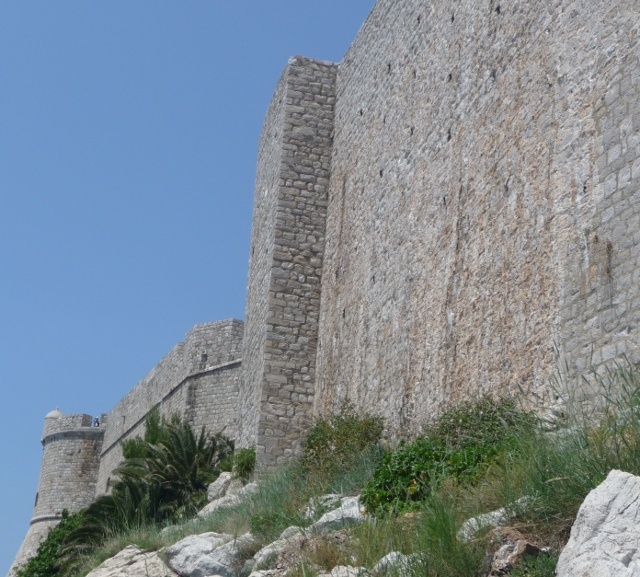
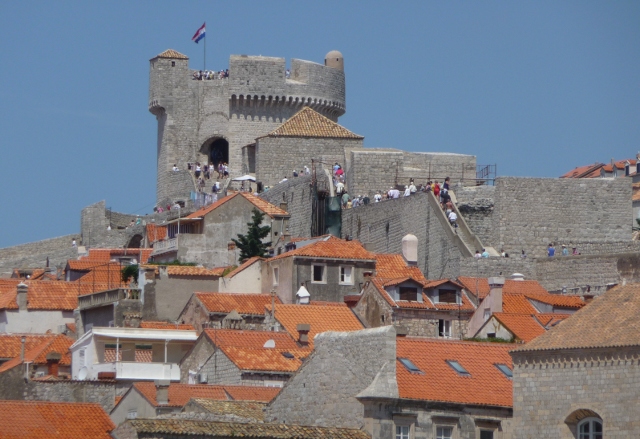
Dubrovnik is justly famed for its city walls, these sturdy structures are 2km or 3km in length, depending on which walking tour leader you eavesdropped on. They have protected the city for centuries, some parts of the walls date back to the 10th century, and they withstood the onslaught of modern artillery during the seven month siege of 1991/92.

It is also estimated that around 68% of the buildings within the walls were damaged in some way during that conflict, whether scarred by shrapnel or shelled to near total destruction. They have been restored using traditional methods and materials by craftspeople from all over the world, and in a few years, when the bright terracotta roofs have weathered a bit more and the new stone blended in, you would never know. I found it hard to picture the horror of that time on today’s sundrenched tourist bustle streets. It’s not ‘over-restored’ either, it doesn’t have the new-old feel of some of the restored towns we saw in Montenegro.

You can climb and walk along the city walls. If you can afford it. We rarely refuse to pay the exorbitant entry fees levelled at some of wondrous sites on our travels, but sometimes you have to think of the bigger picture and this was just 20 Euros (for two) too far. The plethora of boat trips to various islands and other tours on offer were overwhelming, and instead we settled into a relaxing amble around the city streets spread over two days.

We wandered the backways and narrow passages, finding Buža, a tiny bar hidden away in the lea of the walls overlooking the sea. It is firmly on the itinerary though with prices to match, but if we couldn’t do the wall walk we could at least have a refreshing beverage beneath them.

In Dubrovnik no garish signboards for shops or restaurants are permitted – they can only use their outside lanterns to show their names and nature of their business. In so many places we’ve visited shop signage has encroached on the buildings you’ve come to the town to see, so this made a refreshing change.

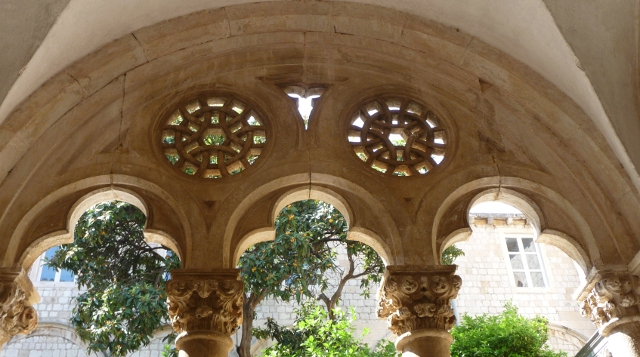
We visited the Dominican Monastery art museum – a beautiful peaceful cloister with religious art and objects, reliqueries and jewellery.

We entered many of the churches, the cathedral and Jesuit church among them. We are now in a mainly Catholic country with a strong Italian influence, so the interiors are often more baroque in feel, with marble the main material used in the altar pieces.

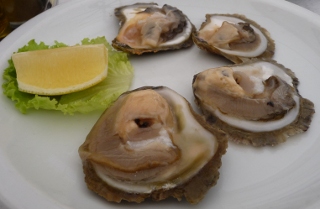
We also went to Kamenica, a seafood restaurant of some repute. Twice. Sitting on a square eating, for once reasonably priced luscious seafood while doing some of the best people watching of the trip was a treat. The restaurant is in our guidebook, but it was overhearing a local telling another tourist about it that sealed the recommendation. Although ordering one dish each, the waitress brought out an extra side table – these were big platters of mussels and little fish – girice – like whitebait. The oysters were good too, as were the deepfried squid and baby octupi we had on our second visit. Nothing like a leisurely lunch of supremely good food to help you fall in love with a city.

We enjoyed playing spot the nationality of our fellow tourists. We have become fascinated by the cruise goers who dominate the scene and the city is very much geared up for them and many shops and restaurants have signs welcoming visitors from named cruise companies. We found out later that in some instances the passengers can charge their costs at these establishments directly back to their on-ship account. I spoke to an American woman in a loo queue who was on the huge Carnival Breeze, she was thrilled to be on its inaugural voyage, but as it was a sell-out trip it was very crowded. We checked online – it has a 3690 passenger capacity. That’s a lot of people descending on a small city in a day (not to mention a crew in excess of 1300), in addition to the other ships in port and all the land-based tourists … It is only June too, we’re glad not to be here in July or August.

Being the slow long-term travellers we are by now, we feel we still only scratch the surface of the countries we visit, but how to even begin to get the feel of somewhere from half a day of rushed sightseeing?

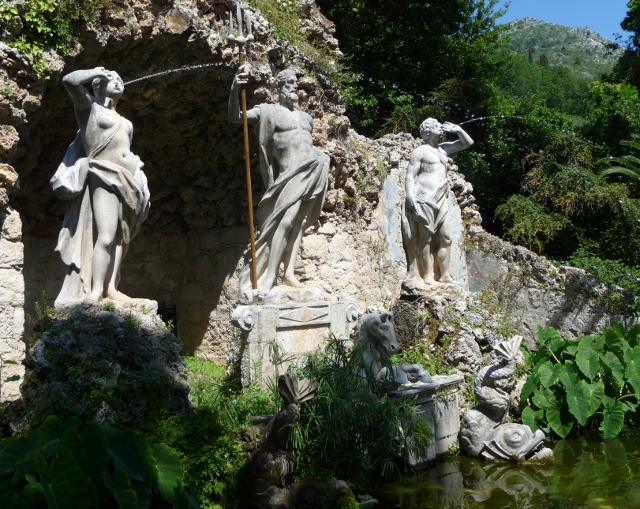
Back in Trsteno in our oasis of calm, we visited the famous gardens surrounding a villa built by nobleman Ivan Gučetić in the 16th century, with the arboretum planted later when the Academy of Science took the property over from the Communist government who had confiscated it from the family in the 1940s.

It’s a miracle that it has survived to this day, most other gardens of this type have apparently long since disappeared. It also received damage during the conflict of the early 1990s, but is verdant haven of beauty once again.

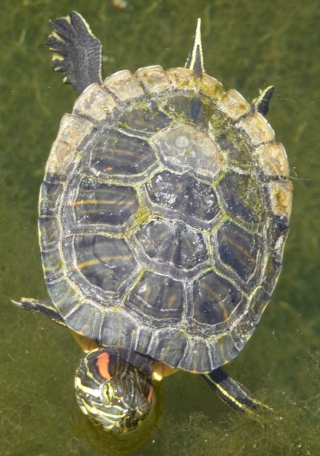
Not overly formal, there is a real jungly feel and trees from cypresses, to bamboo and many different palms. We spotted a snake here too, and frogs, goldfish and a terrapin in the lily padded fountain, and delicate damsel flies flitting from leaf to leaf.

We strolled down to the tiny harbour and had a welcome cold beer at the campsite café after the long slog up again.

We were thinking of everyone celebrating the Queen’s Diamond Jubilee while we were there. From people’s comments on Facebook it sounded like an amazing weekend. Although it would have been good to be in Britain for that, we’re glad to be in Croatia.

Posted in Art & Culture stuff, By Country - Croatia, Food stuff, Travel stuff, Wildlife stuff | Leave a comment

Gorges galore

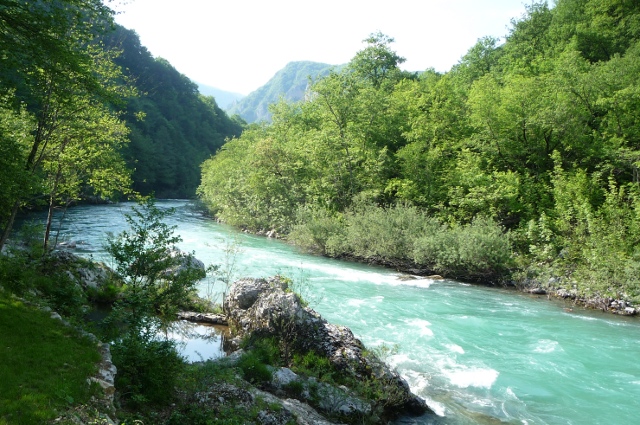
Before leaving Durmitor, we headed to the Ćurevac lookout point, high above the Tara canyon. A footpath took us along the ridge, to a vast stone outcrop from which we could watch the river, far far below, meandering down the base of the gorge. As we headed back towards where we’d left the van, the clouds started to gather, rolling up from below. The path was much less clearly marked on the return, and a couple of false starts had to be rectified. Fortunately, the threat receded as quickly as it had arrived, and we headed off south. We’d wanted to head west, through the heart of the Durmitor massif, but we’d been told the road was still snowed in where it crossed a couple of 2,000 metre passes.

As we headed out of the park the same way we’d arrived, we took a slight detour off towards the Komarnica canyon. We meandered through some back lanes, with signs once more in short supply, and found ourselves heading along a flat and fertile looking valley, with cliff faces heading up on either side. After admiring the view over lunch near the end of the track, we turned around and bounced back towards the main road. As we did so, we spotted another narrow canyon off to one side – with a tiny and fragile-looking bridge over it. As we gazed down from that bridge, the river splashed beneath us, way out of sight between two rock walls barely a couple of feet apart in places.

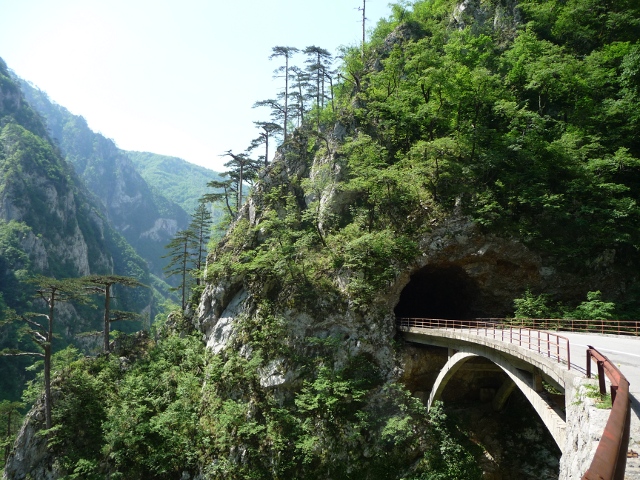
Once we’d returned to the main north-south highway, we headed north towards the Bosnian border. Rock again closed in on both sides, and we were following up the side of a lake, held in place by a dam and hydro-electric power station. As we crossed over the top of the dam (complete with large no-photos signs), we gazed down. On one side, the water level was no more than a handful of metres below. On the other, the concrete face dropped down over two hundred metres, with the river barely visible. We’d reached the start of the Pivo canyon. For more than 25 kilometres, the road wound across one side of the canyon or the other, in and out of tunnels ranging from several hundred metres long to just a ragged arched hole in a rock wall. A spindly bridge linked the two, giving the canyon a logo to put on signs. Eventually, we closed in on the Bosnian border at Scepan Polje. We weren’t planning on crossing the border here – the insularity of British insurance companies meant that we couldn’t without buying yet another expensive fixed-term policy – but the signs for the campsite we were aiming for continued to point straight on as we arrived at the frontier huts. We stopped. We looked at the map. We looked at each other. Eventually, I got out and wandered to the border guard in his little glass hut. Yes, the campsite was straight on. No, we didn’t need to enter Bosnia. No, we didn’t need to do formalities. Just drive around the outside of the frontier post… Where the road turned left to go across the Tara river – our shore Montenegro, the far shore Bosnia – we turned down a little track. Camp Grab stood out from the other dozen or so campsites within this short stretch of river for seeming to be located right on the banks. As we passed a couple of others, high up above, we wondered if it was another bit of wishful photography on the signs. But after a few more kilometres, we pointed the van almost vertically down yet more unsurfaced hairpins, towards the shore of the river far below us.

We weren’t disappointed. We’d found another little slice of heaven to pass a night in. We parked up in a corner of a meadow, and wandered down the steps towards the river itself. As we sat on the shore, with the water lapping gently at our cold beer bottles, watching the current bounce hard off the rocks in the middle of No-Man’s Land, we were happy. Who cared if the weather forecast for the following morning said yet more rain, rain that’d make it virtually impossible to climb back up the track out of the canyon? There was a Pinzgauer ex-military 4×4 at hand to tow us up if we really did get stuck…

The difference in altitude from Žabljak made a huge difference to the overnight temperatures, before the morning dawned warm with the early morning skies as blue as they had been on many other mornings over the last couple of weeks. Fortunately, though, the echoes stopped there – as we swung round the outside of the border point again, and headed down the Piva Canyon, the skies didn’t repeat their usual trick of clouding threateningly.

At the end of the canyon, we decided to follow the road which we should have emerged on straight from Žabljak, if not for those snowed-in passes. The junction turned left, straight into the rockface, and immediately we were climbing steeply upwards, clinging doggedly to the side of the cliff. Within minutes, we were high above the canyon, staring down at the lake’s surface far below. Eventually, the road turned away, and started to pass over a deserted landscape towards Durmitor. We turned around, and headed back down the cliff. On the way up, we’d been slightly startled by evidence of a very fresh rockfall all over the road surface as we exited one tunnel. Coming down, we could see no sign of it – just a few fresh scrapes and some gravel to suggest where it’d been. Then we caught up with the works truck whose crew must’ve followed us up, cleared up, then turned round again. Clearly, there’s a lot of work involved in keeping these roads clear – and around a few more bends, we found out just how much.

A smaller cliff at the side of the road had been judged unsafe, and the road was briefly closed whilst they chiselled away to get back to secure rock. Huge boulders were falling onto the road surface, together with medium-sized trees. Ellie’s wander up to take photographs of the work attracted nothing but a little curiosity, even though she got close enough to the action to feel a quick two-step out of the way appropriate on a few occasions.

With the road re-opened, we headed towards the new site of the Pivski Monastery, moved several kilometres up the canyon – and a hundred metres higher – when the construction of the hydro-electric dam, in the ’60s, usurped the position it had occupied for centuries. The work had taken more than a decade to complete. When we arrived at the outside, we were unsurprised to find no signs of life whatsoever – the guidebook mentioned it is now home to a grand total of one monk. He must’ve been having his lunch at the time. The outside door creaked gently open. The side door to the church was wide open, so we tentatively bent down and went through.
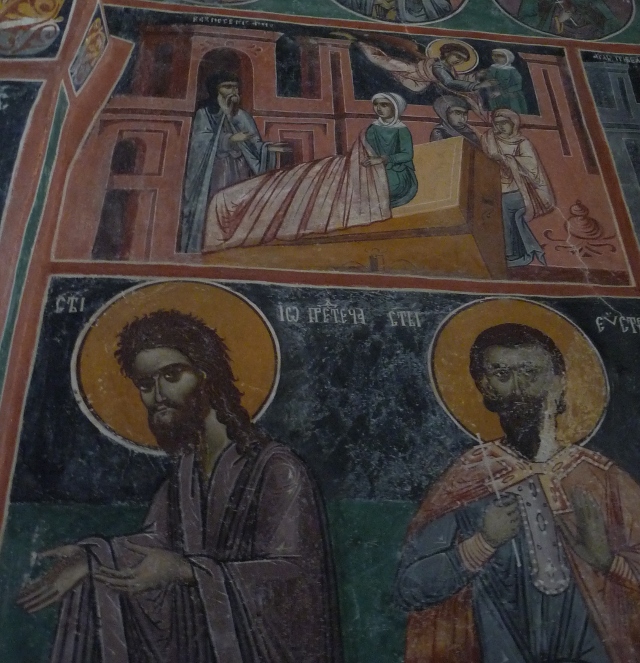
Inside, the true extent of the work involved in the monastery’s relocation became clear. As our eyes adjusted to the gloom after the bright sunlight outside, we saw more and more detail – the huge gilded iconostasis, the massive candelabra hung with yet more icons, the frescoes covering every single surface – all the way up to the high ceiling. The frescoes had been moved, fragment by fragment, and put back on the reconstructed walls. Amazing.

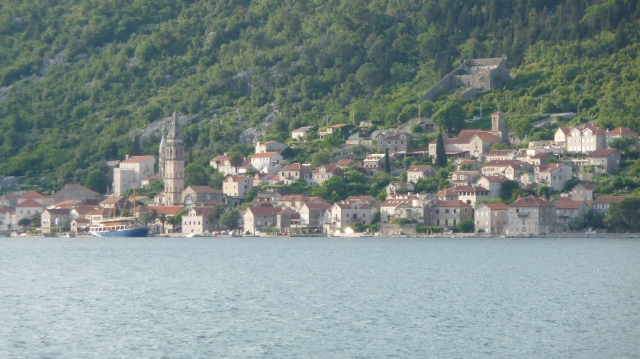
We tore ourselves away, and headed south towards the Kotor bay again, but by a different route – heading onto the northern shore across yet more spectacular scenery. For a country so small – with a population of only about 600,000 – we’d found not a single bland view. Much of the scenery was as dramatic as anything we’d come across in a year of travelling, but so highly compressed. The beach resorts might’ve failed to impress us much but even in a week’s package tour it’d be so easy to head into great natural beauty. As we rounded one bend, suddenly there was water glittering away in front of us, and the two small islands with a pair of churches just off the coast of Perast. We felt like we’d come home – but not for long. We followed the curve of the bay around, past the ferry I’d crossed on my bike, and towards the border. Croatia – a country we’d heard great things about from so many people we’ve met on the road, with not a single dissenting voice amongst them – was imminent.

Posted in By Country - Montenegro, Travel stuff | Leave a comment

Onwards to Durmitor

Once Kotor disappeared from view, we headed across the mountains (yes, yet again) via what looked like a simple route that cut a corner, avoiding Podgorica. The reality, of course, was slightly different – and the simple route was a series of non-signed meandering back routes that went up and down, round and round. We thought we were probably on the right road, but there was one easy way to find out – pick up a couple of hitch-hikers… An older couple of locals waved hopefully at us in the middle of nowhere, so we stopped for them – their huge beams and effusive thanks reflecting the almost total lack of traffic we’d seen. Yes, it was the right way – and they were heading to the town which marked our junction with the main road north – great, little scope for us to get lost!

By the time we got to the main road, though, it was clear that our intention to stop off at the Ostrog monastery briefly then head on up to the Durmitor National Park in one day was more than a bit ambitious – especially since the van’s engine seemed to be running far hotter than normal. We really didn’t want to miss out on Ostrog, either. We thought it was going to be a hunt for a half-way decent wild-camping spot, or the guide book mentioned what sounded like a nice restaurant in the village just before the monastery – maybe we could persuade them to let us kip in their carpark in return for eating there? We clearly weren’t the first with that idea, as the restaurant was marked with a large camping sign… In we trundled, and yep – camping no problem. Pay now. Please. No, now.

We handed over a crisp €10 note, and were pointed to the restaurant’s main car park, with firm assurances that the toilets were going to be available overnight. We parked, fiddled about with the van for a bit to try to figure what was happening with the cooling system – the fan switch seems to have died, a nice cheap and easy job – then headed in to the restaurant. Roast lamb, roast potatoes and a carafe of house red – very reasonable price indeed.

Unfortunately, though, the restaurant staff didn’t seem to have got the message about the loos being left open – and as soon as they closed the restaurant down, we were sat in a fairly expensive car park with no facilities at all until the morning. Hmm. Not what we really wanted or expected. Hiho.

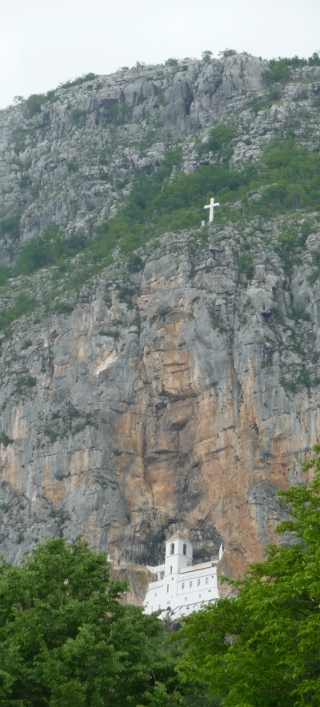
Traffic up to the monastery started early, so we barely lingered past relief o’clock before we followed them up the hill. Ostrog’s Montenegro’s main target for pilgrimages, founded by a seventeenth century monk by the name of Basil. No sooner was it open for business, than he started to get a reputation for miraculous healings. His selflessness in the healing stakes may have been a bit over-enthusiastic, though, as he died only four years after opening for business… Still, it was enough for Basil to become Saint Basil in short order. The monastery itself is in a truly astonishing position – slapped into the middle of what appears to be a sheer cliff face, clearly visible from miles around. As well as that upper monastery, there’s a newer lower monastery – absolutely heaving with people coming to pray for health or give thanks for a recovery. So busy that we took one look and headed straight up the cliff face. There’s a footpath which follows a reasonably straight route, crossing and re-crossing the roadway as it lurches from hairpin bend to hairpin bend. We might not be particularly pious ourselves, but it would have felt a bit wrong to drive straight there…

When we finally arrived, we felt in need of a bit of a miracle cure, and wandered for a look-see. The first thing you notice is a couple of huge army-style frame tents, with stacks of mattresses and blankets by them, accomodation for those on pilgrimage. After popping in to a small cave, black with soot, hot and fragrant with many lit candles – not quite Fatima, but not totally dissimilar, just on the right side of critical conflagration mass – we joined the line of those heading for the atmospheric and beautiful main church, a tiny room hewn into the rock face, accessed by doorways that had me bending almost double. As we entered, we realised that this wasn’t really the right place to just pop into for a peer around – a priest was blessing everybody in turn, as they bowed towards a large and ornate box. As the line inched forwards, we realised that the box was actually a coffin – and that the bowing was praying to the ornately dressed corpse of St Basil himself.

The dilemma – do we try and pass as Orthodox pilgrims, mimicking the elaborate crossing-oneself ritual and risk being immediately spotted as fakes? Or do we just try to fade into the background and dip out of line as we slink out as quietly as possible? We figured the latter was the safer and more respectful option.

Back down at the van, we headed off towards Durmitor. The road seems to have been thoroughly upgraded in the last year or two, replacing the old one’s “parlous state” with “many monstrous potholes” which the guidebook warned us of. It’s a cracking route, though, winding across mountains and past yet more piles of lingering snow.
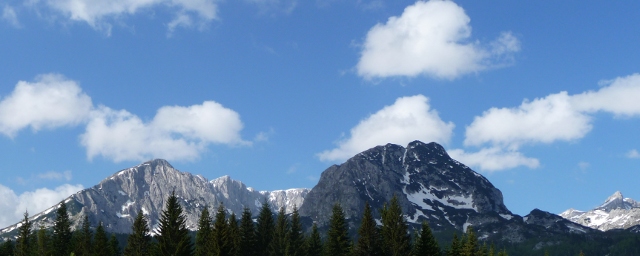
Once we arrived at Žabljak, we picked a campsite for no better reason than it was the closest to the Black Lake, one of Durmitor’s main beauty spots – a huge figure eight surrounded by soaring mountains and thick pine and beech forest.

The first hot shower for a week was definitely enjoyable… From the campsite, we could quickly and easily pick up a trail down to the lake shore, then circumnavigate it along a decent path – well, apart from the bits where we needed to paddle through waterfalls, anyway. The local bears and wolves kept well out of our way, but a woodpecker seemed to barely notice us as we stood at the base of his tree – rapt as his golden-striped head banged back and forth against the trunk.

A social whirl quickly engulfed us, too – no sooner had we arrived than a pair of cats trotted over to say hello, with one quickly getting her paws firmly under the table, while the black tom wandered around ceaselessly, constantly squawking like a Siamese as he did so. Maël and Morgon, from Brittany, arrived with a friendly big fluffy dog who wasted no time in flopping on the floor outside our van so he could smell our cooking and give us big pleading eyes – the cat, curled up on Ellie’s lap, growled gently but didn’t seem too bothered.

A phalanx of German bikers had arrived, and were wasting no time in dragging huge great logs and chunks of wood over with the intent of a bonfire. The campsite owner saw no problem in this, and it didn’t take much persuasion (a beer seemed sufficient) for him to get his chainsaw out to help prepare the branches for burning. It’d have been rude not to join them, wouldn’t it? And so, with the French, we sat around until late in the night as bottles of various spirits were passed around and the chat flowed in multiple languages. Just the thing when you’re being collected at half nine for a morning’s white water rafting down the Tara canyon, Europe’s deepest and bested globally only by the Grand Canyon, eh?

When we’d phoned one of the rafting companies at random, we’d been told that “a friend” might be able to take us out the next morning – and, before we knew it, it was a done deal. Our request for a direct phone number for this “friend” was rebuffed with “he doesn’t speak English”… We felt like ringing around a few more, but it all seemed a bit rude to say “Thanks, but we’ll let you know”. What could possibly go wrong?

In the event, I don’t think it would have made the slightest difference who we’d actually booked through – all the companies seemed to publicise the same section of river. When we got to the base station, it started to look as if everybody was just a sort of loose collective of individual rafting one-man bands, doing whatever for whoever. With our heads only just starting to clear, we were sat down for what we presumed would be the formalities and safety briefing. Nope, it was time for a welcoming glass of Rakija. Then it was time for the wetsuits. We were the only people present, so had the raft to ourselves…

After another short van ride, this time with the raft tied to the roof, we arrived at the start point, and manhandled the raft into the water whilst being thoroughly greeted by a dog almost as shaggy as he was enthusiastic – Ellie’s comment that he looked a bit like a camel wasn’t far off, although she didn’t particularly return his enthusiasm – especially when he tried to play-gnaw her hand. Not a smart move, so soon after her previous mauling.

We were off. The raft captain/driver/pilot/instructor’s English seemed to be on shaky ground once he got beyond the paddling commands that he quickly ran through with us, but that was probably enough. He seemed a nice bloke, anyway. It wasn’t long before we stopped for a quick photo-break (we’d been given a waterproof bag to put the camera in) at the base of a real foaming torrent coming in from one side. A quick trek across some rocks and through some trees, and we had an amazing view of water swirling and leaping and generally being far too active.
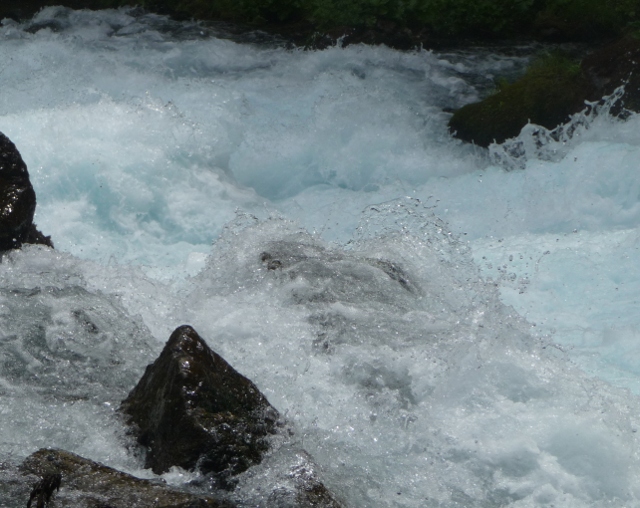
Back into the boat, with a suggestion from the captain to just clip the camera’s case straight to my life jacket – thanks, but I’d feel happier with it in the waterproof bag. As we neared the amazing Tara bridge, I wished I’d taken him up and put it somewhere easily accessible – then we hit some swirling rapids, and it seemed the right decision after all. The paddling instructions became louder and more frantic as we headed straight towards a large rock in the middle of the river. BANG! We hit it, square on. The bow of the boat pointed skywards, and we thought we were going swimming. We landed right way up, somehow, and the captain explained “Only two in raft is problem” – there just weren’t enough paddles to give us the power to fight the current effectively. Oh, well.

Down the river we continued, passing by the picturesque monastery of the Archangel Michael, with the clouds gathering overhead. Then a few drops of rain started, and before long we were wetter from the sky than the river. A crack of lightning was very quickly followed by a massive, rumbling, echoing drumroll of thunder. Then another. We paddled to the side of the river, and sat under a sheer cliff to give us a bit of shelter. Another crack of lightning, followed instantly by the sound of splintering wood, and it started to hail leaves, branches and kindling from way above us. Time to get away from that bank, sharpish, in case there was some big branches – or even a trunk – following. Once we were safely out in the middle of the water again, I glanced back, just in time to see our captain crossing himself repeatedly and enthusiastically…

Before long, we spotted the minibus parked up by a muddy little beach, and the run was over. We dragged the raft ashore, and started to realise the intention was for us to get changed here. Ellie was a bit reluctant – sure, all three blokes (the captain, the bus driver, and another guy as muscle for heaving the raft about) were pointedly looking the other way, but it was still a bit public… No choice, though, and before long we were drily clothed again, with the creaking and protesting minibus being pointed up a ridiculously steep and narrow muddy track for what seemed like miles to the road and back to base.

Posted in By Country - Montenegro, Personal stuff, Travel stuff, Van stuff | 4 Comments

Kotor Bay – castles, cold showers and mega-yachts

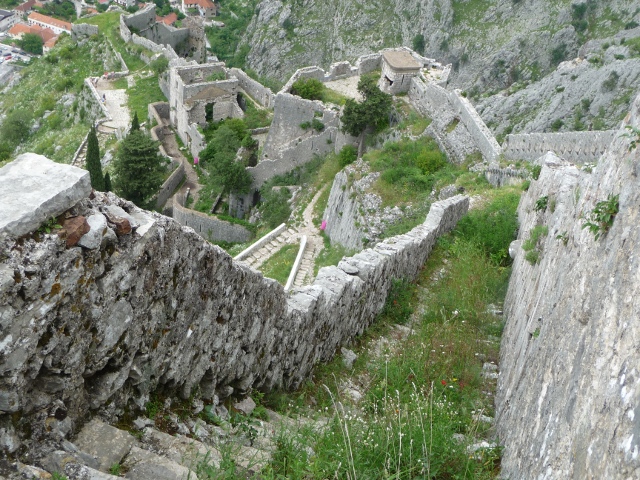
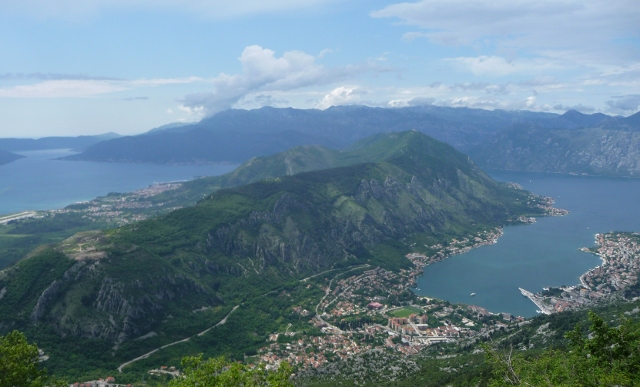
What with the cloud cover obscuring part of the view, we didn’t realise how far we were coming down the mountains into Kotor itself. As we neared the bottom the town took shape and we could see the dramatic fortress on its sharp pointy crag, its walls zig-zagging down the steep sides. As time was getting on we decided to find the campsite rather than embarking on exploring the town.

We drove round towards the western side of the bay along a narrow but very pretty stretch of road right by the water’s edge. Tiny stone harbours with small boats and people sunbathing to our right, pretty cottages, chapels, the odd bar, a few derelict properties, and quite a few obviously refurbished ones with For Sale signs in English, marked the left. We passed a campsite we weren’t expecting to see, which looked quite busy. We pressed on hoping to find the great sounding campsite we’d seen mentioned on the internet. We wanted to be a little closer to Tivat where Susie and Steve, my cousin and her husband, would be staying so that it would be easy to meet up. As we rounded the headland the road got busier and the fjord opened out. We spotted our proposed campsite and went in to have a look. Although described as an Autokamp, you would have fitted approximately two vehicles in and I guessed people in tents would be ok squeezed between the vines. It wasn’t unattractive, but the only shower was in the women’s loo block, with little to hide anyone’s modesty. We decided to go back to the ones we saw earlier, ignoring the motel campsite next door, which was full of dead caravans, and which our guidebook had been less than complimentary about.

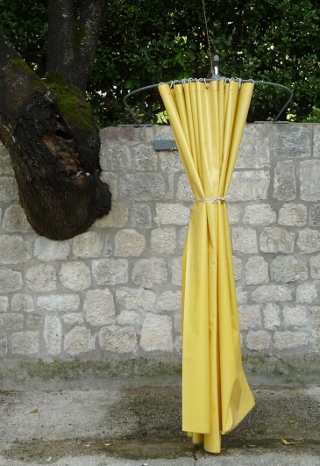
We pulled into Jadran Autokamp and found a tiny space on a slope, all the best spots had been taken by a mix of French, German and Swiss vans. The owner pointed out the loos and showers, only cold water. The shower was in the open air with just a curtain around … the squat loos were spotlessly clean though.

Although not ideal, it not being that hot here at present, we admired the honesty of the cold water. We’ve been in all too many showers we were told would be hot, only to waste water waiting in vain for it to warm up. It was a much nicer location than the other sites though, and after a few days, showering in the open air under the cherry tree felt very much ‘back to nature’. And we gained our first Montenegrin camping cat.

Much in need of a washing machine I spotted one in the owner’s garage, but was told it was not for use by customers. I was quite cross about this at the time as we are, as ever, getting desperate to do laundry. Didn’t they want to earn more money? It was quite soon academic though as the weather became unsettled again quite quickly and rain was forecast on and off for the next few days. Unfortunately, accurately.

The next day, all the other people at the campsite left, so we moved to a prime spot at the front of the small site overlooking the bay. The previous occupants, Theo and Sarah from Switzerland, were heading to Albania so we were able to share information about campsites and what to expect from the roads. They are taking four months out for their trip round the Balkans and we were sorry they weren’t staying longer at Jadran.

A lazy slow start to the day we eventually got our bikes off the van and with just a couple of minor showers to contend with, cycled along to Kotor old town about 10km away. As well as a superb setting, the town is lovely too. Like Budva old town it suffered from the 1979 earthquake, and has been done up and kept very neat and tidy. Its pale stone buildings giving a warm, light and airy feel, the graceful palazzos revealing the influence from Venetian rulers.

There are many pretty squares, lots of restaurants and shops, but drifting off into the alley-ways we came across some tranquil quieter areas too.

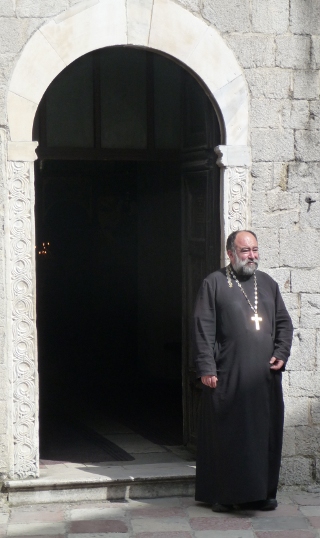
We visited a few churches, a mix of orthodox and catholic places of worship. We have come to prefer the orthodox style, with its warm friendly bearded clergy, and wondrous icons and carved iconostases. The baroque-style catholic churches seemed cold and overdone in comparison.

Being the jewel in Montenegro’s crown,  at the end of a deep fjord, means that Kotor plays host to cruise ships, some of them huge. Passengers can just walk from their ship through the archway into the old town and spend the morning, or the afternoon there.  The tourists looked bored as they followed their guide around – not a smile in sight.

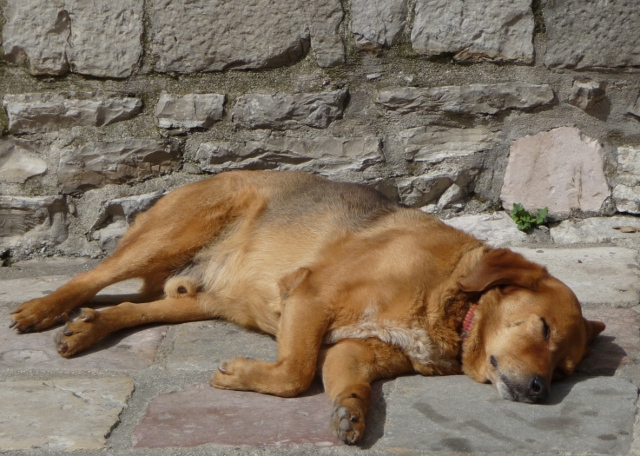
We had a late leisurely lunch in one of the squares, following the progress of a lethargic old dog as he moved from one sunny corner to another for a sleep.

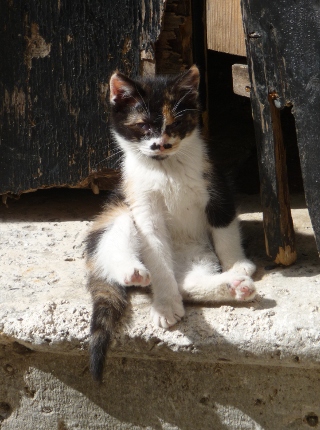
A surfeit of stray kittens seemed to appear from cracks in doors and from under rubbish bins …

Time was getting on and grey clouds started to build up again, so we decided to leave our climb to the fortress for another day and hopped back on the bikes for the cycle home, via a pleasant bar for a beer by the water.

Rain and lots of it fell overnight and into the next day, and we aborted any plans we had other than sitting cooped up in the van.

It brightened in the afternoon though, especially as Susie and Steve arrived and whisked us off to Tivat, lots of wine was drunk and catching up done. It was truly lovely to see familiar faces again and hear news from home, it’s been a long time.

Susie and Steve are very familiar with Montenegro and had seen a lot of changes along the coast since their last visit a couple of years ago. Tivat has had a huge amount of investment in a brand new super yacht marina complex – Porto Montenegro. A lot of the development on the coast is aimed at the high end of the market, Sveti Stefan for example, and this is no exception. This is a billionaire’s playground. It means that there is less choice and poor value for money at the middle and lower end of the spectrum in terms of accommodation, at least all along the coast. Susie and Steve were less than enamoured with their digs, and their unsmiling landlady.

Porto Montenegro is open, although not all the building work is complete. It oozes luxury and swishness, and it is British investment pouring in here, as opposed to a lot of Russian money elsewhere. The boats moored here are fabulous over-the-top palatial creations, registered as far afield as Jersey, Bridgetown, the Cook Islands and Luxembourg. Susie and Steve had checked the price of one of them online – a cool £65 million. There are chi-chi restaurants and glamourous bars, and upmarket cleaning services and chandleries for your yacht. It’s another world from the red campervan and cold water showers!

The weather continued to thwart our daytime plans, but we spent much of the week meeting up with Susie and Steve, visiting a couple of rather lovely restaurants in Tivat, and going to an enjoyable expat curry night at the Tivat Yacht Club. More eating and drinking in other words. We also visited the plot of land Susie and Steve bought here a few years ago and that they are now in the process of selling. It’s a lovely spot high in the hills behind Tivat with the views you’d expect, and quiet, just the sounds of nature. We were invited in by their neighbour, a petite older lady, for a rakija or two, and a struggle to find conversation without a common language.

The weather eventually held off enough for Adrian to take off on his bike round the entire bay (around 45km), taking the ferry over to the other side to start off with. He did it in good time too, arriving back way before expected. We also made another cycle excursion to Kotor, this time making the climb (on foot) up to the fortress. It was worth it for the views and for the achievement of reaching the top after having cycled the 10km there. We felt we’d earned ourselves a beer or two and a pizza on one of the squares.

It was sad to say goodbye to Susie and Steve, but it was time for us to get our act together and head for the mountains. We took a detour on our way out of Kotor Bay, to Perast, a charming town across the water from our campsite, and less over restored than some other places in the vicinity.

We left the area on the multi-hairpin route we’d arrived on, a week later the clouds were kind and lifted to reveal more of the magnificent views of the Bay of Kotor and westwards over the headland to Tivat.

Posted in By Country - Montenegro, Personal stuff, Travel stuff, Wildlife stuff | 2 Comments

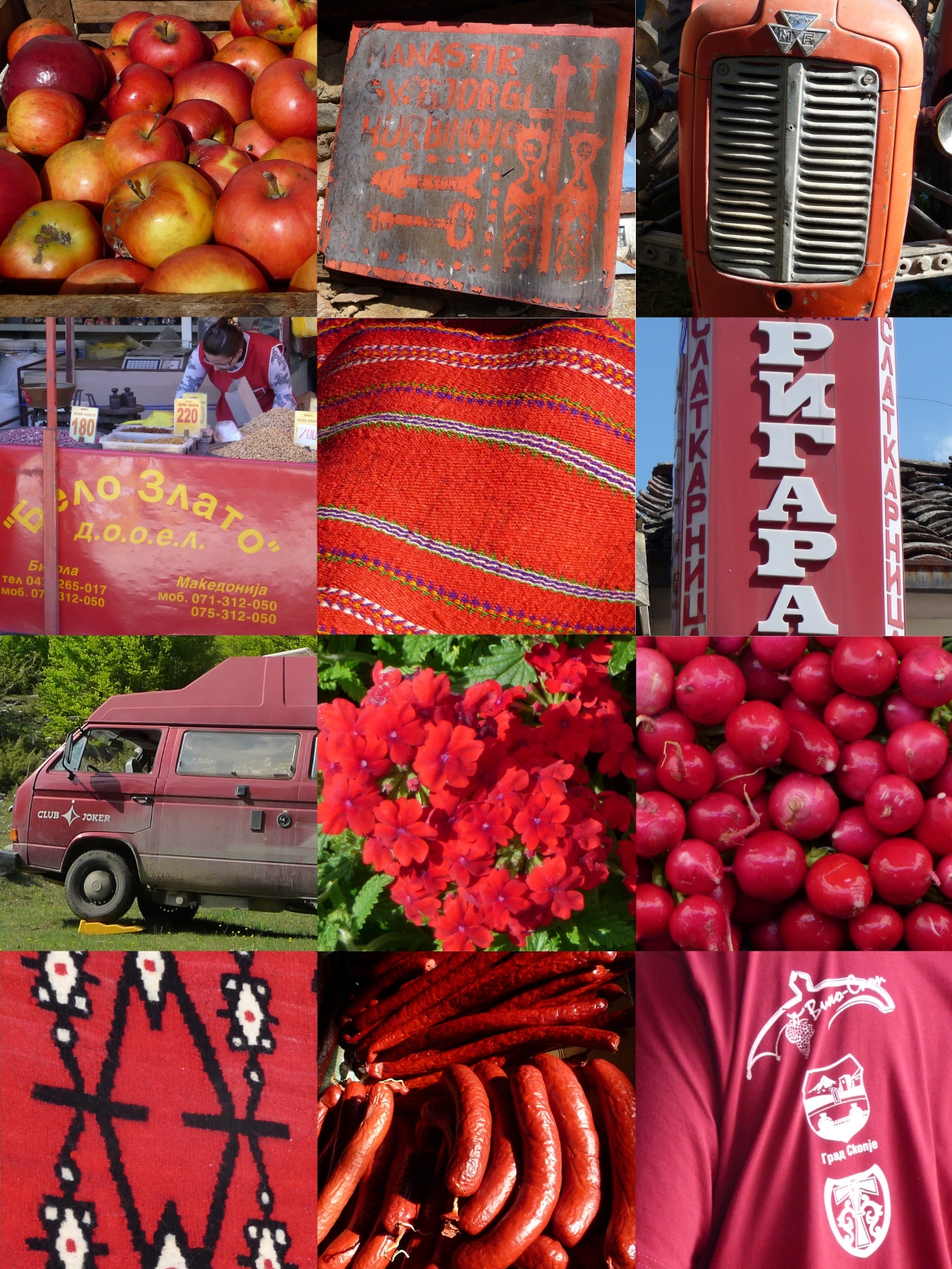
Colourboration – seeing red

Click to see larger image (1280×1706, 1.4Mb)

When Lynne suggested we start our Colourboration with looking at the colour red, I left the internet café after reading her email and all I could see was the ubiquitous red branding of the too familiar worldwide soft drink everywhere I looked. We were in Macedonia at the time. This was the day that saw us skid in snow on a mountain top and ended with the perfect camping place at Kurbinovo. I fell in love with the village and was suddenly more inspired when I kept spotting reddish things everywhere.

I wanted to make the whole collage a story of that afternoon. The colour of passion, anger and Communism, there are so many shades of red. From almost brown, to orange to close to purple – how far could I go and still create a red collage? In practice though, several of the images were too reddish brown and the overall effect wouldn’t have passed muster as a ‘red’ collage. So this collage now encompasses a range of elements from our short stay in Macedonia.

I also aimed to vary texture and subject matter, while still attempting to illustrate the trip. A market,one of my favourite places, provided rich pickings for the colour red scavenger!

The images are as follows (left to right descending):
Apples in Kurbinovo
The sign at the church key lady’s house, Kurbinovo
The old tractor in the church key lady’s garden, Kurbinovo
A stall at Bitola market
Textile from the Smallest Ethno Museum, Džepčište
Sign, Skopje (sun faded red – one of the most common forms of the colour!)
Our van, of course…
Flowers, Skopje
Radishes, Skopje market (shiny from being sprayed with water)
Carpet shop, Skopje
Sausage stall, Skopje
Wine bar waiter’s T-shirt, back detail, from last year’s wine festival in Skopje

Now  I wonder what reds Lynne saw in Devon and elsewhere?

Posted in Art & Culture stuff, Colourboration | 3 Comments

Over the mountains – repeatedly

From Bar, we headed over the mountains inland, back towards Lake Shkodra – or Lake Skadar, as it’s known this side of the border. It’s only a narrow strip of land between the lake and the coast, but it feels like a different country in some ways. You leave behind the coastal resorts and development, and head in to utter wilderness. The road down the side of the lake is narrow and winds high above the water, with the cliff falling sheer down below.

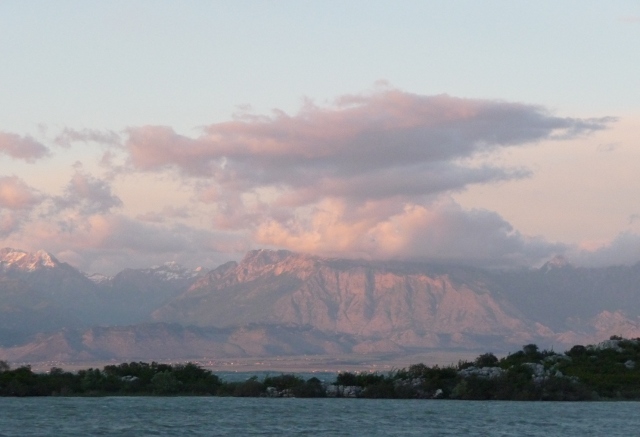
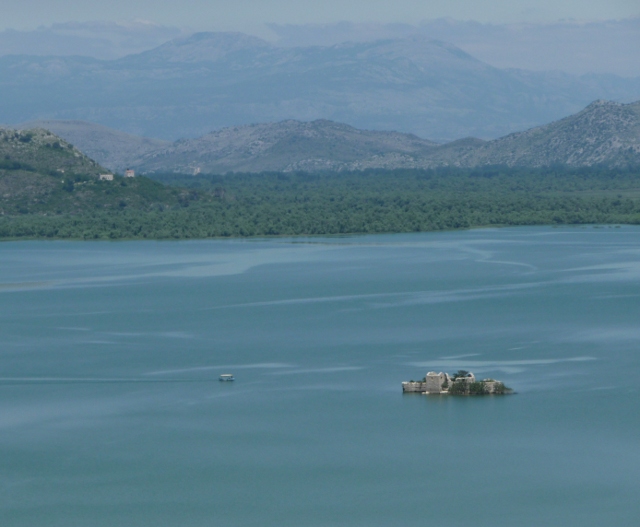
The views across the water to the snowy caps of the Albanian mountains are wonderful, too – taking in several islands with monasteries on, and one with a prison seemingly slightly larger than the island itself.

Eventually, we came to the tiny village of Murici, directly opposite one of the monastery islands, and home to a restaurant which acts as a base for boat trips across. Normally. The water was far too choppy for that to be happening, though – regardless of any other factors. The restaurant allows you to camp in their grounds, so we took advantage of that, in the hope that the next day might be better. The people running the restaurant were friendly and helpful, although it seemed like the place wasn’t fully open for the season yet – and, sure enough, no sign of any boat trips. The dogs they had on site, though, were a bit less welcoming. Whilst wandering in the direction of the loo block, I was headed off and severely growled and barked at, fangs-a-bared. Ellie was clearly an easier target, since the growly-barky distraction gave one of the other dogs a great opportunity to dive in and take a big chunk out of her leg. Fortunately, she was wearing jeans – so her leg’s just badly bruised fore-and-aft where the jaws clamped around…

All that, and it turned out we’d misunderstood the price, too – making it an expensive site, even without the dogs. Any plans we had to stay a second night were not long in evaporating.

(We’ve reviewed the place on TripAdvisor, and just had a message back from somebody saying they’ve been bitten there in the last few days, too…)

And so back over the mountains again. We had a quick look at one campsite, right next to the five-star resort island of Sveti Stefan (it must’ve been beautiful once, but was so heavily over-restored that it looked more like it was full of an estate of bland suburban executive homes).

Quite possibly the best location we’ve seen for a site for months – an olive grove, rolling gently down the hillside towards the sea – but utterly wasted by the facilities. We’ve been in some ropy campsite loo blocks in our time, but these were positively comical. If ever there was a campsite which was crying out to be bought and upgraded, this is it. To add to our laughter, we asked the guy (clad only in a thread-bare towel below his stained tee-shirt) if there were laundry facilities available. Yes, there were – and at only €10 per load.

Finally, we reached Budva – Montenegro’s biggest coastal resort, and home to three campsites, one of which we’d been forewarned was Not Much Cop. Boy, was that correct! It felt more like some sort of pikey encampment than a holiday campsite, with barely a square inch free of dead and dying caravans that hadn’t moved for years. One of the other two was sort-of-closed, with apparent problems with water & toilets – but it was OK if we wanted to stay for one night. Umm, kind of you, but… Which left just one – the eponymous Camping Budva in the centre of town. Somewhere. Somewhere? Surely? Eventually, we found it. It wasn’t really very open, but staying wasn’t a problem.

And so we headed in to town, since it was a Friday evening. The old town was really quite lovely, if a bit freshly polished – rebuilt after the same 1979 ‘quake that had hit Stari Bar so badly, of course. With massive superyachts lined up along one side, it certainly felt very upmarket, and many of the shops which lined every single street fitted that profile. But, somehow, it gelled for us.
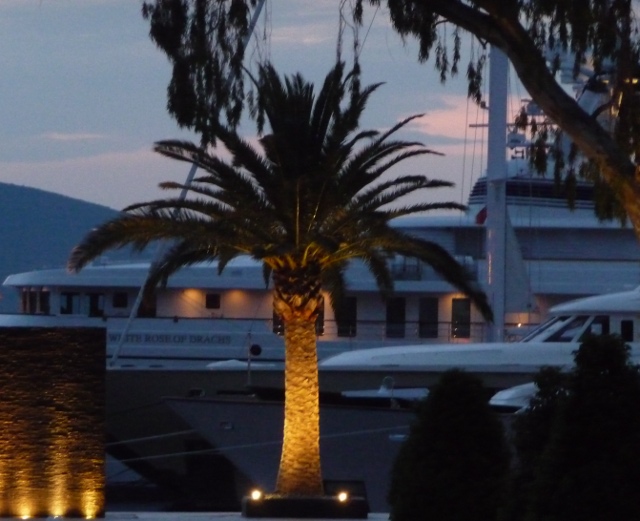
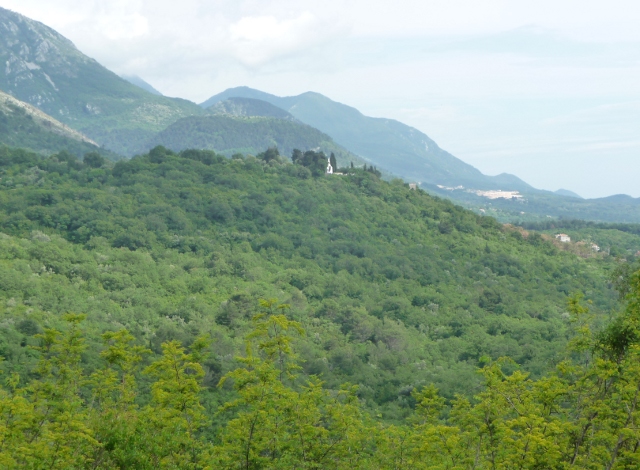
A beer in a beach bar rounded our short wander off, and we headed back to the site – with the upmarket feel rapidly dissipating as we wandered along the boardwalk. Tacky souvenir shops and bars (mostly busily being put back together after the winter closure) everywhere. One bar, though, was definitely open. Very, very open – and crammed. Music and cheering pulsed out from it, and a huge crowd were squeezed in tightly. Not, though, so tightly that you couldn’t see why – a central stage was a mass of bikinis and foam…

I think I must be getting old. We went back to the campsite.

Time to head over the mountains. Again. This time to slightly north of the lake, to the old capital of the country, Cetinje. The current capital, Podgorica, is not really on anybody’s tourist agenda, apparently – it’s just a fairly bland large town. But Cetinje is very different. It’s tiny – about 20,000 people – with a feel of a pleasant small country town. It’s just a pleasant small country town that happens to contain the presidential palace, several government ministeries and Fin-de-Siecle embassy buildings…

For much of the time it was capital, the country was ruled by “Prince-Bishops”, and the town’s also home to a pleasant little monastery, the church of which contains a relic claimed to be the right hand of John the Baptist.

It’s also home to the national museum (or three). We had a wander round the art museum – a few icons, and a stack of 19th and 20th century works by artists from all over the former Yugoslavia, then a section of purely Montenegrin art. Most of it was quite nice, if not exactly world-class. Some of the modern Montenegrin artists, though – OK, it’s a small country, but I think some of ’em were there purely because of their passports rather than any artistic merit… But what do I know? We could ponder how the bleak distopic savagery of many of the works was a reflection on life in an area so recently war-ravaged, but my Brian Sewell impression isn’t really up to scratch.

Montenegro’s big national hero is a mid-19th century Prince-Bishop, by the name of Petar II Petrović Njegoš. It sounds like he’s a fairly worthy recipient of this adulation, all 6’8″ of him. Not only was he a fairly enlightened ruler, but he was a very competent poet, best known for an epic called “The Mountain Wreath”.

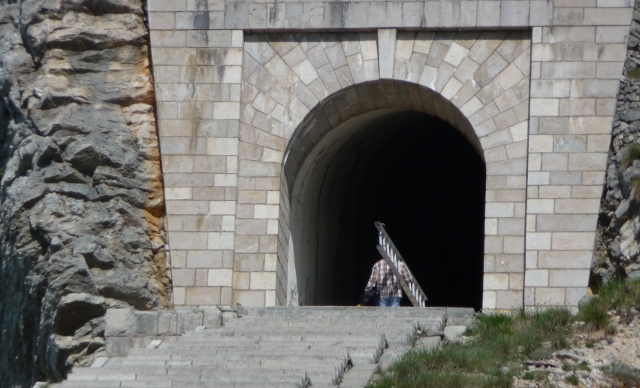
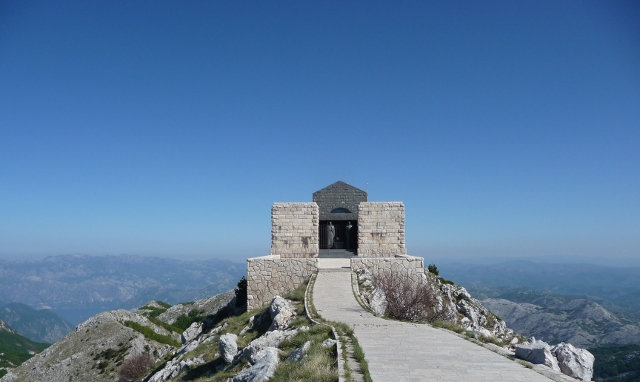
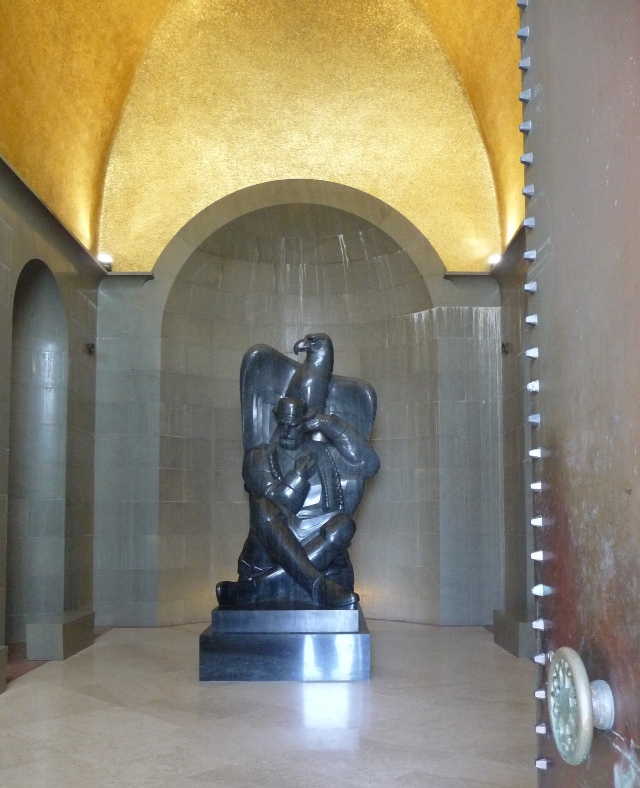
Njegoš is buried in a mausoleum, high on top of the tallest mountain peak in the Lovćen national park, just outside Cetinje. Which, of course, was our next port of call. Over the mountains yet again. After a night spent in the woods of the park, with wolves howling in the not-far-enough distance, we headed up to the mausoleum, arriving just in time to see the ticket chappy starting his walk up the 461 steps, with a ladder over his shoulder.

I’ll tell you something – when I die, I’d quite like to be laid in state in a mausoleum like that. Really quite impressive. He’s not had the most peaceful of rests – initially interred at the monastery for a few years, before he was finally moved up to the peak. There he sat until WW1, when the invading Austro-Hungarians shoved him back down to the monastery again to make way for something to mark their invasion. After they’d been sent packing, he was put back up there again, until WW2, when Italian bombs battered the little chapel. Back down again, this time until the current mausoleum was built in the early ’70s. Poor chap. Still, it was worth it in the end.

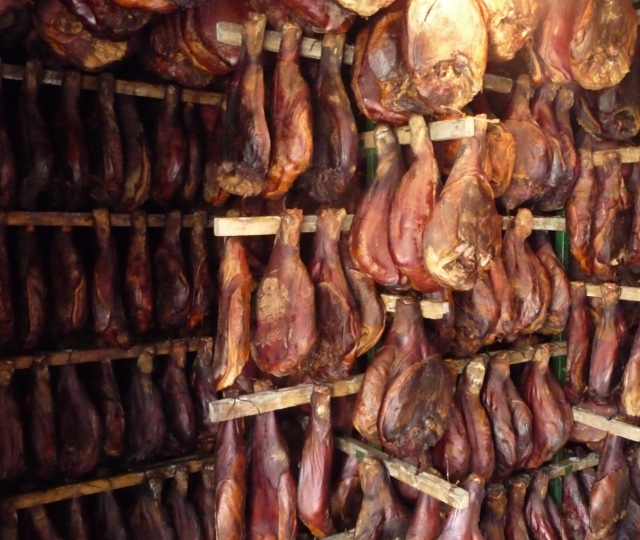
The Njegoš part of his name comes from the small village, way down below the mountain, where he was born – Njeguši. It’s other main claim to fame is as the last resting place of a substantial proportion of back legs of the country’s pigs. Njeguši pršut is a cured smoked ham, still artisanally made with the exception of one factory in the middle of the village. Even that’s not particularly large. As you enter the village, there’s little stalls lined up everywhere. For some bizarre reason, they’re mainly selling knitwear, but you can find the ham without too much difficulty. We asked at one knitwear stall, and were taken round to the back of the guy’s house – where he opened his shed door to reveal it as the smokery.

The smell was utterly mouth-watering, and as he offered us a slice to taste, we had no difficulty in accepting. Washing it down with his home-made Rakija firewater was obligatory, of course. The village is also well known for a cheese, but it seemed that the ham was where their hearts truly lay – and, to be honest, the cheese we bought was very nice but nowhere near as special as the ham.

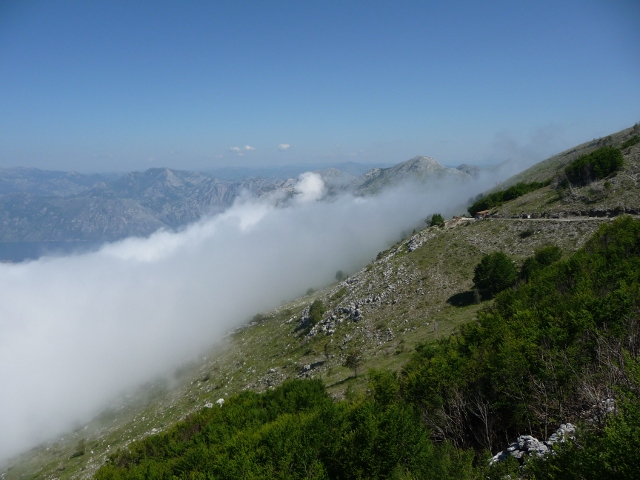
Time, once again, to hit those mountains, and head over to the fjords. The bay of Kotor is, allegedly, Europe’s most southerly fjord. Quite what gives it that claim, I’m not sure – but as we wound over the tops with clear blue skies and started the descent, we were expecting some fanastic views. Unfortunately, we were met with a thick layer of cloud, climbing up the mountain towards us.

By the time we’d negotiated about ten of the thirty-odd hairpins, we were dropping out of the bottom of the cloud, and we finally started to get those views.

Posted in Art & Culture stuff, By Country - Montenegro, Food stuff, Travel stuff, Wildlife stuff | Leave a comment

A colourboration

I’m thrilled to announce a collaboration with Lynne, or DoveGreyReader, a well known and highly respected book blogger. If you are interested in a wide range of reading – both fiction and non-fiction of all sorts, you mustn’t miss a trip over to her site. She’s a prolific reader, and writes about a lot more besides. We met at a literary conference quite a few years ago now – I knew her before she was famous – and I’m delighted that she is following us on our travels, taking one of the many vicarious seats in the van. One of those not occupied by all the people we’ve met along the way who were so lovely we wanted to take them with us, from tourist board ladies in Portugal to Albanian campsite owners’ grandmothers, quite a few Italians and Tunisians, and a whole Macedonian family. Not to mention quite a few camping cats, and not least the family, friends and people we haven’t met (yet) who are following in our wake.

Lynne mentioned to me that she liked noticing patterns in the world around so I sent her a few images from our vast store of trip photos. She has made them into great collages and this seeded the idea of our colourboration. We each take pictures in our separate worlds at around the same time with a colour in mind, create and post a collage of these. We will be starting with the colour red in a week or so’s time. We may also look at patterns again now and then. In the meantime you can see Lynne’s collages of my photos over on her blog site and find out more.

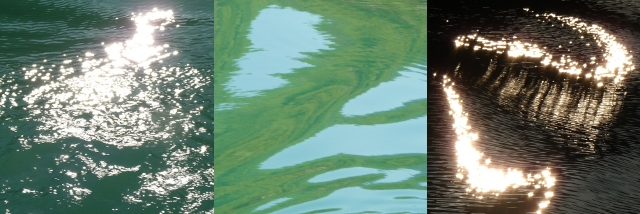
I have always loved taking pictures of patterns and textures, reflections and shadows, the finer details, things you may not notice at first. This kind of project leads one to look at things differently and I am looking forward to sharing this with Lynne and with all our followers. To whet your imagination further, here’s a small taster of light on water patterns from our recent Komani ferry trip.


A huge and overdue welcome to new passengers joining us from DoveGrey, please make yourselves comfortable, and enjoy the ride.

Posted in Art & Culture stuff, Colourboration, Site stuff | 6 Comments

A year in a red campervan – our lives, the road movie

One year on and we’re still here, on the road. This is no longer ‘Ellie and Adrian’s big trip’, but our way of life. It’s what we do. For now.

How far have we come?

We guestimate at 40,000km across eight countries and counting. Our odometer died for a time between Portugal and France, and then again in Sicily … and it’s still not working!

We’ve slept in 167 different places, from the dirty floor of a Tunis-Palermo ferry to the pristine wilderness of the mountains. We still haven’t found the perfect official campsite, but Etna Wine and the ‘duckling’ farm south of Rocamadour in the Dordogne come close.

The joys of digital mean we’ve taken more than 16,000 photos. Yes, we are ‘managing’ them, but we do need to edit them down a bit.

Would we do anything differently?

Back in January 2011, when we bought our red van, we were embarrassed by its size – it seemed so big and shiny. We’d always camped in tents before, so it was the height of luxury, warm and dry. When confronted by the giant white and silver beasts of motorhomes on the Continent that we soon dubbed ‘fridge freezers’ we came to realise that our van was anything but big. It is small and perfectly formed though and with a very few exceptions for a van of its ripe old age of 24 years, it has carried us safely for many miles. We’ve driven it hard too, over ranges of mountains from the Pyrenees to the Alps, the Appennines to the roughest roads of the Accursed Mountains of Albania. It’s met snow, the spray from crashing waves and the desert sands of southern Tunisia. It’s been lost up narrow cobbled streets all but taking people’s washing down. It may not have air-conditioning, a bathroom or a drop down coffee maker, but we can take it down all the tiny less travelled roads we love so much, park in the middle of villages or cities, and that’s exactly what we wanted from it.

All we can think of really changing about it is that sometimes we could do with thicker curtains…

Oh and by the way, it’s far from shiny now, wearing its travel dust like a badge of honour.

What are the best things about the trip?

We have deeply appreciated the spirit and generosity of the fellow travellers we’ve met along the way. Sharing information and stories, socialising until the early hours, or having an impromptu lunch or a coffee together in a layby. It’s kept us sane and kept us on the road.

Having contact with so many charming people in the countries we’ve been to and realising that not having any common language need not be a barrier to friendship and offers of help, as well as getting a precious glimpse into other ways of life. There’s so many people and cats we would have gladly welcomed to travel our road with us.

Seeing the most wonderful places that the world offers, nearly every day. New experiences at every bend in the road and discovering new foods and drinks.

Travelling with the freedom of the open road, wherever it goes, and hardly ever knowing where we’ll be spending the night.

What have we learned?

We are fitting the pieces into an enormous jigsaw puzzle of world cultural history, from pre-history to the present day. It is fascinating to see the influences from different civilisations and spot connections between different nations, languages and customs.

Our language skills have improved considerably and we are regularly practising our French and Italian, and I have even dusted off my ancient schoolgirl German. We have used all the Finnish words we ever knew, and have learned some Arabic, Albanian and Serbo-Croat. We have better miming abilities too.

We’ve learned that being able to say just a few words in the local language opens doors and wins hearts – a really rewarding result.

We have the power to change the weather simply by putting a load of laundry on.

The length of time it takes to navigate out of a town with no signage, is in direct proportion to how much we are longing for our picnic lunch that we promised to have just after we got clear of said town (Avellino, southern Italy we remember you well, and so many others).

Possessions have become less important, and the tight space means we acquire very little that isn’t a consumable or a replacement. Putting things away and keeping as tidy as possible prevents irritation …

We’ve become more aware of what we consume, particularly water.

Do we miss anything from home?

We got over missing things a long time ago, but a pint of bitter and a good roast dinner now and again wouldn’t go amiss. And oh how we’ll appreciate the washing machine when we get home too.

The journey is far from over (we hope), but we feel it is timely to give thanks to all those who in whatever way have helped us live our dream:

Thank you to all the family and friends who’ve acted as post-people – getting important things to us by courier, mail or in person.

Thanks to friends old and new who’ve put us up, helped us when we broke down, got stuck in the mud, or the sand, or ran out of wine.

Thanks to everyone who is following our blog – it’s great to have so many vicarious passengers along for the ride. We love writing and illustrating it and your comments and greetings give us the encouragement to continue to do. Don’t be shy, introduce yourselves – we would love more comments.

Special thanks to Matt and Berenice, who are renting our house and valiantly holding the fort, checking the mail, dealing with the boiler and overflowing drains, and keeping up appearances with the neighbours by ensuring there’s a surfeit of unusual cars parked out front.

In fond memory of Gerald and Gunnel, without whom none of this would be possible.

This kind of travel is joyous and intense. So many impressions in one day make the time expand and contract in strange ways. The highs and the lows are more keenly felt. We have no regrets and we appreciate every day we’re on the road. Well, except when it’s tipping down with rain, the van’s leaking and full of laundry that won’t dry… those are the times when the van seems really small and it’s all too easy to add to the low mood when glasses of wine are so easily spilt. The highs more than make up for that though, and you can always pour more wine. The marvellous thing is that we’re still on the road together, all three of us … and we haven’t woken up with a start to find we’ve dozed off on the tube and it was all a dream. We’re really living that dream, and we’ve hopefully still got a good few months of travelling wherever the road goes to come.

Posted in Personal stuff, Site stuff | 25 Comments