Crna Gora – or – The Black Mountain

Montenegro. It’s the former Yugoslavian country that you’ve not heard of. All the others – Croatia, Serbia, Bosnia and Herzegovina, Macedonia – roll off the tongue far more readily, even if it is only to be followed by the ubiquitous Eurovision “Nul points” or as winner of the longest country name in Europe – although at least now Macedonia is all but universally recognised, it’s been able to drop the “Former Yugoslav” bit off, leaving it with just “Republic Of” for Sunday Best.

But Montenegro? Probably because it’s so small – only about 600,000 population in the whole country, and just over 100 miles across and up/down – it’s one of those that gets you serious points in any spontaneous travel quiz.

When Susie & Steve, Ellie’s cousin and her husband, first told us that they’d bought a plot of land in Montenegro, “Where?” was most certainly our first reaction. Now we’re here – with just over a week in hand before they fly in for a short holiday. Since we can’t wait to meet up with them again, the plan is to slowly take the first bit of coast, towards the resort of Tivat where they’ll be staying, then head into the mountains up north.

After Albania, our first impressions are, to be frank, that it’s all a bit posh, and all a bit bland. But that’s compared to Albania, so not exactly a fair test.

Once we’d crossed the border, we had a little scout around for Lake Šasko, so we could have a picnic lunch on the shore. We never did find it. As we headed down yet another narrow and little-used track in search of it, we did find a big and scary sign telling us we were in “Frontier Territory”, though. So we gave up. Eventually, we found Ulcinj, the first biggish town up the coast. On a very quick look, the centre struck us as nothing very special, even if we did manage to buy a much-needed national road map, so we stopped off at a little supermarket prior to finding the campsite that we knew to be just outside the centre. If that was a typical small Montenegrin supermarket, we were in food porn heaven. Again, after Albania (much as we love it), not difficult, but even so. We stocked up on some delicious cold meat and far too many nibbles.

The campsite and beach were, well, a campsite on a beach. A big long (very, very long – longest on the Adriatic coast) beach, sure. But… bland. Scorchingly hot, but somehow not tempting enough to get us out of the shade. So, the next day, we headed a bit further north, to the next site which we knew was open.

We saw the signs for Camping Utjeha, and dropped off the main road down towards a small and stony-beached bay. There were signs for another campsite, too, but the list we’d got said it hadn’t opened for the season yet. We reached the bay, and found the road more-or-less closed by roadworks. We could get to the sign for the other site, but not to our target. But what’s this? We’re being dragged in to the closed site, Camping Oliva. It’s open. We park up, and head to the veranda of the house to register. We’re thoroughly made welcome by Grandma, who isn’t one to let linguistic differences get in the way of communicating, pressed into seats and force-fed glasses of home-made Rakija while she lectured us on the alleged shortcomings of the other site (some serious rivalry, it appears) as the heavens opened and the garden flooded.

Once the rain slackened enough to return to the van, we quickly got chatting to the only other people staying there – a Dutch couple, Chris & Annelies. As we continued to hide from the weather in their awning, the chat turned into a glass of wine or three or five, sopped up by one of Ellie’s chicken curries. Not only had they brought their utterly gorgeous four-month old Australian Labradoodle (A mix of the obvious two, plus an Irish Wheaten Terrier) with them, but they seemed to have adopted a local random puppy. On a walk, they’d found three very young pups looking sorry for themselves. One had followed them back, and was being fed and de-ticked by them. The other two quickly got in on the act, but couldn’t quite twig how to get from the next-door garden in to the campsite – so their food had to be passed through to them…

The port city of Bar isn’t particularly special, but the old town of Stari Bar certainly is.

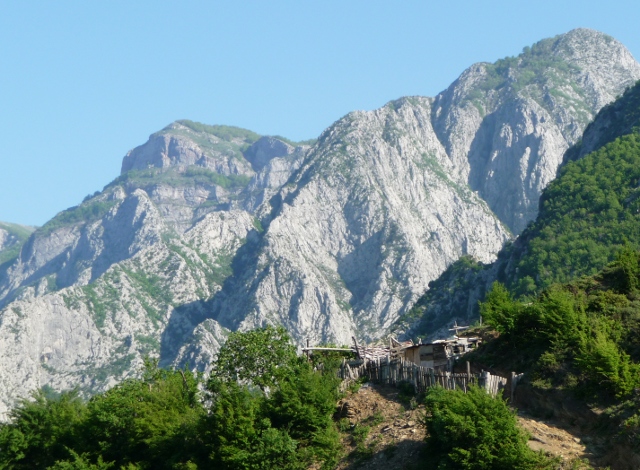
Once you’ve negotiated a pleasant little cobbled street of very nice restaurants and reasonably tasteful souvenir shops, the walls of the old town loom before you. In a fantastic location with a spectacular view over the coast and up to mountains, it’s had a hard life – culminating in the ruins being almost destroyed by a massive earthquake in 1979.

The walls, together with the churches, palaces and houses they contain, have since been restored and reconstructed partially. The ambitious project, though, has struggled since first the break-up of Yugoslavia then the wars which followed. Initially aimed at producing a mix of spaces for public enjoyment of theatre, music and culture, many of the venues are still just empty shells at best. As you wander round, though, with wild flowers and giant snails everywhere, you can really get a feel for what could have been – and may still be. Let’s hope that if and when it does happen, it doesn’t lose any of the laid-back appeal it currently has.

The new town of Bar’s biggest appeal was a purely consumerist one. If we’d thought the little supermarket at Ulcinj was good, we had a real shock in store. The butcher’s counter was a dream – superb quality meat, with a good choice of cuts. A fantastic deli counter, with a big stack of various smoked and cured sausages. OK, there was no fresh fish at all – it’s a port city, so maybe the harbour’s got a good market? – and the fruit and veg was a bit lacking in choice to our UK same-selection-all-year-only-the-source-country-changes eyes. But… it even had… GIN! AND! TONIC! Both! At the same time! This was a first for us since we left the UK. Our eyes scanned the shelf. The Bombay Sapphire and Hendricks were hard to pass by, Gordon’s a bit less so. The couple of bottles named after seemingly random London suburbs (Wapping? Finsbury? Seriously?) easy, but we finally made a choice. And so, with groaning basket, we headed to the checkout.

And there the fun started. No, we could not buy the half litre bottles of the ubiquitous brand of local beer. But why not? Finally, with the help of another member of staff, we came to understand. We couldn’t buy them, because we hadn’t got any empties to trade in. There was no problem on smaller bottles, bigger bottles or other brands. But those bottles (probably the most numerous on the shelf) – no. But how do we get empties to trade in, so we CAN buy them? Ah. Sheepishly, she grinned and shrugged. She didn’t have the first clue either. Judging by the crates of empties outside various bars, one answer does seem to be obvious, although I’m not sure it’s the one that’s really intended.

Posted in Art & Culture stuff, By Country - Montenegro, Food stuff, Travel stuff, Wildlife stuff | 2 Comments

On leaving Albania

When I was back in the UK for a wedding last July, I looked in Stanford’s (London’s travel bookshop) for the guidebooks and maps we would need for onward travels. Not the easiest thing when you’re not exactly sure where the road is going and you can’t load up too much for space reasons. Failing to find an available book covering all the Balkan countries, I found a guide just for Albania. I had some vouchers that needed spending so I bought it. At that stage, we hadn’t thought any further than visiting Croatia, and Albania really wasn’t on our radar. It was later on when we met Florian and Nelya in Sicily in their VW Transporter, that Albania got mentioned again. They loved it. On reading our guidebook – Bradt’s Albania, written by Gillian Gloyer – clearly in love with Albania and Albanians herself, we were even more inspired to visit. After our trip to Tunisia, the route from southern Italy to Albania seemed the obvious choice.

We’d met no other longer term travellers who had been south of Croatia, it just isn’t on the map of places people generally travel to, or only briefly to transit on the way to Greece. We didn’t know much about what to expect from a country that was so closed in by its Communist regime for so long that very few outsiders went there, and no Albanians came out. After the collapse of Communism and the pyramid selling schemes fiasco had plunged the country into anarchic chaos in the nineties, you didn’t hear any more. It’s the bad news that sticks. Those events are 14 to 20 years ago now, and in the meantime things may not be perfect, but it’s a peaceful country. We felt safe and very welcome. The people are genuine, very helpful and curious to know about you. They love all things English – football most of all. We’d been told that questions often get very personal and we skillfully deflected questions about earnings. Learning a few words of ‘Shqip’ brought many smiles, especially when we mixed up hello, goodbye and thank you. Some people then assumed we could understand the directions and instructions they rattled off at top speed. It’s amazing how much you can communicate with simple hand gestures and miming too.

An Albanian guide we met in Gjirokaster said that Albanians do three things freestyle: driving, parking and building. There were no private cars under Communism, and then all at once this restriction was removed, and everybody evidently got driving lessons from Greeks and Italians. Mercedes are the order of the day, they will withstand the poor roads better than anything, lots of VW Transporters too. And big 4x4s on foreign plates, and sometimes with no plates at all. The driving was certainly no worse than we’d seen in Sicily, but the elaborate roadside shrines – often fully engraved headstones with pictures of the deceased – perhaps tell a wider tale.

It’s the blend of religions and cultures that’s captivating – mannerisms, furnishings and words we’d grown familiar with in Tunisia – here in Albania. Now in south eastern Europe, as in North Africa, we are seeing the touch of the Ottoman Empire that ruled here for so long and spread its influence so wide.

The different peoples that have come and gone, settling in different places. The blurring of ethnic groupings, the borders not quite fitting – more political than human – all those things that make this area a fascinating place to visit, but which have also fuelled so much turbulence over the centuries.

Ilva, who we met on the way to Korça, spoke about the zeal of her people. Their ingenuity in overcoming the obstacles of the past. We have heard about the difficulties of emigration, the loss of highly trained individuals, and in a country where you have to ‘buy’ a job, it’s money not skills that count. But how to overcome the inevitable problems this causes? Economically, it’s on a slow upward path. The infrastructure, laid low by years of neglect, is being worked on, but it will be years before it’s completed, and many roads are still difficult.

Although the main tourism is, as usual, focused on beach resorts, the scope for adventure tours and ecotourism is great in the rugged interior. As the pace of development increases, the things that are so charming about the country could so easily be lost. We saw in Tunisia how local people are changed by mass tourism, losing that genuine welcome. The freestyle building along the coast in particular is in danger of ruining the beauty so many come for.

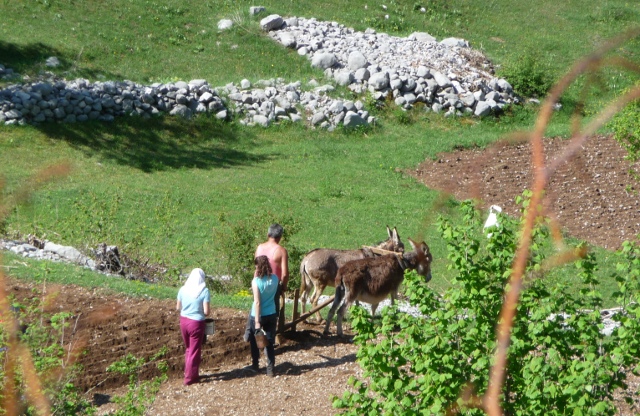
We saw more evidence here of overseas intervention than we saw in Tunisia – Oxfam projects, the US Peace Corps, and Dutch development workers. Charming as the traditional ways are, using donkeys for transport, freight and ploughing for example, it also points to poverty. The small farmer would far rather have a car or a tractor or both, and running water would be great too.

In Albania, there are few signs because everyone who needs to know where somewhere or something is already knows. Or people can ask can’t they? Yes, there is often someone who can speak English, or Italian or German, but not always. Few restaurants have menus. They can tell you what they have. Of course it would be more convenient if there were more signs and menus, but we’d have missed out on lots of experiences and interesting misunderstandings if there had been. A restaurant with a menu in five languages with pictures of the food is a turn off. Better the back street diner where you get invited into the kitchen to look at what they’ve got under various pan-lids, or get to peek in the freezer, or ask them to give you what they have and hope for the best. It won’t cost much, and it will be delicious, even if it’s just eggs and sausages.

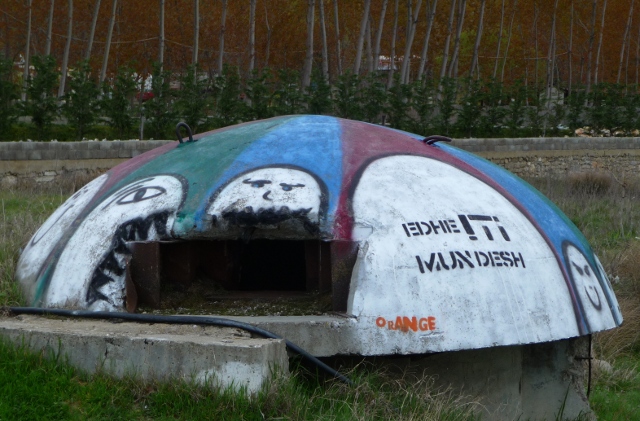
There are still millions of bunkers dotted around the country – concrete evidence of the paranoia of a Stalinist dictator. Almost impossible to destroy, there is estimated to have been a bunker for every four Albanians (around 700,000).

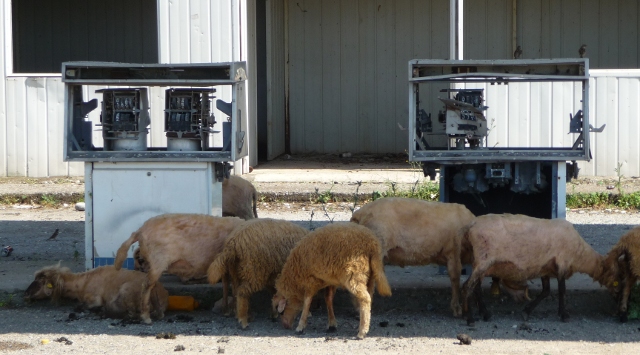
Then there is that air of secondhandness – the buses mostly acquired from other European cities, the myriad minibus taxis and vans with liveries ranging from German school buses, Swiss Golf shops, and even ex-British minibuses with the doors on the wrong side so the passengers have to board in the middle of the road … Petrol pumps still in Deutschmarks or with out-of-place Scandinavian Statoil branding.

The country exceeded our vague expectations on all fronts. From the wild mountains to the lakeside to the coast, the landscapes were awe-inspring.

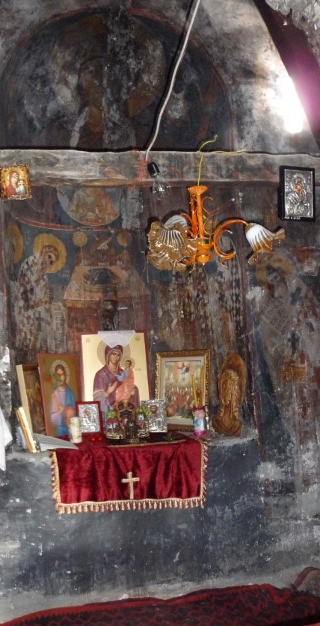
Challenges lay not where we expected – as well as the lovely people we met, we always found good places to eat and sleep. Any frustrations lay in finding the right road and when we did find it hoping that it might be good enough to take us where we were going. Albania may hold its cultural heritage dear but doesn’t realise that what it has is special – all the more precious because so much has been lost during the turbulent past. Hunting for the person with the key for tiny churches with magnificent frescoes that anywhere else would have tour buses outside, both here and in Macedonia, made for a not-unpleasant diversion and we are rarely in a hurry. Refreshing to be such a long way from the trappings of tourism, we felt like the discovery was ours alone.

Writing this just three days after leaving the country, I still have such a warm feeling about it. We’re so glad to have had the opportunity to spend a little time there.

It’s been a fascinating three weeks of jaw-dropping mountain scenery, incredibly bad roads, amusing insights, kind-hearted people, perfect wild camp spots and some exquisite meals. It’s erratic and it’s eccentric, and it’s charming. If you ever pondered visiting one of the most unusual countries in Europe – don’t delay, it’s changing fast.

Posted in By Country - Albania, Personal stuff, Travel stuff, Uncategorized | 2 Comments

Another chapter closes

After our couple of days in the mountains near Theth, our appetites were whetted for a last taste of the Accursed Mountains. There’s another road on the map, north of the Theth road, which curls along the Montenegrin border towards the village of Vermosh. We’d heard that it was 4×4 only – but it had to be worth a look-see.

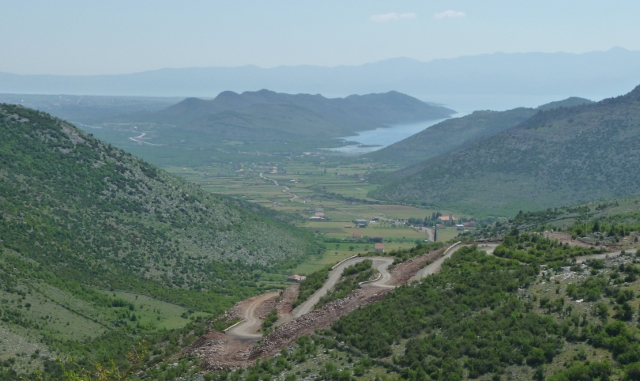
The junction to the road, at Hani i Hotit, was where we’d realised we’d missed the Theth road so we knew exactly where we were heading this time… The tarmac road plunged straight across a plain away from Lake Shkodra, the largest body of water in the Balkans, and towards the mountains, where it suddenly changed from tarmac to dirt and from straight to very, very wiggly and steep.

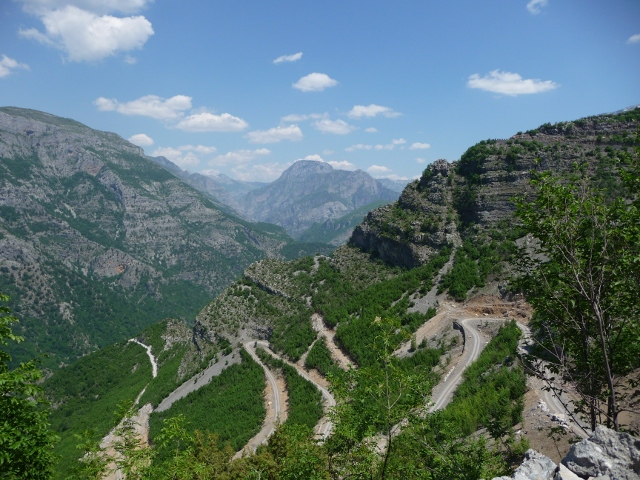
The road is being worked on, so is currently just a bed of rough crushed rock. We wound up innumerable hairpins, past the machinery being used to widen and (eventually, we presume) surface the road. Once at the top of the initial ascent, it headed through a village, then round some more bends – at which point, the vista opened up massively, giving us a huge gorge heading off into the distance. Wow.

We looked down – and saw our road continue towards the gorge but far below us. Through the binoculars, the surface looked decent, so we continued onwards, down another steep series of hairpins.

We wound round a couple of small side gorges, and towards the main river. After a few more kilometres, we were stopped by a guy in a dayglo jacket. We got out of the van, and walked towards the crest he was standing by. The road ahead was being actively worked on, with a large digger shifting rock from the road surface to the verge. Whilst it was clear that the digger would be moved out of the way in a few minutes, that would have left the road far too rough for us to realistically traverse. In addition, the descent they were working on was far steeper than any we’d come across to that point. We could probably get down it, but would we be able to get back up again? We’d previously set ourselves a “last turn-around” time, after which we’d be staying there overnight no matter what. That time was approaching rapidly, and it all started to look like the only sensible decision was to accept that we’d met a barrier too far.

We’ve been massively impressed by the rough road capabilities of our van, but at the end of the day if we break it, we’ve got ourselves a very big problem indeed. Since it was now mid afternoon on Saturday, and our Albanian insurance expired on Monday, we didn’t really have any slack time to resolve any issues either. So, reluctantly, we did a U-turn and headed back out. We might not have got all the way to Vermosh, but we’d seen yet more astounding scenery, and we’d got far further than we could realistically have done in any other type of motorhome or campervan short of one with 4×4 and significantly higher ground clearance.

On the way back up, though, we stopped to have a check under the van after one particularly rough section – and found that we were missing something fairly important… The waste tap for our grey-water tank. Where it had been, we just had a large hole in the lower edge of the tank. Whilst the tank itself didn’t appear to be damaged, and the tap had merely been pulled out of the threads, we had to face the fact that any water that we drained out of the sink wouldn’t be contained but would pour straight onto the ground – not something that’s particularly ideal for maintaining good relations with campsite owners.

As we headed back to the campsite we’d been at a few days previously, Camping Albania, we spotted a small shop piled high with building and plumbing equipment outside. Perfect. We went in, quickly ascertained nobody there spoke anything but Albanian, and attempted to make ourselves understood through mime. Fortunately for our sanity, the ubiquitous translator was quickly found, and our plight became understood. Another passer-by took charge of the situation, and was rummaging through the stock of plumbing fittings for something about the right size. After a couple of attempts, a bung was found, and screwed in to place. It seemed to hold water. Great. Time to pay.

No, it was quite definitely not time to pay. Not only did our assistant refuse to let us do so, insisting on paying for the bung himself, but he was quite firm that we should also join him for a drink in his cafe. Given that it was another 30degree day, it wasn’t exactly a difficult suggestion to agree to – and the price of a couple of drinks was not a heavy one for his help. But, no – once we’d finished our drinks, he was again adamant. If we were to meet in London, then it would be our turn to buy the beers. In Bajzë, though, he was the host.

Whilst we’d been having the drink, a guy in his twenties had been brought in. His English was flawless, and we had a chat about the economic realities of life in Albania. He’d spent, he told us, two months living in London. Whereabouts? Harmondsworth. We chatted on. It turned out that his stay in Harmondsworth had not been entirely voluntary, but had been enforced upon him by his method of entry into the UK… He’d travelled to Ireland, as Albanians are free to do, then crossed over the land border into Ulster, and on to the mainland. Without, of course, a visa for the UK. And that’s how he came to be in the detention centre for illegal immigrants awaiting deportation. His extended stay there was due to what he freely admitted to be a wildly optimistic attempt to seek asylum – turned down, of course, as without grounds. He held no grudge against the UK, and retained his ambition of living and working there. In Albania, it’s incredibly difficult to get a job – and if/when you do, you earn a pittance. €2-300 per month is regarded as decent. Sure, many costs are low, but many others are near to the European norm. Then, of course, there’s the barriers put in place by corruption. To get that job, you have to pay the person recruiting you. Often, nearly a year’s salary is required. An amount which you have to take out a bank loan for, meaning that most of your pay for several years is spent even before you’ve earned it. If you travel abroad, though, it’s possible to earn as much in the three months which Albanians can stay visa-free in a Schengen country as in a whole year at home.

As we sat in the last shreds of sunset at the campsite, an expedition-equipped Toyota LandCruiser 4×4 pulled in and parked up next to us. Writ large upon the side was the web address http://www.SilkRaid.fr – and we quickly made two new friends.

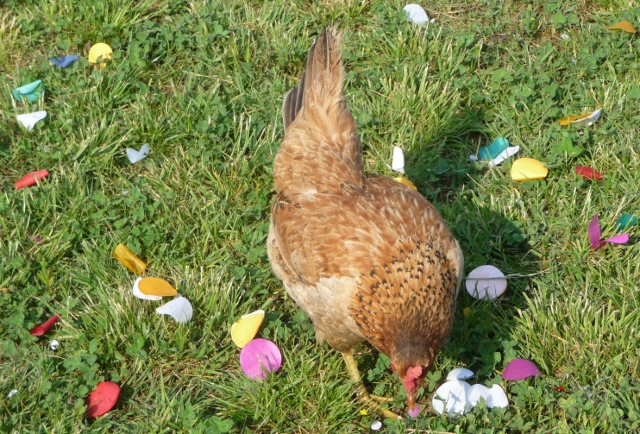
Pierrot has had to retire early due to ill health, but his ambitions were undimmed. His mother had been from Laos, and whenever they’d returned it’d been by air. Now, he wanted to go overland. His wife was going to fly out to meet him in six months time, whilst his son, Clement, was coming with him. Even better, it was Pierrot’s birthday. And so our last night in Albania drew to an end accompanied by the popping of champagne corks and a pyrotechnic confetti-bomb.

We awoke and shooed the chickens away for long enough to clear up the paper confetti they were trying to eat.

There was no doubt about it – the time had come to head towards the Montenegrin border. After a long and protracted saga of proving that the knowledge to be gained on the internet is much greater than that held by alleged experts, we’d managed to convince our insurer that as a step towards Serbia’s impending EU membership Green Cards were no longer required and that our policy was indeed valid there. After escalating this from the broker – a specialist brand of one of the UK’s largest insurance chains – to the actual insurance company behind the policy, we finally got agreement that this was a country we wouldn’t need to buy an expensive and restrictive border policy for. However, our certificate still didn’t list the country on it, so we requested something in writing just in case we had any police or border problems. No problem – they’d be glad to issue us with… a Green Card.

When an emailed copy arrived, we noticed an interesting wrinkle. Whether due to the fact that, since they didn’t know about the change, they still only had old copies of the Green Card in stock, we don’t know – but the Green Card that arrived had SRB for Serbia listed in the pre-change manner. And since the change meant that Montenegro could no longer outsource their own insurance management to their bigger neighbour, MNE was not listed at all, but was explicitly mentioned in writing as being covered by the SRB box.

That left us with a little dilemma. Was this Green Card actually valid at all? And if so, for where? The insurer hadn’t mentioned Montenegro at all (they probably hadn’t heard of it), but they’d been adamant that Serbia and Croatia were the only countries they would provide cover for. A little digging into the workings of the international insurance agreements revealed a couple of details that gave us grins. Not only were the old Green Cards still valid for two years as a transition arrangement, but if an insurer issued a Green Card for a country in error, they had to stand by it. We were definitely covered for Montenegro, a country with a reputation for the most expensive border policies in the region.

All that remained was to convince the people at the border of that…

We arrived at the border, and whilst we sat in the queue of cars on the Albanian side, our passports and van registration had been collected by a very friendly border guard, together with those of everybody else in the queue. As he sauntered back to the hut, we wondered if we’d ever see our OWN papers again out of the large stack he had in his hand. At the first hut, we were glanced at, a pair of vaguely familiar looking passports were stamped then passed round the back to the second hut. We were asked for our Green Card. It suddenly dawned on us that – instead of there being two separate border bureacracies joined by a No-Man’s Land, when the EU-branded sign behind the huts proudly proclaimed “The First Joint Border Crossing In The Balkans”, this was what it meant. This was the Montenegrin entry, not the Albanian exit. We handed over our colour print-out, held our breath and crossed our fingers. He studied it, turned it over, and looked sceptical. “It has been emailed to us – this is normal in the UK for insurance papers”. A grunt. Our very own passports were stamped, handed back to us along with the car papers, and we were waved forwards. We were in Montenegro.

There really is nowhere like Albania. We left with the feeling that there have been three of the best weeks of the trip so far, and a determination to return.

Posted in Art & Culture stuff, By Country - Albania, By Country - Montenegro, Officialdom stuff, Travel stuff, Van stuff | 2 Comments

The mythical road to Thethi

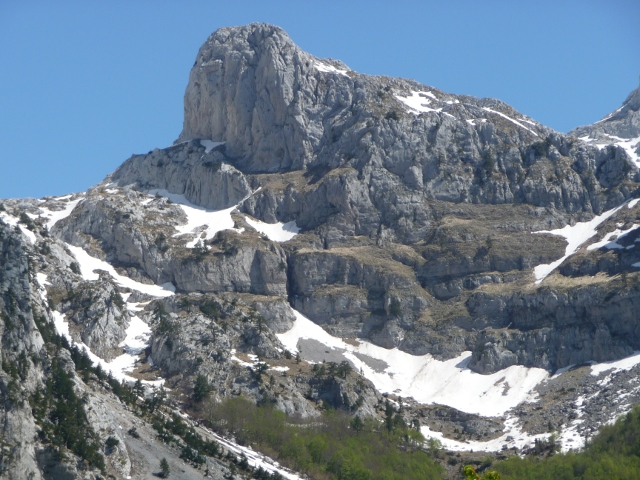
Sometimes when a thing proves difficult to do or is in the end totally unattainable you yearn for it even more. So it was with Thethi, reputedly one of the most scenic of Albania’s remote settlements set in a deep valley surrounded by the tall mountains known as the Accursed Mountains or Albanian Alps. Northern Albania has the reputation for upholding traditional life, but is also seen as remote and rather backward compared to other regions of the country. You  see a few people in national dress and age-old farming methods are still in use.

It also upholds the strict moral codes laid down by Lekë Dukagjin, a clan chief back in the 15th century. These codes govern much of life, including marriage and property. They also govern the system of honour bound revenge killing, or blood feuds. These only affect male members of a family and where someone was at risk of being killed, they would hide in a ‘lock-in tower’ for months until an agreement was made to call off the feud.

Apparently the feuds were suppressed under Communism, and most of the lock-in towers demolished. Following its fall and the chaos that followed, the tradition  revived again and is in existence today in this region. In Thethi, one can see one of the only original lock-in towers still standing, which can only add to the intrigue and fascination of the area.

After making the Komani Ferry trip – this was just about the last elusive bit of Albania to see. Although a resort in summer, Thethi is rather difficult to access. The only viable road there was variously reported as possible by a two-wheel drive vehicle or only possible with a 4×4. It was hard to find answers, so like the Komani Ferry, we decided to drive up there to see for ourselves. The main road out of Shkodra started easily enough but there was a lot of intermittent roadworks going on between the town and the Montenegrin border at Hani-i-Hotit. Brand new stretches interspersed with rough dusty bits, on and off the new bit of road, in and out of villages. The turning leading up the valley towards the mountain pass for Thethi is off this road. Somewhere. We were almost to the border without spotting it though and of course there were no signs. We doubled back and did eventually spot a road which could only be the one.

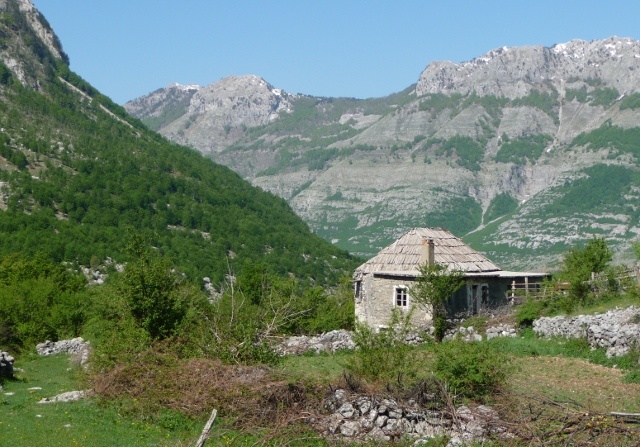
A narrow but reasonably good tarmac road leads slowly up the dry-river bed valley past small farms and hamlets, the mountains rising on either side, until the tarmac abruptly ceases and it becomes a very stony road indeed just as you enter the village of Bogë. The village is scattered below the mountains and didn’t seem to have a focal point.

We drew to a halt beside a café perched on the first floor of an unfinished house, but we were collared by a man who insisted we take our beverage in his garden, which turned out to be another café, of sorts. His pretty, but toothless grown up daughter then brought two beers on a doilied tray. Everyone there was in agreement however, the road to Thethi was closed. A firm hand gesture. Snow. In mid-May, Thethi is still snowed in. In spite of such hot weather. It was ok though, they were happy for us to camp in their garden if we wanted.

Sad but resigned to missing out on Thethi, we decided to see how far up the road we could go, and set off rattling and bumping along the track out of the village.

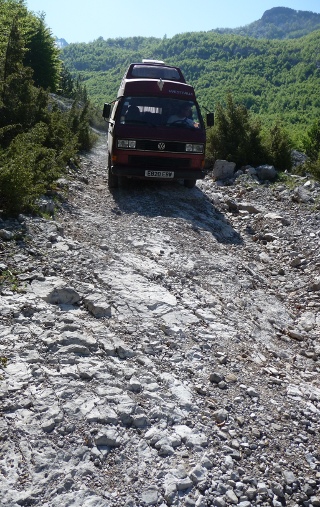
Sometimes relatively smooth, sometimes lumpy with large stones, the rocky surface below emerged at times. The van coped exceedingly well and we passed more farms and stony meadows as we climbed slowly up the valley towards the jaggedy snowy peaks above us.

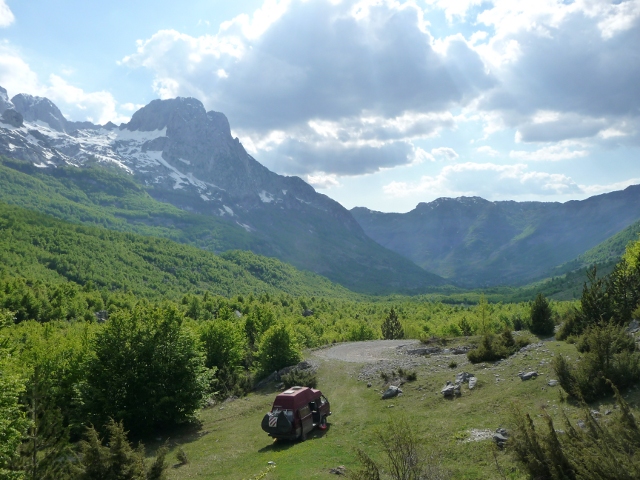
We spotted several possible wild camp spots along the way, and it was after a particularly tortuous rise, just as the road started to seriously climb that we drew to a halt off the road in a grassy hollow.

This was about as far as we should risk taking the van and with our ramps we could almost make the van level. Another wonderful alpine camping place. Mountains all around, only natural sounds, stunning beauty. Thethi might be glorious, but this was also close to perfection.

We relaxed and absorbed the views, enjoyed our dinner outside, until the sun dropped behind the distant ridge and the air grew chilly and drove us inside.

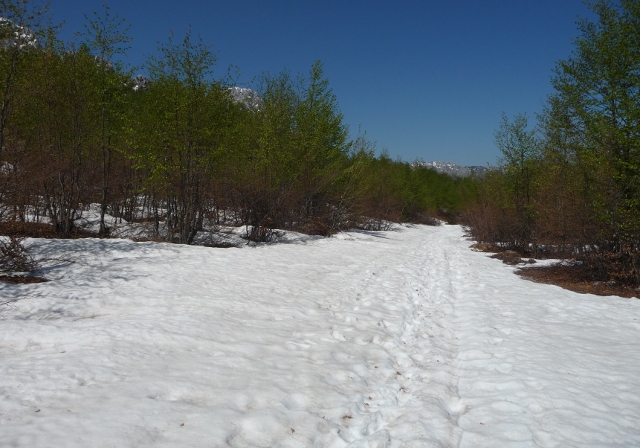
Next morning we woke early and not having much of a plan, we decided to walk up the hill to see if we could get to where it was blocked. The road up was surprisingly gentle with its gradual gradients, and lack of really rough bits. It wound through beech groves, with their soft spring attire. The van grew tiny far below us and the views ever more dramatic. After a couple of hours of climbing, we reached the first snow, which although not that deep, spread across the road, it didn’t look as though a vehicle had passed through recently although some may have attempted it. We skirted it, continued round a couple more hairpins, and there was the real blockage – a lot of snow as far up the track as we could see, and this was a patch where it was levelling out.

We considered walking further on, but it would be at least 10km on to Thethi and we didn’t have food with us having only planned a simple stroll. We could have brought the van up here quite easily, but we could never have got through the snow. Unfortunately we don’t have time to wait until it melts. A few days more? A couple of weeks? Judging by the footprints, people have been walking through the snow – perhaps getting taxi rides at either end.

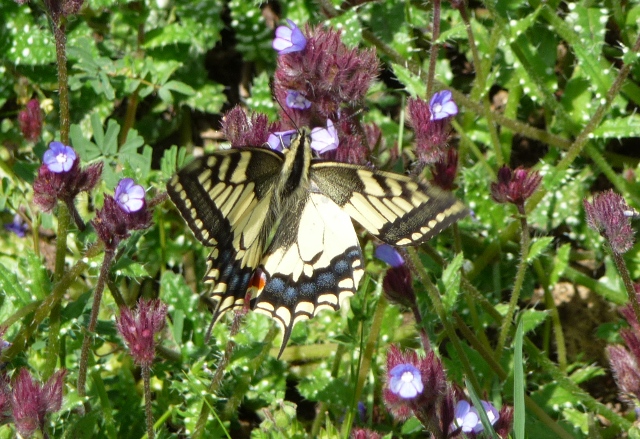
We reluctantly turned and walked back down to our hollow. It was so lovely and peaceful, we decided to stay another night. The place was alive with insect life – butterflies and huge flying beetles with gleaming gold green bodies, bees and bugs of all sorts. We also saw lizards, including the rather spectacular creature below.

Quite a few cars went up and then came back down, at least one every couple of hours. Two Belgians pulled in for a chat – they had tried but failed to make it over the pass. One of the guys had been to Thethi before – it’s a wonderful place, he said.

Then there was the mystery of the ones who went up and stayed up or came down without having gone up. Perhaps there was another mystery road through the mountains, or perhaps there were a couple of houses hidden away up there in the forests.

It was a slow careful trundle down to the village again the next morning. We’d come up further than we realised, and even downhill the road was tough in places and rocks twanged the underside of the van alarmingly.

We may not have made it to Thethi, but we’d come as close as we could and it would be hard to beat the natural surroundings we’d spent two nights in.

Posted in By Country - Albania, Personal stuff, Travel stuff, Van stuff, Wildlife stuff | 1 Comment

Komani Ferry

Our guidebook says that the Komani ferry is “one of the world’s great boat trips, right up there with Norway’s Hurtigrut”. With a recommendation like that, you can’t possibly miss it, can you?

Yet it looked for a while like we might have to do that. We’d been told various contrasting stories about what was happening – it’s running, but it’ll cost you €90 to take the van on; it’s not running at all; it’s running but pedestrian only – that we figured the only way to get the correct information was to just go to Komani and investigate. It’s not the handiest of ferries to get to, either. One end is about 40km of rough track away from the main road, and that’s the easy one. There’s a reason that the ferry’s the viable public transport for a wide area of the country – to take what passes for a road to the other end of the ferry’s route is about 150km.

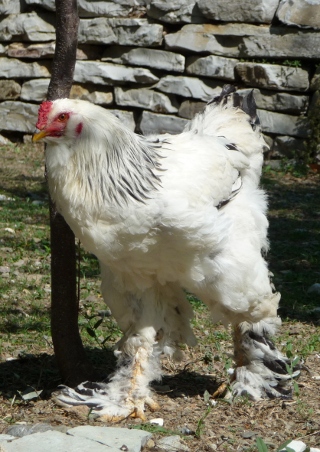
We arrived at Komani late afternoon, knowing that the boat runs only in the early morning, and having been told of a small campsite shortly before the ferry’s dock. It turned out to be a very pleasant little landscaped area, just next to the hydroelectric plant at the base of the dam forming one end of the long thin artificial lake. After parking the van in amongst a throng of wandering chickens, some apparently wearing furry stilts, it was time to find out what was happening. After suggesting we might like to eat in the “restaurant” (and opening the chest freezer to show us a loose quarter of cow sat next to a couple of large fish by way of menu) the owner, Marko, explained the situation in his excellent Italian – which we just about managed to follow. Apparently, we’d missed the car ferry that morning – and there wasn’t one scheduled until next week… Oh. It might be possible to charter a boat, though – for only €100 or so… Hmm. Eventually, we understood that the CAR ferry might not be running (apparently, it suffered some sudden and drastic buoyancy issues last year) but there was a foot-passenger ferry running every day. A plan started to come together, which we mulled over as we cycled up the road to investigate the dock itself. It might only be 1.5km from our base to the dock, but it took us a good half hour to get there up a VERY steep incline, not helped by the last 500m being through a very under-illuminated narrow and winding tunnel. As we recovered over a desperately needed beer, we received confirmation – yes, the pedestrian boat was running every morning, leaving at 9am. Strangely, the return down the hill only took about five minutes…

The hill seemed, if anything, steeper as we cycled back up at 7.45am, not helped by managing to share the tunnel with several ancient and knackered Mercedes minibus taxis heading to meet the boat. The small dock, empty the previous evening, was a buzz of activity. Luggage was piled everywhere, and the taxis were joined by a much more modern (but similarly knackered) Chinese-made pickup loaded with several cows.

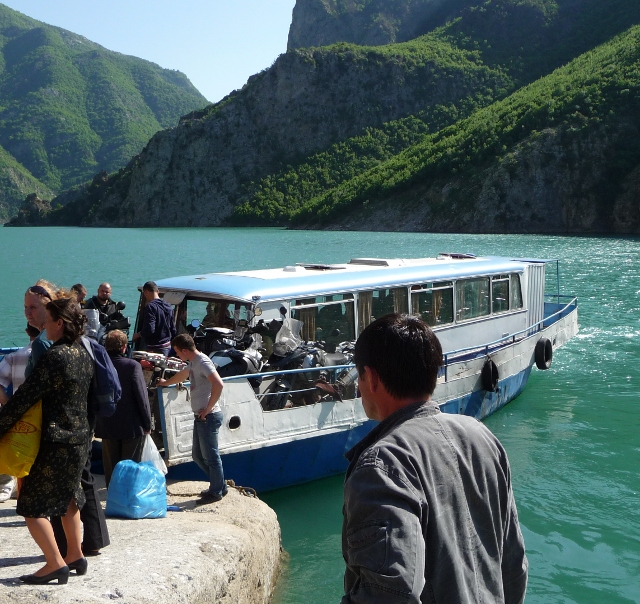
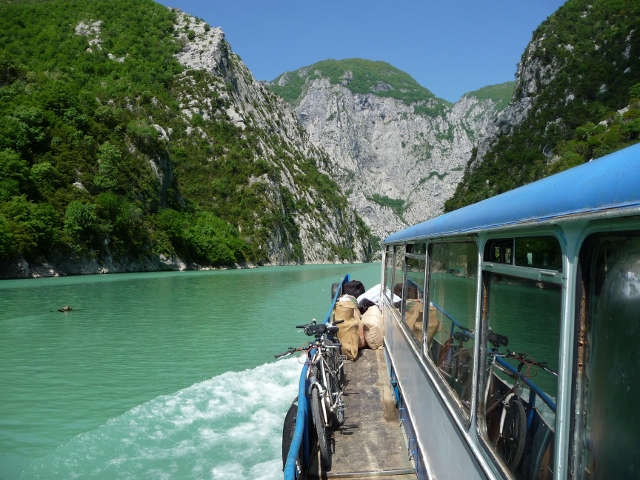
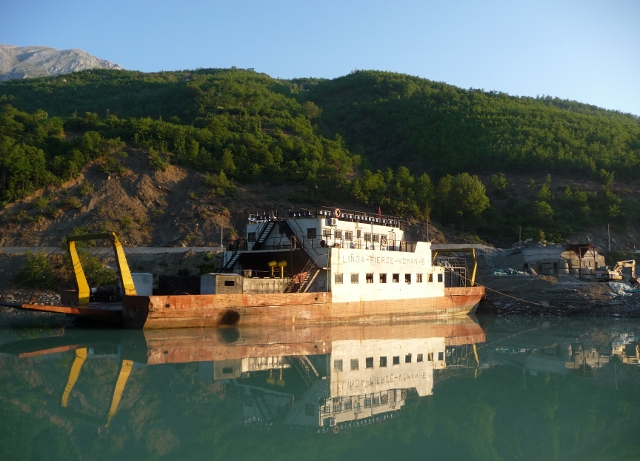
Finally, a small dot appeared around a headland up the water. It grew closer, and formed into a small boat. On the deck of the boat is a throng of people, a pile of luggage and several motorbikes all clustered around a bus. Maybe this IS the vehicle ferry after all? It’s too late to go and get the van. Then, as everybody starts to get off, it becomes clearer. There isn’t a bus on the boat. The bus IS the boat.

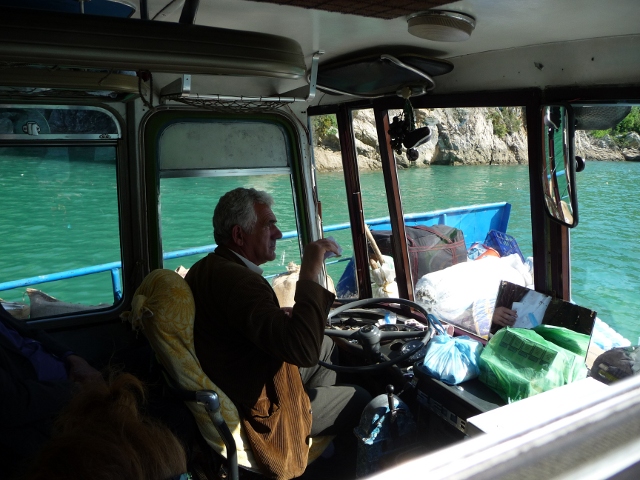
The top of an old coach has been welded onto the hull of the boat to form the cabin. Even the captain uses the driver’s seat of the bus – and the steering wheel.

Against the back of the bus, some bits of old shipping container have been welded into a sort of lean-to forming a toilet, complete with crucifix dangling next to the door. Abandon hope all ye who enter here…

Everybody jostles to load. Our bikes are wheeled up the precarious gangplank and are leaned against the rail, and piles of stuff get stacked on the front of the deck, with the captain gesticulating furiously as it starts to interfere with his view. We’re off.

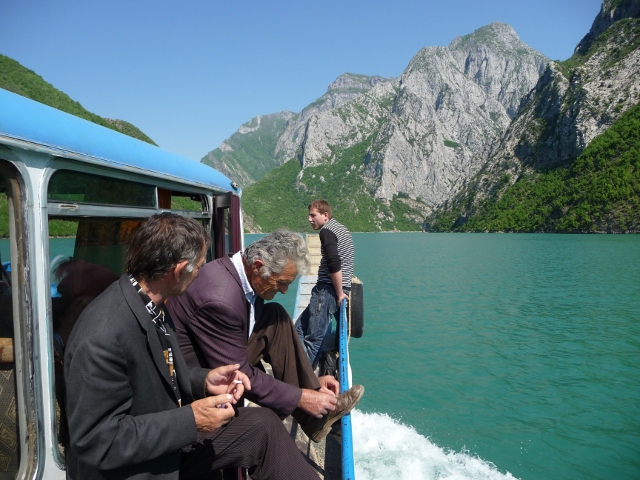
Our fellow passengers are almost all locals, who stay rigidly sat inside the bus except for the odd ciggy break, leaving the walkway around the outside to us and the only other tourists – four Danes whose Albanian driver/guide had seemingly been similarly confused over the status of the boat, with several rapid phone calls to try to find them alternative transport at the other end whilst he drove round to meet up with them… Fortunately, the cows are not loaded. Nor are the goats which are also meandering around the dock.
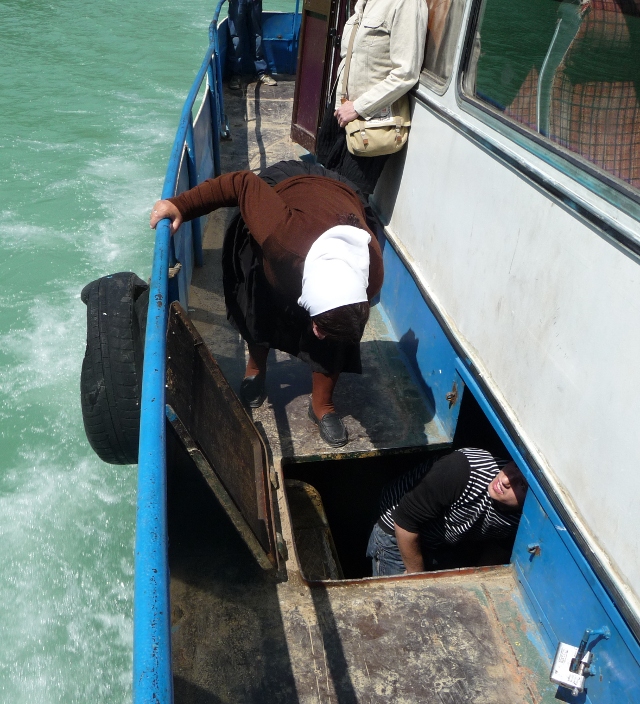
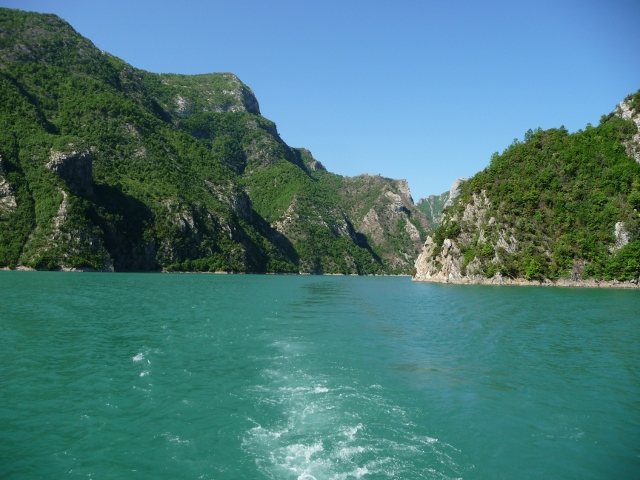
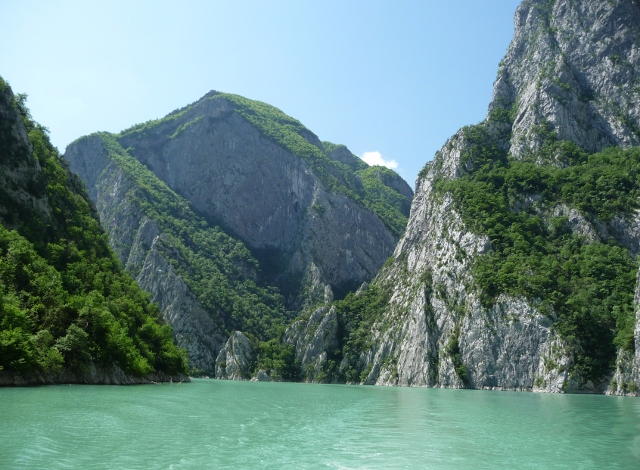
For three hours we puttered serenely in a little cloud of diesel smoke, stopping occasionally at utterly improbable pieces of seemingly random sheer hillside. As the boat approaches, people suddenly appear from the undergrowth, ready to leap on board, some carrying outboard motors and sacks of very fresh fish. Some of the passengers on board get off, clambering up the steep and loose shore, no matter how ancient and decrepit they appear to be – or wearing stiletto heels and carrying two small children.

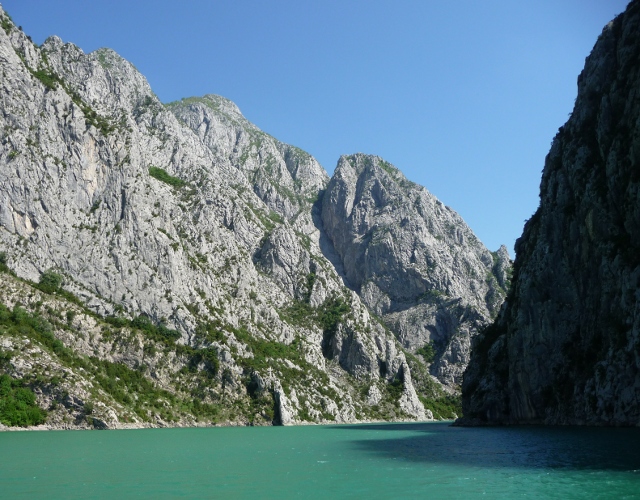
Other than that, there’s not much to say about the boat journey itself. The old adage about the relative values of pictures and thousands of words has never been truer.

The trip ends next to a couple of shabby car ferries, tied to what appears to be a builder’s yard in the middle of a substantial roadworks site. One of the ferries has been repainted recently, whilst the other is probably about to be. Either way, neither looks ready for use in the immediate future.

We get off, wondering what to do next. We’re loaded onto the ubiquitus Mercedes van, and our bikes passed up to the roofrack, almost by default. Twenty minutes later, we’re in the middle of Bajram Curri – the great metropolis in these parts.

Actually, Bajram Curri is a surprisingly easy place to waste an afternoon and evening in. Apart from the stunning setting, with snow-capped mountains rising on all sides, the town has a buzz about it. We find the hotel which we’ve been recommended, and investigate the options for rooms. For €20, we could do a lot worse. The room is a decent size, although we can barely open the door to the balcony, and once out there we decide that’s not a great loss. Covered in large piles of pigeon poo and with a view over building sites, it is not inspiring. We go to find some food. The pleasant outdoor bars along the road seem a good first place to look, although they can’t help. No matter. Whilst we sip a beer in the sun, an ice-cream sundae is brought to another table. Mmmm. We flag the waiter down and try to order one. As usual with Albania, communication difficulties are easy to overcome – somebody nearby will get dragged in to help, and so it proves here. No, no food is available. OK, we’ll have another beer and one of those ice-creams. Nothing arrives. Eventually, we give up, pay and leave. We continue to wander, heading into a small clothes shop. As Ellie browses, the girl running the shop is having a video-chat with somebody via her iPhone leant on a shelf. We hear a mention of tourists – that’ll be us. A tinny voice calls out to us from the phone, and we find ourselves having a natter with her sister – who’s living and working in Barking, on the edge of London…

We find a small fast-food shop in the main street. There’s no menu – of course – but the owner is cheerful and speaks good French. He gives us a quick run-down of what’s available, including holding up a Qofte kebab to illustrate his suggestion of a sandwich. Great. That’ll do nicely. But how many? The Qofte he waved about wasn’t large – Ellie says “two”, whilst my rumbling stomach says “four”. We sit down, and before long our food arrives. Ellie has two large bread rolls filled with salad, kebab and chips. So do I. Maybe mine have twice as much meat in? No, wait. It appears the other half of my lunch will be served just as soon as I’m ready…

After that, we really don’t particularly fancy anything to eat that evening, but we know that we’d better – breakfast is unlikely, given that we’re due to get the minibus back to the ferry at HALF PAST FIVE the following morning. So, after another wander around town, we head down to about the only other food option – the hotel’s bar, where pizzas are available. Two cheerful Americans greet us as we walk across the bar, and we join them for a drink. Garrett & Eric are Peace Corps volunteers, who’re half way through their two year stint in the area. Garrett, from Chicago, is working in the local health centre, while Eric, from LA, is teaching English in the high school. We pass a very pleasant evening chatting about the area, and the minor cultural differences from their hometowns…

It’s still dark when the alarm goes off, but has got light by the time we wander out into the main square to wait for the bus. We don’t need to wait – no sooner are we there than it arrives, ten minutes early. This is probably a good thing, as the only other person around is somebody that Garrett & Eric described to us as “the Ghost”. An elderly man, half-buried in a moth-eaten cast-off military uniform several sizes too big for him, he’s shuffling around. Apparently, he’s paid to protect the various businesses in town from burglars. This would seem an incredibly unlikely state of affairs, were it not for the AK47 slung over one of his shoulders. With that, it merely seems hilarious in a vaguely scarily improbable way. We get to the village a couple of kilometres short of the dock, just before the boat’s due to leave at 6am – and that’s where we stop. The driver gets out, and heads into the cafe, joined by most of the other passengers. Twenty minutes later, they return and we head to the boat. Miraculously, it’s waited for us – although, we gather from the two Dutch guys who are the only other tourists on it, that was the matter of some animated discussion amongst the crew. This time, the boat’s deck cargo includes a cement mixer.

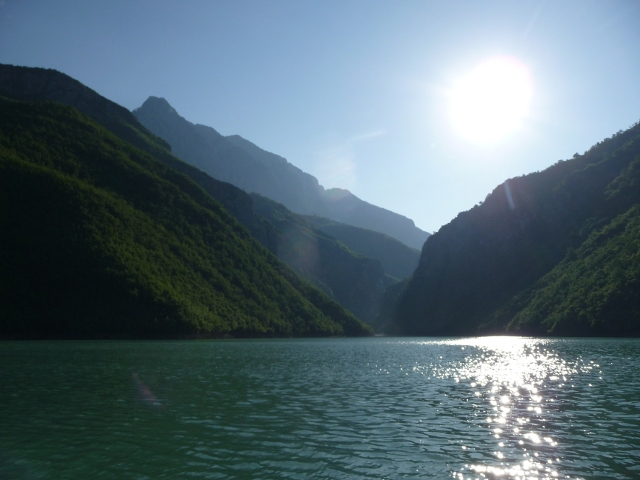
It’s much colder as we return, and much of the lake is cast in shadow as the mountains hide the still-rising sun.

As a result, I don my fleece, and my (prescription, needed for driving) sunglasses are on and off. As it warms up, I remove my fleece over my head – forgetting that the sunnies are hanging from the neck. I don’t see them go over the edge of the boat, but it’s the only place they can possibly have gone…

On the way up the lake, the crew had peered into the engine bay on various occasions. On the return, this appears to be more frequent, with each visit taking slightly longer.

The boat keeps throbbing along, though, and for another three hours we cruise gently past isolated houses high up on the hillside.

Eventually, we arrive, and the scrum unloading the boat mingles with the scrum loading.

The cargo waiting for the return voyage includes more motorbike travellers, together with a washing machine. It’s all fitted on within ten minutes, and the Komani ferry heads back off down the lake again. For us, this has been an unforgettable return trip through utter beauty. For the people of the region, it’s just a bus ride.

Posted in By Country - Albania, Travel stuff, Uncategorized | 3 Comments

Nearing the north

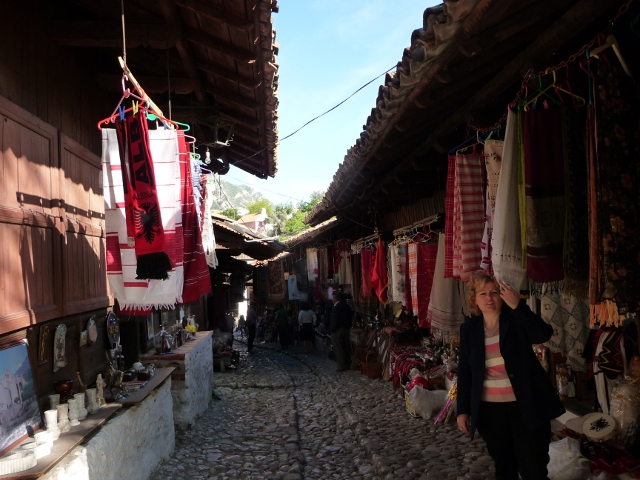
Kruja was the first bit of proper full-on tourist industry we’ve really come across in Albania. Apart from the nearby hotel which advertised camping (sauna and pool included – but migawd, you were paying for ’em!), we were guided into a parking place in town by a nice man with a very official looking, if dog-eared and illegible, laminated badge around his neck who seemed to be claiming parking would cost us 100lek per hour… While we sorted ourselves out and tried to ignore him, he got bored and wandered off, leaving us to sneak off towards the castle while he wasn’t looking. The route from town to castle takes you through the old bazaar – a wonderful cobbled winding row of simple and ancient-looking wooden shacks, roofs virtually meeting in the middle. At least, that’s how it’d look when everything was closed up. Which they weren’t.

Every one of the shacks was open, with the unsuspecting tourist assailed by cries in most major and a few minor languages entreating you to come on in and spend money with them and them alone. Goods available ran the full gamut from t-shirts to hip flasks to antique furniture to rusty rifles to Mother Theresa paperweights to hand-woven scarves and ice creams. We managed to get to the castle with wallets unscathed, and took a look around us.

There’s not a lot left of the original castle – just the outer walls and some foundations inside, together with a Venetian tower on one end, and some older houses. One of these houses is another Ethnographic museum, very similar to those we’d seen elsewhere, whilst just down the hill from there lies a tiny Bektashi Tekke, restored and still run by the current senior member of the clan who’ve run it for years, and are even reputed to have converted Ali Pasha Tepelena, who we’d “met” several times already – all the way from Butrint to his playing host to Lord Byron.

At first glance, though, the castle walls look to still contain the keep, in remarkably well preserved order. Then you realise that it’s a modern pastiche – built in the early ’80s by Enver Hoxha’s daughter and son-in-law (also responsible for the Pyramid in Tirana) as a Skanderbeg museum.

The party obviously wanted to sign the 15th century bane of the Ottomans up as a fully-fledged member, to get some of his glory and heroism to rub off on them – and the museum really does take the whole personality cult thing to a new level. It’s hilarious, tacky and cheesy, from the two-story-high sculptural tableau in the atrium through to “Skanderbeg’s desk” with “Skanderbeg’s correspondence files” sat on it, and with a huge stained-glass picture wall illustrating one of his battles.

After that lot, we needed a change of scene – so fought our way back through the bazaar (gaining ice creams, t-shirt and scarf en route, but managing to avoid the rest), back to the van (without any kind of parking ticket or other demand for money) and headed up a tiny, steep winding lane through the back of the town centre, which soon turned into a high-quality and excellent condition road up a serious mountain. At the top, where our map showed the pass continuing over to some other villages, there was nothing – just a car park at the back of a slightly abandoned-looking hotel and a path down to a small bar, together with a very military looking set of aerials guarded by a man in a uniform with a large gun… A couple of bends down the hill, there was a sign off to a restaurant, via a dirt track which might have continued past and down the other side of the mountain. The restaurant was surrounded by rolling grasslands, with dozens of picnicing families – all sat, cheerfully on rugs, surrounded by piles of rubbish. One story we’ve heard is that litter was very seriously penalised by the communist regime, so the freedom to leave all your junk blowing everywhere has been eagerly picked-up as part of the new freedoms. Whether this is true or not, I have no idea – but any “Keep Albania Tidy” signs that might be put up would very quickly be invisible behind bottles, cans and plastic bags. Still, we found a very pleasant layby right on the road, where we watched all the picnicers return to town, some on foot despite town being 10km of road and 1000m of altitude away, most in massively overloaded cars and trucks before we settled in to another night of peace and amazing views.

The next link north in the chain of castles is at Lezhe. Another centre of the Skanderbeg industry, this is much lower-key… His tomb sits in the ruins of the small and simple cathedral. The church walls sit about six or seven foot high, underneath an oversize modern steel free-standing roof. Bronze shields line the walls of the cathedral, commemorating his major battles, with the tomb and a large bust at one end overlooked by a huge mosaic of his double-headed eagle standard, now the country’s flag.

When we first entered the park surrounding it all, though, we thought we wouldn’t be able to see inside – the doors were chained and padlocked. However, we’d not even quite reached the structure when a girl came at a run from the ticket office, unlocked and let us in – before launching into a full explanation and guided tour in excellent English. Just as this finished, our exclusivity wore out completely – as a couple of classes of primary-school kids started to line up at the door, clamouring to come in. But they weren’t allowed to until the tourists had finished…
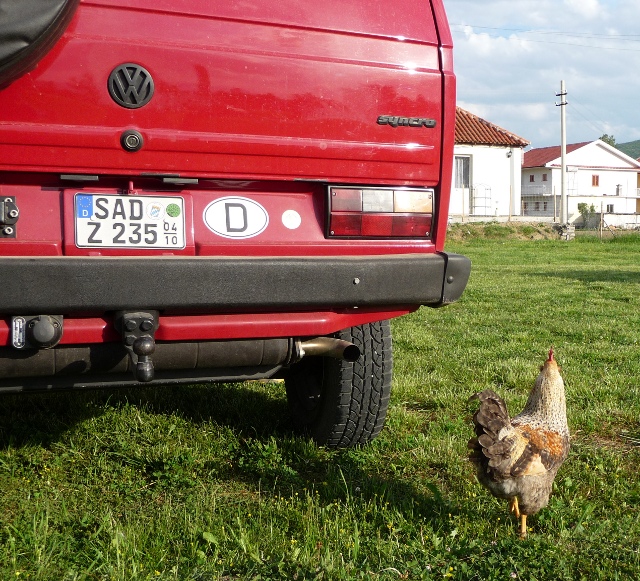
A little further north, approaching the main northern centre of Shkodra, and we stopped off at Camping Albania. The first campsite to be opened nationally, a few short years ago, it’s run by a Dutch family who came out in the early ’00s to work in aid and development projects, but found they were playing host to more and more travellers – so why not formalise it? We’d had high expectations – and the facilities lived up to them. However, there seemed to be something missing. There just wasn’t the enthusiasm and vibe we were expecting. When we arrived, the camping field was completely empty – apart from umpteen curious chickens, although they seemed unable to assist with our need for a couple of eggs. It wasn’t long before others started to arrive, though – starting with Hannes with his VW camper, very similar to ours – except his was the very desirable 4×4 Syncro version – just the thing we could have used on several occasions.

As the evening wore on, we found ourselves not receiving information but being the source of it instead, since the site’s the first stop off for all those heading into the country via the Montenegrin border only a few miles north. We went over maps and lists of campsites several times, including racking our brains to try to think of sites which the two couples of German caravanners would be able to use without reducing their accommodation to a pile of splinters. Difficult…

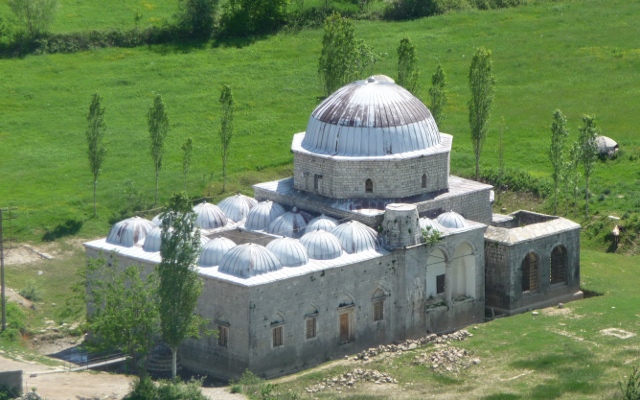
Rozafa Castle was our introduction to Shkodra, with the amazing views in all directions you’d expect of the location – at the confluence of three major rivers and on the bottom corner of the large lake which forms a good chunk of the border to Montenegro, and with the beautiful (if boarded-up) “Lead Mosque” sat nestled gently on the plains at the foot.

The castle itself seemed to be playing host to visits from about three quarters of the entire Balkan school-age population, and we just managed to get back to where we’d left the van parked half-way up the steep entrance road before the throng descended en masse to their waiting buses.

Once we found the centre of town, no easy matter given that every single road has been renamed or is suddenly and without signs closed due to roadworks – or both – it had a very laid-back and Mediterranean feel, very different from the rest of the country with long lines of pavement cafes. As with Tirana, though, food seemed to be in short supply at the cafes. At the one which did have a menu outside, we were quickly dragged away from the street table we’d been about to sit at, and ushered up to the first floor terrace. We’d only been intending a smallish lunch, but were tempted by the Shkodran speciality of lake carp, in this case baked in a sauce – delicious, and a huge portion. After that, we needed to wander around gently to recover a bit before heading on, so tried to find the Marubi Phototheque, the archive founded by the first person to take a photograph in Albania. Together with the work of his direct descendents, the archive documents much of the last 150 years of this fascinating country – once you actually manage to locate it. Our guidebook said it was in a “difficult-to-locate” alleyway, and gave a rough location on the map. This turned out to be incorrect, though, and their suggestion of asking a local was quickly brought into play. The first few pointed us in various directions but to no avail. One lady, running a clothes shop and possessor of the most amazingly unconvincing set of painted-on eyebrows we’ve ever seen, pointed in a completely different direction which we both understood differently. Finally, we asked a woman running a newspaper stall – she despatched her identically dressed identical twin daughters to lead us straight to the door… The collection on display isn’t large, but it is fascinating – from illustrations of traditional dress to a portrait of King Zog and his sister, to various historical events – either “live” or reconstructed later in the studio. The archivist who was giving us a guided tour and working our Italian hard was soon interrupted, though, by an effervescent 20-something who explained in English that he was the director of the archive and a total Anglophile. He loved English football, English television and music, even our National Anthem… He also explained a bit about how the archive is trying to get their material more widely seen, starting with a move in a few months to new and larger premises. We didn’t suggest that maybe a few signs would be a good start.

Our final stop in Shkodra was the tourist information hut – again, not quite where our map suggested it was – where we were given the news that the road to Theth was very much do-able without a 4×4 (contradicting the one piece of concrete information we’d been given at Camping Albania), but that the Komani ferry was not currently running… and that was precisely where we were planning to head next.

Posted in Art & Culture stuff, By Country - Albania, Food stuff, Personal stuff, Travel stuff | Leave a comment

City break Tirana

Leaving Durrës I thought I’d selected a good route that would take us to the camping place in the suburb just south of Tirana centre, without us having to tackle the city’s notorious traffic on a Friday afternoon, and without taking the motorway. Signs are not a priority in Albania, but after a few false starts and stopping to ask where on earth we were, we somehow found ourselves on the right road. Most of it was a country route through undulating rural areas. The highlight was spotting some ancient remains of tanks that had just been pulled out of a field on a lorry.

The one last turning we had to take to avoid the city somehow vanished and before we knew it we were in central Tirana driving along a main boulevard with a river running down its centre with grassy banks rising up to the meet the thoroughfare on each side. The traffic was busy and typically erratic, but we counted turnings and managed to find the right route out again. Our campsite was at Hotel Baron in Sauk. On first sight it looked closed and rather down at heel, but we pulled into the garage forecourt just in front of it to find out what the score was, we’d already phoned ahead to check it still existed. The young attendants were only to happy to help – the main entrance to the hotel was on the other side of the garage, but a bit of the road just in front of the driveway was being resurfaced. We could walk through and leave the van there. Our first impressions were thankfully overridden as we were greeted by very friendly staff, a much nicer looking hotel on closer inspection with an out of the way car park where we would camp, and a key to our own bathroom in the hotel. And why not have a drink on the terrace overlooking the edge of rolling countryside at the rear of the hotel, while we waited for the resurfacing to finish? Luckily by the time we had drunk our beers, the tarmac was done. We were lucky, this was around 4pm and a car had still been waiting to drive out after lunch at the hotel restaurant.

We settled in quickly and caught the bus into the city, a mere 3km away and a grand total of 60 lek for two of us – that’s about 35p – not each, but for two! It took us close to Skanderbeg Square – the main focal point of the city, with a beautiful painted mosque on one corner – probably one of the older buildings still left in Tirana. It is the one city we’ve been to that has barely any old bits. We followed a short walking tour from our guidebook to help get our bearings as the evening light hit the large Communist era buildings and the statue of national hero Skanderbeg himself astride his horse in the centre of the square.

It was a large expanse with wide avenues leading into it – plenty of space for all those military might parades of the past. The square is also home to the National Historical Museum with its socialist realist mosaic of the proud partisans.

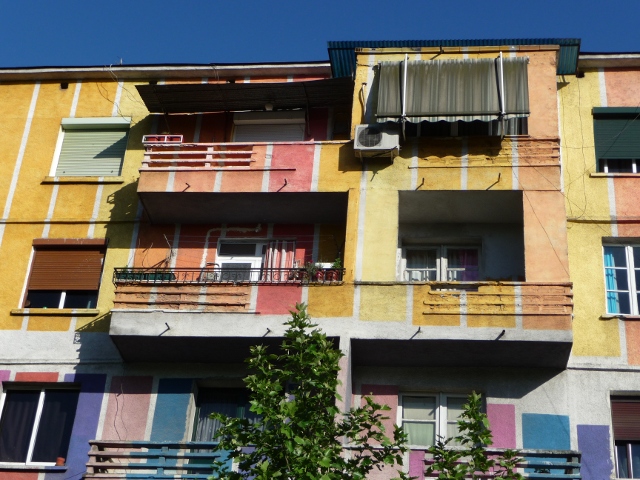
The Albanian flag has been ‘corrected’ now, the star above the two-headed eagle has been removed. We also strolled down to the old Tanners Bridge, and looked at the colourful apartment blocks on the other side of the boulevard we’d driven in on.

A mayor in the early 2000s was an artist and decided to brighten the city up by using colour on a lot of the dull apartment buildings. They’ve faded a bit now, but they still liven things up.

After a beer at a bar in a restored old house, we went in search of dinner. We inadvertently stumbled onto the trendy quarter, known as Bllocku, formerly a Party elite area where ordinary Albanians weren’t allowed to go. They are making up for it now though. It is a few streets full of hip bars and cafés, their plush seating areas crowding the pavements, flash cars cruising up and down (many big 4x4s on GB plates…) and the young Tiranians dressed up to the nines out drinking. Drinking what mainly appeared to be coffees and soft drinks, a few beers and possibly some rakis, but mainly non-alcoholic. Not eating. No food being consumed as far as we could see anywhere. Albanians still don’t tend to eat out very often and we turned to our guidebook for suggestions. Several of the tempting-sounding restaurants seemed to have disappeared, but we managed to find one, Era, and tucked into some wonderfully filling Albanian specialities. We love the food here, but there just aren’t enough Western European foody tourists coming to Tirana to support the few restaurants there are, and those that do come are all too often in tour groups who tend to eat in their hotel restaurants. Era was quite busy though, and incredibly good value. Unlike most captial cities the prices are not higher here than we’ve found in the rest of the country.

On Saturday morning we went to the National Art Gallery. There was an exhibition of Ibrahim Kodra’s work, a contemporary of Picasso with his own take on Cubism. What we’d really come to see though, was the collection of Socialist Realist works. These propaganda depictions of happy workers flexing their rippling muscles, gaily wielding their hammers and sickles in victorious stances with such joyous titles as ‘We are at the forefront’ and ‘Lift the revolutionary spirit high’. Women workers were portrayed alongside men, with backdrops of foundries, hydro-electric plants and tractor factories. Also there were works on display that didn’t pass muster and were black listed by the Party for not conveying a positive enough message, and the story of one artist who had a whole studio of bronze female nudes destroyed because they apparently showed foreign influence.

In Tirana, more than anywhere else in Albania, one is reminded most strongly of the Communist Era, and after a lovely lunch at a small backstreet locals’ eatery, we passed below the famous mosaic facade and entered the National Historical Museum. This huge building houses exhibits showing Albania’s history from pre-historic times almost to the present day. It has a hall of fabulous icons, many from churches we’ve visited around the country. It also covers the Communist time with poignant reminders in everyday belongings of those imprisoned, tortured and often executed during those years, usually without any trial, for transgressing the Party line. Very little of the text was translated, but the harrowing pictures of firing squad shot corpses and exhibits of blood stained clothing didn’t need so many words to get their meaning across. There was a grim reconstruction of a prison cell, and a display of instruments of torture.

We imagine that Tirana has changed an incredible amount in the last twenty years, and it looks set to continue to do so at a fast pace. It has a vibrant feel, an unexpected amount of green spaces and use of colour in public areas. It aspires to be a player on the European stage and one day that is sure to happen – definitely an up and coming place.

We did a lot of wandering, augmented by stops at bars and cafés for refuelling and checking out of landmarks, such as the rather dilapidated pyramid, once a museum of Enver Hoxha’s life, designed by his daughter and son-in-law, and a leafy flash part of town full of embassies, and upmarket shops and bars. We ate out at an outdoor restaurant before following the coloured light walkway past the unfinished American Hospital skyscraper to the bus station. Looking out for our bus amongst the second hand buses presumably bought cheaply from a French city and still showing the French advertising and destinations, on the front these are covered with pieces of paper showing the Tirana destinations but are not lit up.

Sunday morning found us breaking into the grand but closed Martyrs’ Cemetery. It seemed to be the accepted method judging by the bent railings and the fact that a perfectly respectable Albanian lady and her Canadian companion came out that way and gave us directions. Set on a hill overlooking the city it is the statue Mother Albania that presides dramatically over the tombs of fallen Partisans, including 19 year old Margarita Tutulani – still very much remembered judging by the flowers on her grave, and other notable citizens. The tomb of former dictator Enver Hoxha has been removed and his body buried elsewhere.

After navigating our way out of the city via Skanderbeg Square, we headed for Kruja about 40 minutes’ drive north.

Posted in Art & Culture stuff, By Country - Albania, Travel stuff | Leave a comment

Albania again

Our short tour around Macedonia almost over, we headed south from Tetovo towards Lake Ohrid, to cross back to Albania. The route took us through the Mavrovo National Park, meaning that, whilst we’d not spent much time in the country, we’d managed to “tick off” every single one of their National Parks. Mavrovo is centred around a long thin artificial lake created by damming a river for Hydro-Electric power, before the river then dropped gently through narrow steep gorges, but not a patch on the natural beauty of Ohrid or Prespa.

The monastery of Sveti Jovan Bigorski is reputed to be the most beautiful, and amidst the most dramatic scenery, in the country – and it’s certainly impressive, with sharp peaks rising from it in all directions.

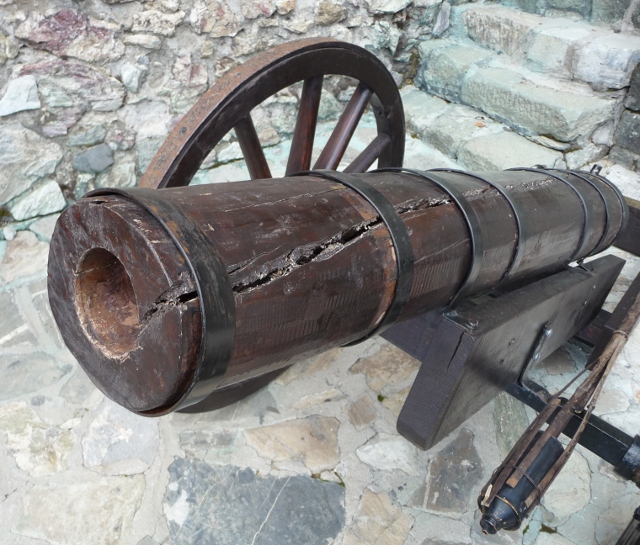
It felt a bit too freshly restored and polished for us, though, with the church the most remarkable thing about it. As well as a wonderful Iconostasis carved by the same three as the one in Skopje’s Sveti Spas, there’s a shimmering silver and gold reliquary more akin to a Victorian steamer trunk, containing what’s claimed to be bits of various saints, including a section of John the Baptist’s forearm as well as a splinter of wood from the cross. Outside the church, there’s a cannon with a difference. During the battles for independence from the Ottoman Empire, the monks of Sveti Jovan Bigorski developed a secret super-weapon which was easily and stealthily manufactured by peasants in any mountain village, due to the barrel being made of… wood.

Apparently it was effective – although short lived, as the barrel split after only a few shots. The real value of the cannon, though, was as a surprise ambush weapon and as a boost to national morale.

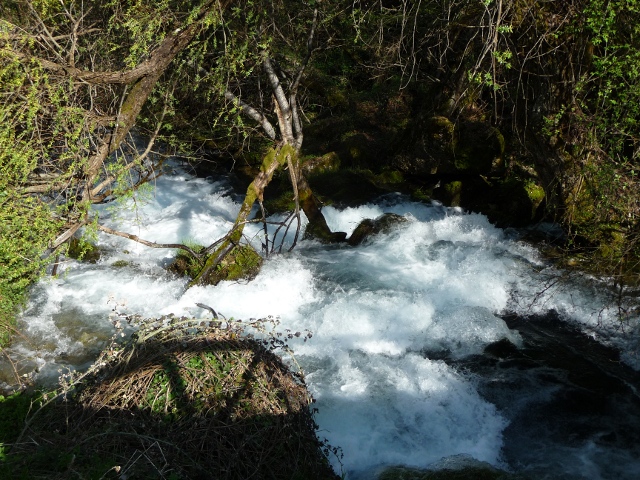
The village of Vevčani had a different solution to the question of national morale, during the time when Yugoslavia was melting into a seething mess of nationalism and ethnic fighting – they held a village referendum and after a 99% “Yes” vote declared independence, letting it be known that they’d stockpiled weapons ready for anybody who said otherwise. As a result, everybody shrugged and left them well alone. They’d already had other problems, with the government threatening to come and divert their springs, piping the water down to the town of Struga. Barricading the road to the village worked just fine for that, too. Their springs were certainly worth all the hassle – absolutely glorious, with water gushing out of rock from umpteen points, forming a raging torrent through trees and waterfalls.

We had a quick stop to make in Struga before we hit the border – we needed to get shot of our last few Denars, and we had a space on the dashboard in need of a Macedonian flag fridge magnet… When we’d come through Struga on the way in, we were unimpressed. But a second look – on a sunny Sunday late afternoon – somehow made all the difference. It’s not one of the world’s great destinations, sure – but it’s actually quite pleasant. The canal from Lake Ohrid has broad walkways either side, with everybody strolling past the various cafes and bars.

So back to Albania, and straight to our friendly fish farm campsite, but we were greeted by a total contrast to the previous week… Instead of an empty field, we had to squeeze in to the last available waterfront pitch amongst a horde of Slovenian fridge-freezers. Still, the grilled trout was excellent again, as were the views across the lake towards the mountain where we’d got stuck in the snow less than a week earlier, although now with much less of a white cap.

It was time to start to bimble towards the northern half of the country, but not before stopping at one of the many roadside tyre-fitting workshops, to have the tyre swapped off the wheel that had been damaged in Pogradec when the nuts came loose, and onto a wheel we bought at a scrappy just before Struga on our way out of Macedonia. Repeatedly in Alabania, we’ve been lightly confused by people quoting us prices which turn out to be in “Old Lek”. The Lek was devalued by a zero in the 1970s, but it doesn’t really seem to have sunk in yet. They’re all quite happy about what they REALLY mean, and won’t try to take ten times the amount you owe, though. So when the tyre guy told us 200 Lek, we wondered if we were somehow misconverting – but no, he really meant two hundred Lek. Just over a quid. To swap a tyre from one wheel to another, including fitting a new valve, and then to fit it onto the van – AND check all the tyre pressures for us, too. Bargain.

Before we hit Tirana, though, there were a couple of places south of the city that we wanted to see. Our first stop was Elbasan, with the old town centre surrounded by the original city walls. The city was definitely enjoying Mayday, with banners across the wide modern boulevards and music pumping forth from bars as everybody just milled around. The old town was quietly pleasant, with a lovely old mosque and church. We’d seen the priest wandering the other way while we were approaching the church, and sure enough the gates were firmly locked. As we peered over the gate, an old boy on a bike arrived, rattled the lock and rolled his eyes. Out came his mobile, and we distinctly heard him say “two tourists”. Nope, not good enough – the priest was, he mimed, having a siesta and was not going to stir for anything or anybody. Hiho. Out we headed, in search of the hot springs and spas we’d heard were nearby. Eventually, after a bit of confusion, we found them – and wondered why we’d bothered. The spas seemed to be very medically orientated, and – to be honest – it was difficult to imagine anybody putting up with the sulphuric stench voluntarily…

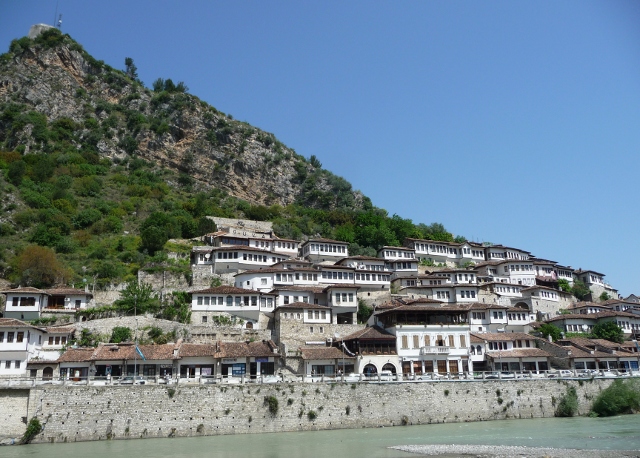
Berat next, one of the oldest cities in the country – and definitely one of the most beautiful, with old houses spreading out gently both sides of the river. On one side, a steep hill rose behind them, topped by a formidable looking castle.

We planned to meander through the old town then drive up to the castle, but somehow the wander that started by the lovely painted Bachelor’s Mosque found ourselves half way up before we knew it, so continued. At the top, sweating and panting in the hot sun, we were glad to find a little shop with frozen bottles of mineral water. The castle only contains eight of the forty-two churches which used to be here, and seven are locked all year apart from their saint’s day. The eighth, though, is not only open but contains a museum dedicated to probably the best Albanian medieval icon painter, Onufri. There’s also an art gallery at the bottom of the hill dedicated to an English painter who spent some time in these parts in the 19th century – Edward Lear. Yep, the same Edward Lear, the man who wrote the Owl and the Pussycat, as well as innumerable other nonsense poems.

Our trip started to look a little lacking in ambition when we met a couple of Germans, Katja and Tommes – who’ve been on the road since December in an old Mercedes van, returning from India overland… They’d had relatively few problems, the most major being visa woes for Iran meaning that they’d had to be escorted across the country in short order. Could they have sowed the seeds for the next leg of our trip…?

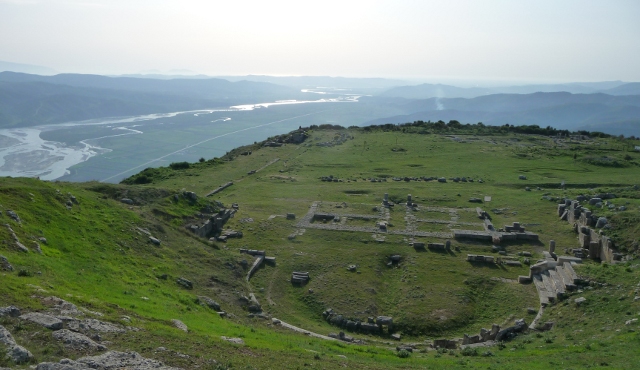
Byllis next, a ruined city dating back to the Illyrians before being used by the Romans. High in the mountains, it occupied a strategic point with commanding views across the main river route to the coast – and, as the sun set, we could see the ribbon of the river leading all the way to the glint of the sea many miles away.

We’d headed in to the site in late afternoon, thinking we’d have a quick look around then find somewhere handy to camp. However, it turned out that it was not a problem to camp in the ruins of the city itself, scant metres away from the remains of the cathedral and fortifications. Another amazing view for our night’s sleep.

The ruins themselves are interesting, with our wander around the evocative theatre and various other buildings accompanied by large colourful butterflies, but it really was the location that made Byllis truly special for us.

After a night at a campsite on the beach, base to a German couple – Gunther & Martina – who run a business operating 4×4 tours of the Albanian backwoods, it was time to head towards the capital, Tirana, via the main port of Durres – itself nothing very fascinating, except for the old amphitheatre and some dramatic Socialist Realist statues around the remains of the old city walls.

Posted in Art & Culture stuff, By Country - Albania, By Country - Macedonia, Travel stuff, Van stuff, Wildlife stuff | Leave a comment

The small museum with the big heart

From Skopje we turned west again towards the city of Tetovo. Tetovo lies at the foot of the mountains that mark the border with Kosovo, and it is also part of a majority ethnic Albanian region within Macedonia. We had particularly come to see a tiny museum in a village just north of the city. The Smallest Ethnological Museum in the World is at Džepčište, and is a collection created by Simeon Zlatev, known as Mone. Mone has collected local traditional items for more than thirty years and houses them in a couple of rooms at the family’s home.

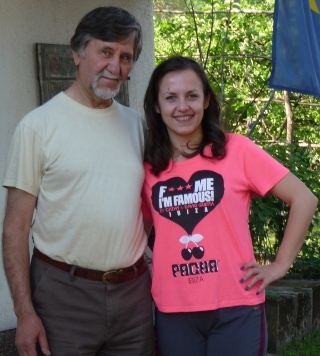
At first we didn’t know we’d arrived in Džepčište, then we spotted the single sign ‘Museum’. Following it up a side road we were still none the wiser. Locals tend to know where any foreigners are going so we were shown the right way. We parked the van and went in through the garden gate of an ordinary house. We were warmly welcomed by Mone and his daughter Ivona. Ivona speaks excellent English and apologised that her father does not speak a word of the language (we apologised for not speaking many words of his language). We were invited to sit in the garden while tea and coffee were made, and then a whole exhibition was unpacked and laid out for us on the lawn – the overflow from rooms inside.

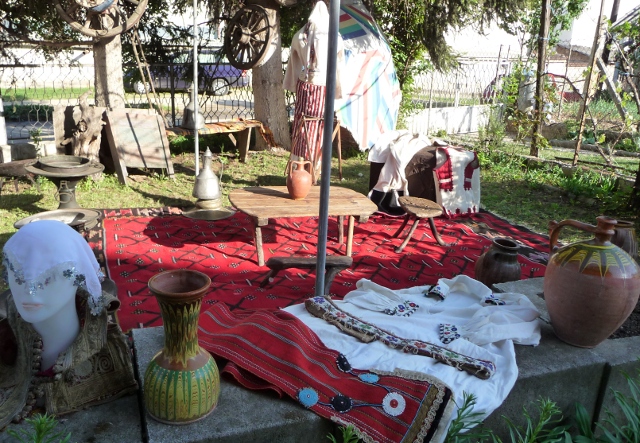
When it was ready, we were invited to peruse the objects – beautifully handmade traditional costumes, small items of furniture, including a stool made from a single piece of wood – the stumps of the branches forming the legs, as well as jewellery, tools, pots and pans.

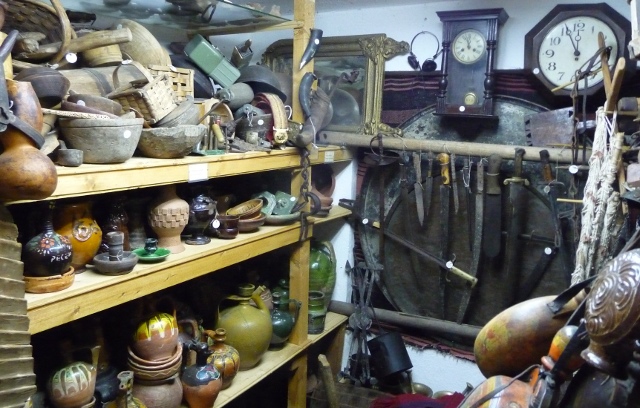
Then we stepped, one-by-one, into the two rooms inside. They were crammed with objects – memorabilia, old photos, cameras, ornaments of every sort, lots of ancient radiograms, beautiful chests, all carefully catalogued and arranged.

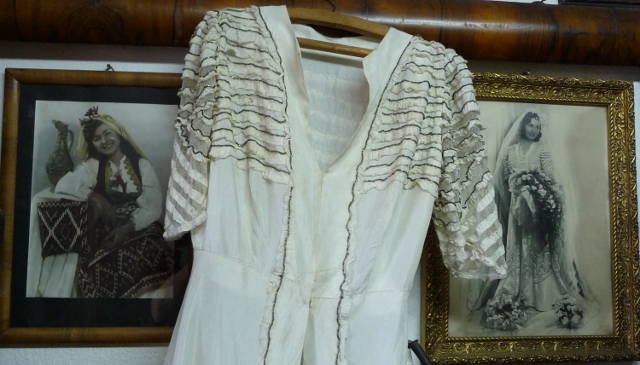
Most poignant was the photo of Mone’s mother on her wedding day, with the dress she was wearing hung up beside it.  His mother is now over 90 years old and Ivona resembles her strongly.

We must have spent at least a couple of hours talking to Ivona and Mone, learning about the collection, their lives and talking of Ivona’s offer of work in the States. It is a terrific opportunity for her, but as the only child, it’s a terrible wrench for her parents. There are few opportunities for young people in Macedonia though.

Before we left, we asked them if they knew of anywhere we could camp. Mone, through Ivona, suggested a monastery about 10km away, where he was sure they would let us park overnight. To make sure of this and to show us the way, he and Ivona jumped in their car, and lead us there. The Lešok monastery complex also has an outdoor restaurant and the tail end of a wedding party in the grounds made for a lively atmosphere. Mone went to talk to the priest in charge, returning a few minutes later to say that all was well and they were happy for us to camp there.

The church of Atanasias at the monastery was destroyed in 2001 during the inter-ethnic conflict that flared up in the area. The Zlatev family is part of the Macedonian minority, and Ivona clearly remembers waking to the sound of gunfire and bombs. The family moved to Skopje for a time, but fortunately the museum and the village survived intact.

With EU aid, the church has now been rebuilt and is seen as a symbol of reconcilation. We went to admire it and meet and thank the priest who had given permission for us to stay there. We had dinner at the restaurant and made our van at home and passed a peaceful night.

We had promised to stop into the museum the next day and wanted to say thank you. Mone’s wife, Mirjana was there and made us tea of wild herbs collected in the mountains, and insisted on providing us with supplies of the herbs so we can make our own on the road. We were touched by the family’s kindness and generosity and will remember our visit to Džepčište fondly.

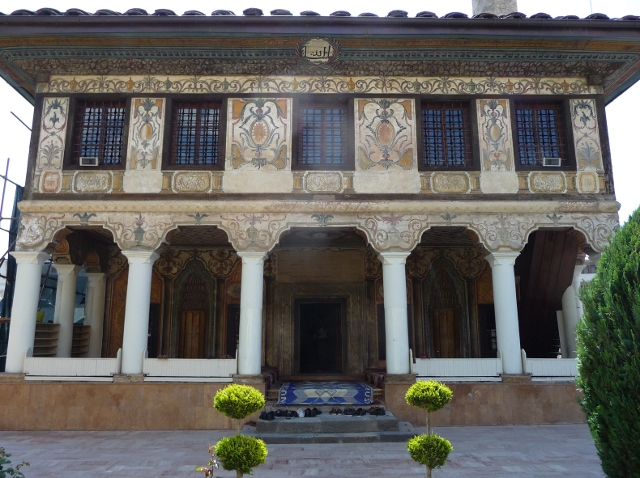
We had two sights to see in Tetovo itself, the first we found easily – a wonderful painted mosque in the centre of the town. We wandered into the garden around it to have a closer look.

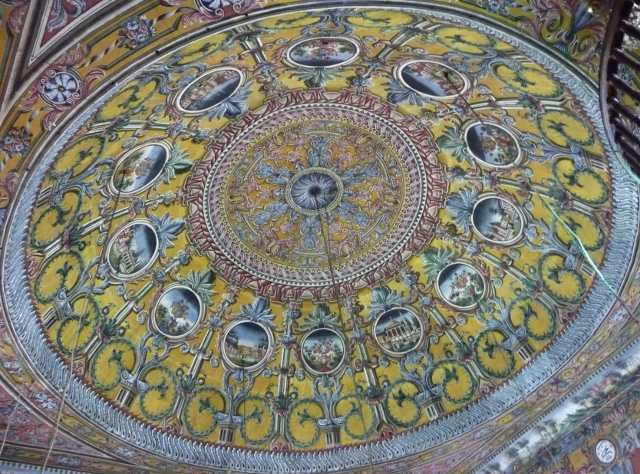
We didn’t expect to be allowed inside, but the guardian beckoned to us and removing our shoes, we entered. It was magical. The floors were richly carpeted, chandeliers hung from the ceiling and every surface was painted with flower motifs, including the domed ceiling. It is one of the most beautiful places we have seen.

Our last stop in Tetovo, when we eventually found it, was the Bektashi tekke – Baba Arabati. The Bektashi order is a form of Islam, founded in the 13th century,  related to Sufism, which emphasises the mystical. After the fall of communism, it has seen a revival among Albanians. This tekke, akin to a monastery, was founded in the 16th century and is set in a garden compound with different religious buildings mainly dating from the 18th century. However, the tekke at Tetovo has also had a troubled recent history. Its most recent conflict being with Sunni Muslim militant groups who occupied and damaged buildings in 2002. We wandered through the gates and the security guard showed us round. It was hard to imagine any sort of conflict in such a tranquil place.

Tetovo is still seen by outsiders as a trouble spot and people from other parts of Macedonia don’t tend to go there if they can help it. After, when we mentioned to Macedonians that we’d come from Tetovo, they wondered why on earth we had gone there. We told them – to visit the smallest museum run by people with the biggest hearts.

Posted in Art & Culture stuff, By Country - Macedonia, Personal stuff, Travel stuff | 5 Comments

Scoping out Skopje

Bitola wasn’t really all that great as a destination – there were some good views of the city from the mountains of the national park, and the old bazaar and market area was quite pleasant for a quick wander through, but – somehow – we just wanted to get on the road again as quickly as possible. The weather had started to seriously heat up, and as we headed straight to Skopje the ol’ sweat glands were starting to get the work-out they’d been waiting for. A quick picnic overlooking the vines of Macedonia’s main wine-growing area was our only stop. We’d toyed with the idea of visiting the monastery of Treskavec, above the town of Prilep, but we decided that we’re too wussy. Various sources we’d found describe the walk up to it as “two hours” or considerably more, and not an easy one, either. It’s allegedly possible to stay – but apart from our lack of a backpack big enough to take all we’d need up there (including food), we just didn’t much fancy trekking all that way to get a “Umm, sorry”. Yes, we know. We’re crap.

Skopje, though, is not.

Once we’d found the city’s campsite – in the grounds of a Best Western just off the main Eastern approach motorway (but far, far nicer than it sounds) – we headed in to explore. What an absolute gem of a place. The old city spreads between the sprawling market and the river, on the other side of which is the main centre of the new city. We managed to waste a day just wandering around and around the old town, with no particular aim.

Apart from the streets of old buildings – a little “buffed-up”, but as much for local retail and streetfood as for tourism – the city’s got a couple of real gems in the art galleries.

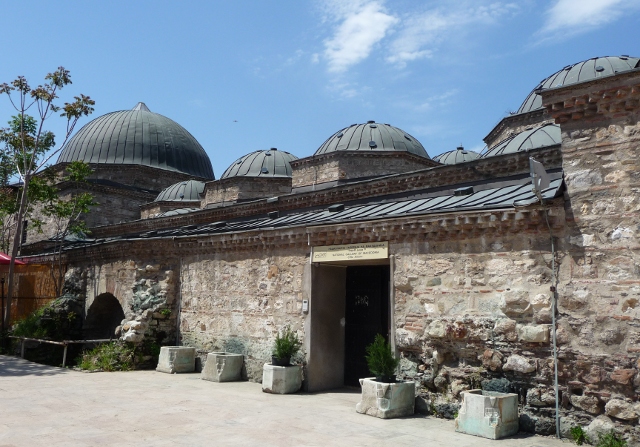
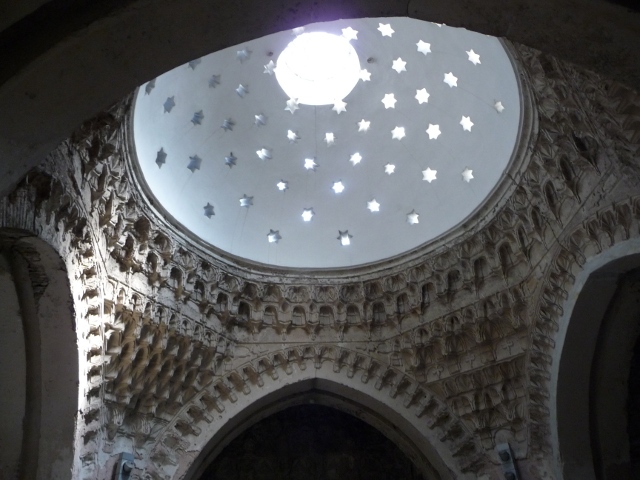
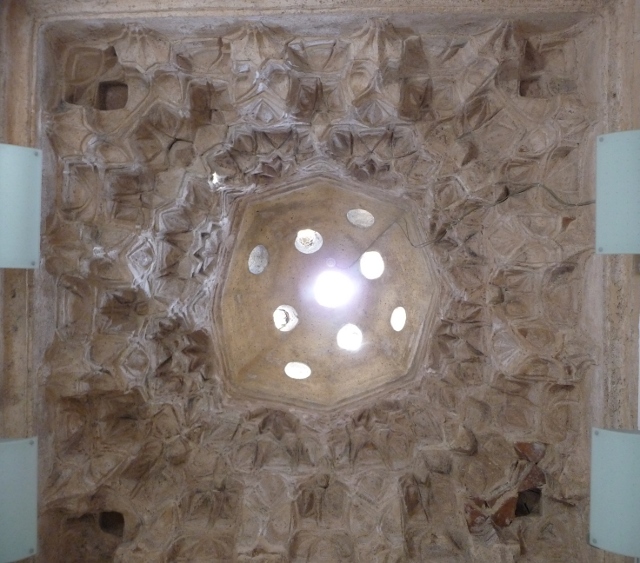
Converted from ancient Ottoman hammams, the two are much more worth visiting to gawp at the buildings than the contents. A mix of huge, echoing halls with beautiful domes and small, intimate side rooms; all with light shafting through tiny skylights and giving a beautiful diffused airiness, restored but in such a way as to allow the feel of crumbly age to come through.

The streets also wind upwards, to the walls of a castle staring out over the river sharing the top of the hill with the grandiose Mosque of Mustafa Paša. Not far from there, the small church of Sveti Spas seems to consist of just a courtyard and (lovely rickety) wooden bell tower – until the guardian unlocks a door in one corner, opening into the large semi-underground church itself. When it was built, the Ottoman authorities had made it illegal for a church to be taller than a mosque, so there was one easy solution available…

The church is completely dominated inside by the vast carved iconostasis, which took three master craftsmen seven years to carve. The pillars and columns are hollow filigree, despite being carved from a single chunk of wood, and the panels underneath the icons themselves were carved with scenes from that saint’s life. Utterly, utterly beautiful.

The small church of Sveti Demetrija, near the old (but much rebuilt and restored) Stone Bridge over the river, was a complete contrast – the frescoes so hidden by soot from the candles that only the gilding was visible. This church was definitely alive, in real use by locals – they’re probably the only ones who could actually find it, given that it’s almost completely surrounded by building work! The whole of the river front on the old town side is being very heavily facelifted, with massive and very grandiose new buildings being erected – apparently, to house various government bodies currently in rented office space around the city.

One thing’s for sure, it’ll look good when it’s done. The central focus of the new city (and, let’s be honest, the only bit we really wandered around) is a large square just over the bridge, with a huge column topped by a statue of Alexander the Great and surrounded by very melodramatic fountains separating Alexander’s troops from some hungry looking lions. Oh, yes – and Ellie was amazed to find a branch of Peacock’s – apparently a British low-rent clothing chain… <shrug>

Our taste buds also enjoyed Skopje, you’ll be unsurprised to hear – from nibbling away at delicious Byrek and Kebapci snacks, to sitting in the sun with a bottle of very pleasant white outside a wine bar, listening to John Lee Hooker blues competing with the Muezzin from the nearby Mosque, before the day finished off with a good spread at a street restaurant before getting the bus back to the campsite.

Skopje is a truly lovely city – sure, we saw it at it’s best, on probably the first properly hot Saturday of the year, so everybody was busy just wandering and basking. But it’s worthy of a definite place in our list of favourite cities. The only pity is that it’s probably not worth a city break on it’s own – we felt we’d pretty much “done it” in a day – unless you’re happy to organise yourself some transport and get out of the city, too.

We did just that on the way out (although we didn’t need to do the organising bit, clearly) – as, it appears, did three quarters of Skopje. The hillsides leading up to the lovely church of Sveti Pantelimon were choked with parked cars – not helped by a large number of TV crews. We found out the reason why they were present, as we sat having a bite of lunch in the van before heading back down again… Some VIP, presumably a fairly senior politician, was visiting the building site of what appeared to be new monastery accomodation just over the road from the church. All a bit of an anti-climax, really, but I’m sure he found it a very agreeable way to get some TV time on a sunny Sunday…

Posted in Art & Culture stuff, By Country - Macedonia, Food stuff, Personal stuff, Travel stuff | Leave a comment