Deeper into the Auvergne

I am writing this while still stranded following our breakdown in the Dordogne (see post ‘Are we making your forecourt look untidy‘) but things are looking up now after a stressful few days of no progress and being without our home and transport. There will be a full update on the whole saga in the next day or so. In the meantime, we’ve got access to our photographs again now so have put images in a couple of the earlier posts, and I’ll now update you on our journey through the Auvergne.

After leaving Hérisson, our lovely hedgehog town, we continued south towards Montluçon. Another town not mentioned in the guidebook, but which a Dutch couple we got talking to had recommended. It is a larger, rather industrial town on the river Cher, but has a medieval historic centre. We followed the printed walking tour we picked up from the tourist office and whiled away a pleasant hour or so.

A cross country bimble took us into the more dramatic scenery of the Puy du Dôme area where long extinct volcanoes have created distinctive  mountains. On a previous trip we had driven up Puy du Dôme, the tallest of these, which was in a thick cloud at the time, and the weather was so bad when we got to the top that we didn’t make it out of the Dyane, so a bit pointless really. The road up is closed in August, and we didn’t feel like making the ascent on foot this time so we admired it from afar.

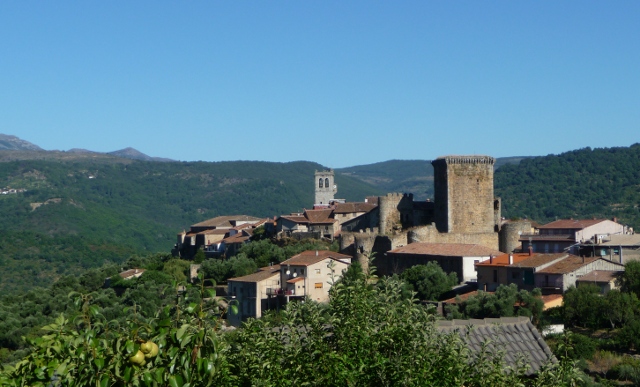
We enjoyed the mountains and gorges as we drove south through this volcanic area, punctuated by small towns in dramatic settings, often with ruined castles perched above them and churches and houses of dark volcanic stone. Most notably St Nectaire (famed for its cheese), and Besse – delightfully picturesque but not too spoiled by tourism.

Le Puy-en-Velay

We pushed to make it to Le Puy-en-Velay for Saturday morning’s market, and it was worth it. A huge bustling food market thronged much of the older town with the best in fruit, vegetables and other produce that the area has to offer. It’s mushroom season at present and the damp summer means more wild mushrooms than ever and has seen prices for the prized ceps and girolles drop.
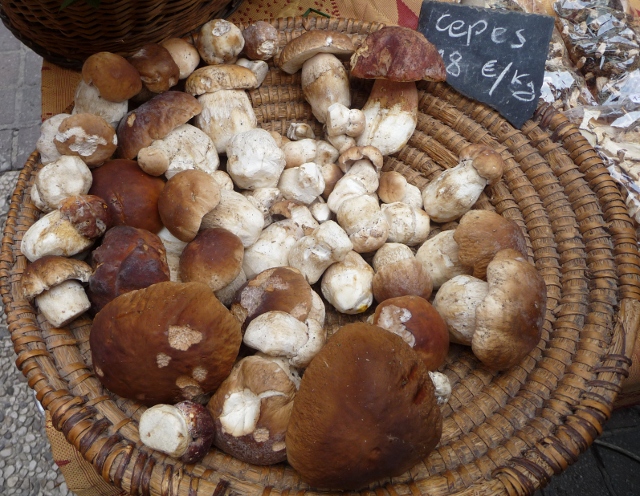
Le Puy is also famed for its lentils and we bought these as well as lots of other tempting goodies, helping ourselves to all the tastings on offer as we wandered. These included variations of some of the Auvergne’s great cheeses, tangy St Nectaire, Cantal – texture similar to cheddar and very tasty, Salers, and perhaps more widely known in the UK, Blue d’Auvergne.

Then it was time to see the rest of this intriguing city, which is one of the main starting points for pilgrims on the Chemin du Saint Jacques de Compostelle, El Camino de Santiago de Compostela (in Spanish), the path of which we’ve crossed many times now during and since our trip through northern Spain.
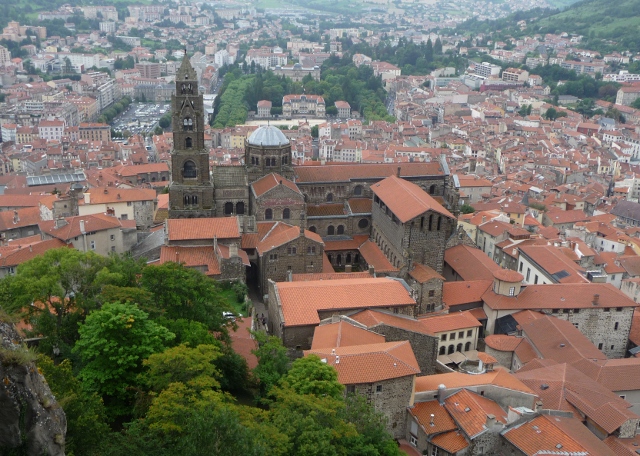
Le Puy’s cathedral, famed for its black madonna, is perched high above the city and you climb a steep street and sixty steps up into it. Literally. The steps take you into the middle of the cathedral from below, not the traditional front entrance. It does make an auspicious beginning for pilgrims beginning their long journey to Santiago. The cloisters also beckoned us as the heavens opened. The shower didn’t last long and we then climbed still further to the top of the volcanic rocky outcrop way above the cathedral to see the giant bronze statue of the Virgin Mary made from more than 200 melted down cannons taken at the siege of Sebastopol. You can also climb up inside the statue, and it was really odd to see people sticking their heads out of the windows in the statue’s robes. The view was magnificent – there are also several other rocky columns with statues or chapels on them in and around the city. Unfortunately, the dull weather meant our photos of the city don’t do it justice.

Returning to the lower city again, there was scarcely a sign of the market, and restaurants were busy putting out chairs and tables as fast as the square was being swept and pressure washed. A crêpe of chèvre, lardons and mushrooms washed down with cider was the perfect lunch after our climb.

Mont Mouchet

Le Puy was the furthest south and east we intended to go on this part of our jaunt into the Auvergne, and we headed back westward towards the Margaride – another mountainous area of the Massif Central. The deep dark greens and blues of the scenery and the unsettled weather made it a good day to see the Mont Mouchet area – there was distinct air of foreboding around the place.
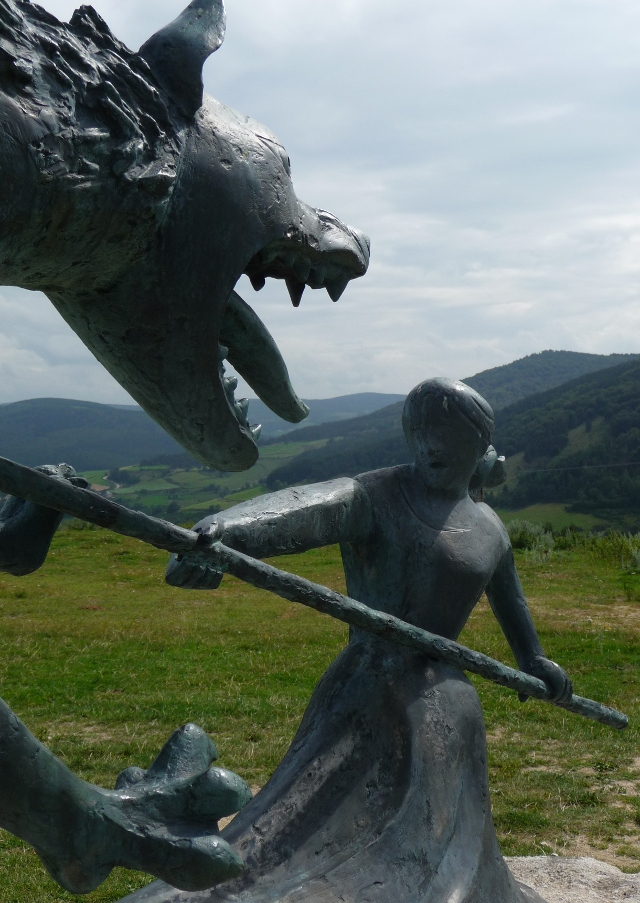
Firstly, in the 18th century this district was terrorised by the Beast of Gévaudan – a huge wolf thought to be responsible for the deaths of many men, women and children. But was it really a wolf? Was the man who caught it really a psychopath who was himself responsible for the deaths?

Secondly, we found out about the Battle of Mont Mouchet and parallels are drawn between the story of the Beast and that of the Battle. This whole area saw much Resistance activity during the Second World War and our eyes have been opened to the significant part played by the heroism of the Resistance and the ordeal of local people during that time. The war still casts long shadows here.
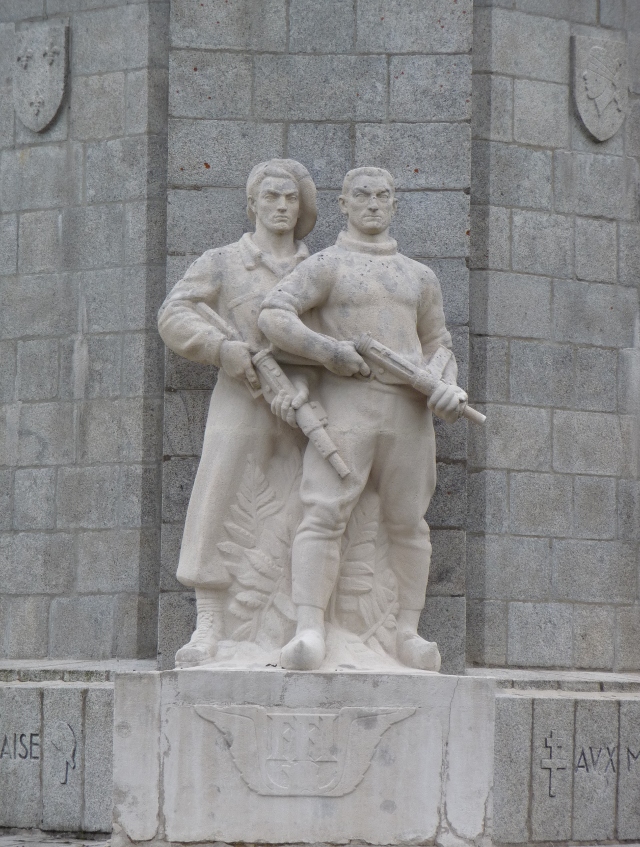
In June 1944, armed Resistance fighters – the Maquis fought for several days on forested Mont Mouchet to prevent or at least delay German forces from the south heading north to join those fighting back against the Allies following the Normandy landings. There were significant losses on both sides, but eventually the Germans captured and executed or deported many of the Maquis to concentration camps where lots of them perished.  We visited the poignant memorial and museum of these events.

Following the battle, the Nazis carried out reprisals on surrounding villages, including tiny Clavières, where we camped on a farm that night – cooking our market purchases: merguez sausages, Puy lentils, girolle mushrooms and haricots noirs, which disappointingly turned green when cooked, in our van. Another thunderstorm raged outside around us as if serving to remind us of the heroic and tragic events that happened here.

Posted in By Country - France, Food stuff, Travel stuff | 2 Comments

The elegance of the hedgehog

Spoilt for choice for places to visit in France, we didn’t quite know which direction to head in on leaving Salbris. The day we finally left the weather was as uninspiring as it was on the day we first headed there, and this time without all the 2cvs for company.

Although ultimately heading for the South West, we headed for the Massif Central area, and the Auvergne in particular (more South East-ish of Salbris) and got to the edges of this region quite quickly.  We meandered through pleasant countryside trying to ignore the fact that the van was making a knocking sound again, very similar to the one we had just paid good money and waited two days in Salbris to get fixed …

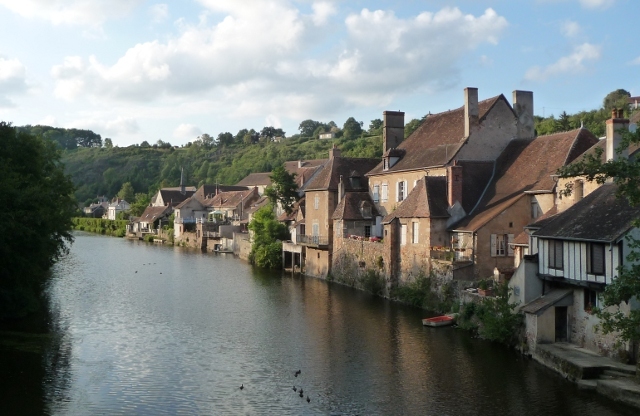
We took a detour off the main D2144 route south towards Montluçon on a smaller road down the Aumance valley. Suddenly there was a small town with ruined castle towers in front of us … it was a wow moment … there were pretty cottages along the river and a medieval archway – oh, and a campsite across the river with empty pitches by the water. We did a u-turn and headed there straightaway. After Adrian made a hasty repair to the bike rack which somehow had a close encounter with the hedge on entering our pitch, we were set to explore the town.

We fell in love with this town called Hérisson. It was after walking a couple of streets and noticing lots of houses with decorative number plaques with hedgehogs on them and a couple of business were actually called hedgehog in English or had hedgehog ornaments in their window displays, that I remembered that Hérisson is French for hedgehog.

We explored the castle and climbed up to a restored chapel and wandered down most of the streets admiring the ancient houses and could almost see ourselves living somewhere just like this found quite by chance, and not in any guidebook.

The only thing that stopped us from lingering in the town called hedgehog was the promise of more elegant towns deeper into the Auvergne.

By the way The elegance of the hedgehog or L’élégance du hérisson is a wonderful book  by French writer Muriel Barbery.

Posted in By Country - France, Personal stuff, Travel stuff | 1 Comment

19th World Meeting of 2cv Friends, Salbris, France

As we were driving east and northwards across Spain and up through France, I was imagining all the thousands of 2cvers busily packing their cars in preparation to head to Salbris from every corner of Europe or even flying in from around the world. All the 2cvs merrily bouncing along! As we drove towards Salbris on the day before the meeting opened, however, our mood was as low as the cloud and sideways rain we were driving through. The thought of a week in a muddy rain-drenched field is never heartening. our spirits only began to lift in anticipation as the sun broke through and we started seeing more and more cars. Salbris was already buzzing with hooting and waving – and cafes were overflowing with onlookers. As we saw more and more 2cvs around, we felt sad not to be in one.

We headed north to the outskirts of Orleans to meet up with a large contingent of friends gathering at a cheap formulaic hotel and the anticipation and excitement was palpable.

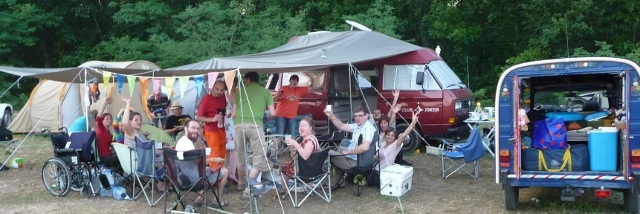
After a great catch up with everyone, it was early to bed because if there’s one thing we know about getting to a world meeting, it’s best to get in the queue as early as possible, especially when a minimum of 5000 cars are preregistered. Thanks to Sam for cajoling eight cars to get up at 6am, we were in the queue just outside Salbris with just 1000 cars ahead of us, by 7.30am. Later in the day the queue was to stretch to up to 10 km long. The gates opened at 10am and we were on the site by late lunchtime. Friends arriving later were full of horror stories about the many hours they waited, the misinformation, the disorganisation. In the end and in spite of a few international incidents over marking out of territory, we managed to find space for most of our friends to camp together and were later able to joke about French use of hazard tape. As the light failed, it was harder for newcomers to spot camping opportunities and many ended up camped on grass verges in the town for the duration. Although the meeting got off to a shaky start – we were all there, altogether and about to have loads of fun.

By the end of the meeting there was upward of 7000 cars on the site – the biggest ever meeting of the friends of the 2cv and its derivatives. The discordant start to the meeting, the seeming lack of planning for the expected numbers attending and a major spate of thefts from tents, a bar that didn’t serve wine (in France!) but offered a disgusting rosé/grapefruit juice mix which soon got dubbed pample-f’ing-mousse, a laser light show with fireworks and fountains delayed by lack of translations of the safety announcements (where was the hazard tape when it was really needed?) couldn’t stop the general air of joviality ensuing. The disorganisation manifested itself best for us when we saw two disorganisers cycle towards each other, collide and fall off their bikes …

But all that aside, the warm spirit of the lovely friends we were camped with in Tarp City – our shanty town encampment – and the joy of meeting up with pals from years gone by really made the meeting for us.

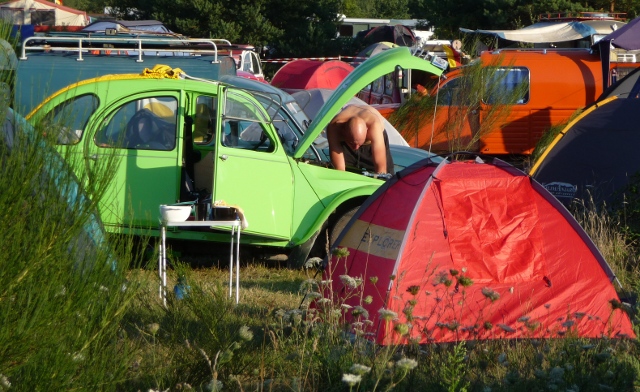
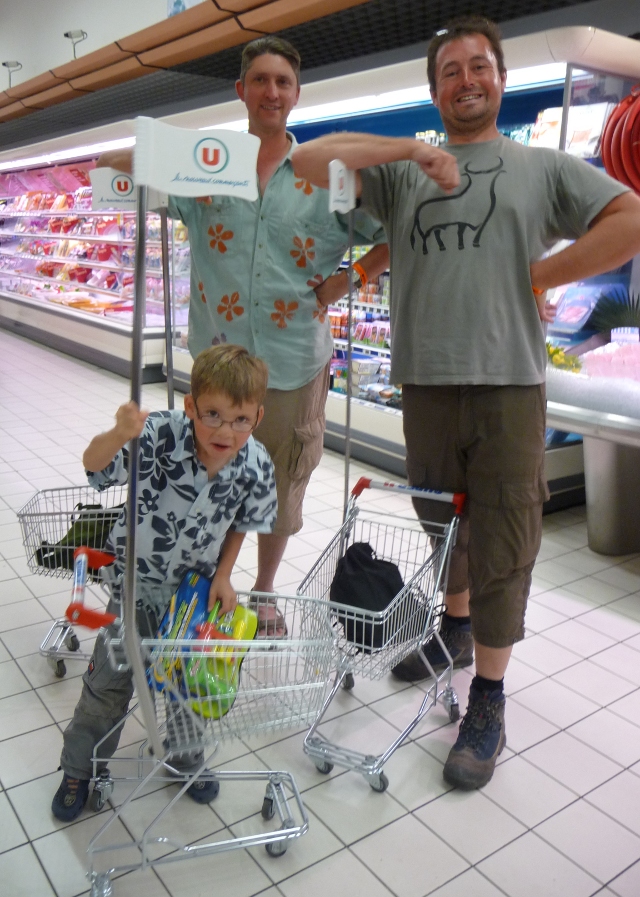
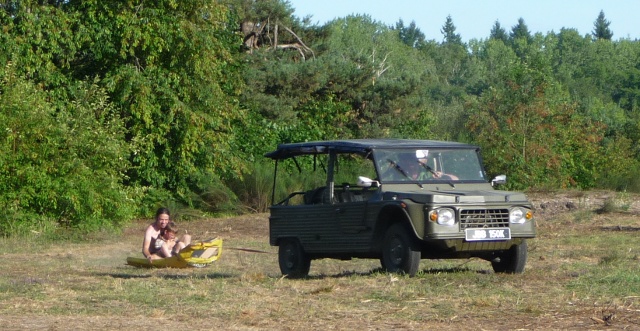
A full week of partying, relaxing and chatting, the odd beer or two, Wiltz’s campmade chips, making communal curries, braving the hover and hope loos, and fetid muddy showers that got you only slightly cleaner than when you went in, a camp Hawaiian party, dancing to lots of Europop LaLa songs, introducing foreigners to table wrestling, being introduced by new Greek friends to raki, a crowded bustling fleamarket. Super-U supermarket and all the other shops who made us so welcome with 2cv related displays and put up with grown men racing kiddy trollies in the aisles, and the resurgence of the ancient sport of bonnet sledging.

Immense amounts of classic cars, from the charming rusty and mossy sheds driven straight out of a field to pristine shiny beaming models, via all the hybrid customised often tasteless vehicles. All ages and backgrounds rubbing along together – in Tarp City (known also as Tarptopia) our harmonious group stretched from five to fifty-two years. And the sun shone on us all… for six whole days!


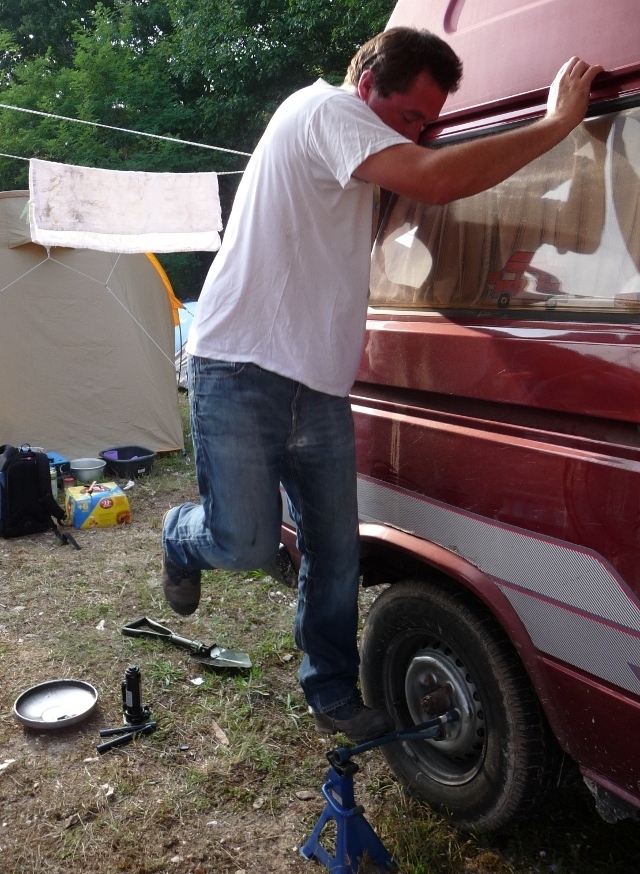
After the World … After a week of constant socialisng it was so sad to say goodbye knowing it’s going to be some while until we see everyone again. Now here we are, sitting in the town campsite in Salbris in our van with dramatic weather outside – our first full on thunderstorm. Lightening lasting several seconds, heavy heavy rain and our tarp needs to be taken down in case the wind gets up, and our silvers (padded heat reflective window covers) have yet to go on. We have stayed on for a couple of nights in the town to get the CV joint on the van sorted. We were able to order the part locally and have spent all day relaxing, doing almost nothing and just waiting for it to be fixed by a local garage. The challenge of fixing it in Tarp City was too great and cocktails called at the time.

The town is empty, we can see the site from the campsite and it’s almost all gone now. Local businesses are rubbing their hands as they count up their profits, probably planning early retirment. The townspeople must be relieved to be able to drive around without a 2cv traffic jam. There are a few 2cvs still in town, mainly those of the organisers. We still have our wrist bands on so get some waves and cheers from them and the various lala songs are still earwigging us.

Tomorrow we head onwards … no firm plan even now. Let’s see where the road goes. Ici continue l’aventure …

Posted in By Country - France, Personal stuff, Travel stuff, Van stuff | 1 Comment

Are we making your forecourt look untidy?

We’re jumping a bit out of sequence in posting this now – the blog itself’s still about two weeks back – but we thought you might like to know about this.

The van is currently hors-de-combat.

We’ve already mentioned the CV joint knocking  on the way through Spain and France. A new one was ordered, arrived, and was fitted after the world meeting. The clonking stopped. Briefly. It sounded like a different joint, then got worse and we were in no doubt it was the newly replaced joint that was duff. Still, the original clonked for 1,500km or more, so we can consider our options at slight leisure.

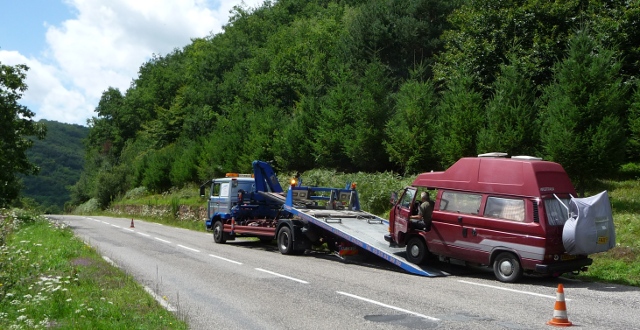
Yesterday, as we left Argentat along the Dordogne river, the clonking turned into a loud bang – and forward motion stopped. We called ADAC’s recovery line (cheaper than UK-only AA/RAC, but covering whole of Europe), and started in on lunch. Not long after, a chap in a Berlingo stopped, to tell us he was going to tow us… <insert comedy mental image here> and was just off to collect the truck.

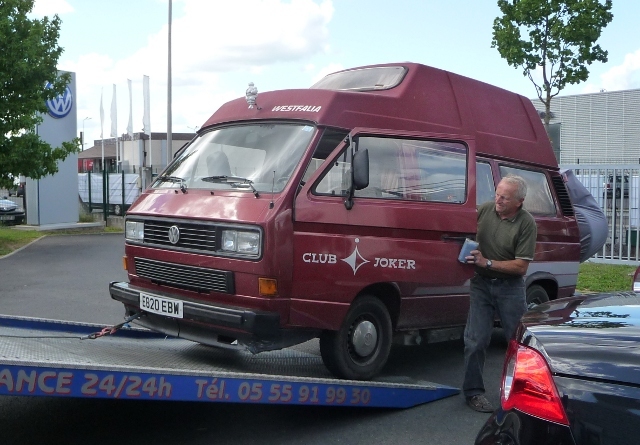
So – by half past four, we were in the yard of the VW dealer in Brive-la-Gaillarde, Axess Automobiles. Clothing etc was rummaged together, a taxi was called, and we headed for the tourist office to find a hotel – ADAC pay for three nights accomodation whilst your vehicle’s fixed.

And, to the best of our knowledge, nothing has happened since. We’re about to start night two, and – apart from a quick phone call at lunchtime to say that it “hadn’t been diagnosed yet” (The driveshaft rotates when you let the clutch out, the wheel doesn’t. Diagnosis should be quick enough, even for a main dealer.) – we’ve not heard a sausage.

Watch This Space.

Plan B (and, yes, it may very well involve tactical deployment of an international incident) is being hatched.

Still, on the bright side, the hotel’s very pleasant, has decent internet access (for the first time in a while…) and we’ve used them as an address to order a replacement camera battery charger and memory card reader from Amazon.fr, so we should have pictures on the last couple of posts – and be caught up with new posts – by morning.

So – what’s Brive like? The guidebook wasn’t exactly inspiring about it, so our expectations weren’t much higher than our spirits as we cruised straight past some fantastic sights and villages on the back of the truck. The anonymous industrial estate the dealer’s on didn’t help much, either. But last night and today, we’ve not done much but wander around. It’s not a destination, let’s be honest – especially given the location in the heart of the Correze, just off the Dordogne river, surrounded by utter loveliness. But it’s a very pleasant town. We’ve spent the afternoon at a museum looking at the local WW2 resistance – and learnt a lot about bits of the war that were totally new to us, such as the campaigns to get French workers to migrate to Germany to fill in their labour shortage – and then tripped across a scintillating art exhibition in a small church. Last night being Monday, open restaurants were in short supply – and whilst the one we ended up eating in didn’t leave us disappointed in the food, it was the floor-show as Madame got ever more irate with the young waitresses which we’ll remember longer.

But none of that affects the overall tone of our stay. We’re here – let’s be honest – against our will, without transport, and without any of the things we’ve grown used to. Helpless. On Sunday night, we cooked some pasta sauce, enough for Monday’s meal. That’s sat in the (switched off) fridge, and will have to be chucked. Pity, it was delicious. Meanwhile, we couldn’t buy any of the wonderful produce from the market in town this morning. We feel like we’re missing something major. And it’s all a bit depressing.

Posted in By Country - France, Personal stuff, Van stuff | 11 Comments

En-Route to Salbris

Fortunately, the CV joint held up – and we reached the foothills of the Pyrenees intact. The views from the pass had been as good as expected, not least because of the dramatic change in vegetation as soon as we passed the abandoned border post.

Where the Spanish side had been a consistently parched beige, with only odd bits of scrub, the French side was lush and verdant. A picnic lunch by a small lake, surrounded by grass and trees was accomplished just before the reason for the scenery started to make itself clear. France’s July has apparently seen atrocious weather.

We stopped for the night at a farm campsite just north of Condom. After figuring our route by what sites were available through Spain and Portugal, it made a very pleasant change to return to figuring the route, then just tripping across accomodation en-route. The farmer was bemoaning the lack of business coming his way – it seems that the weather was proving utterly discouraging, and he was starting to hurt financially from it. We really must look out for more farm sites, and give them our business. Especially if they all offer wine degustations like this one…

None of this mucking about with a small sloosh into the bottom of a glass – full measure after full measure, including the local fortified aperitif, Floc de Gascogne. We slept well…

A local boulangerie did us very proud indeed for breakfast and lunch, despite it being Sunday morning, and we headed North again – van still clacking loudly, but still going.

At the small town of Châtelus-Malvaleix, south of La Châtre, we found a tiny municipal campsite next to a lake – but no sign of life at the reception. Oh, wait. The reception’s only open from 14.30 to 15.00 daily… So, come the morning, in to town to find the Mairie and pay there. We’d clearly been spotted, as we were greeted with “Ah, you’re the people in the red VW…?”
The town itself was lovely, in a faded and slightly crumbling way. Unfortunately, it also seemed to be dying on its feet – many houses were seemingly empty, and for sale signs were everywhere – similarly faded and crumbly. The estate agent’s in town was also apparently moribund, with the particulars in the window faded to almost illegibility.

Our final stop en-route was Bourges, just 40km south of Salbris, and a quick stock up at some of the out-of-town stores, before heading towards the meeting – the number of 2cvs in the area was still surprisingly low, but a lunchbreak in a layby saw a brief chat with a couple of French 2cvers interrupted by the arrival of a blue high-top T25, who’d seen us and done a U-turn for a natter…

Posted in By Country - France, Travel stuff, Van stuff | Leave a comment

Out of Iberia (part 2)

After Marvaõ, we were really intending to have a bit of a tonk across Spain – still with a feeling of slight disappointment after our time in Galicia. The plan was to stop in at Salamanca and Segovia, but otherwise just kill some miles and hope the scenery was decent.

The municipal campsite at Caceres was an absolute jaw-dropper. Not so much the view (none to speak of), but for the fact that on check-in we were given the key to our en-suite bathroom…

In the corner of our pitch was a small brick hut, containing our very own shower, loo & sink. Spacious and clean, we both wanted to just stay there until we got bored of the novelty. In the morning, reluctantly tearing ourselves away from Our Own Loo, we headed to have a quick glance at the old town before hitting the road.

Several hours later, we were firmly in love with Spain again. Crammed with the most fantastic old palaces, churches and houses, it drips with atmosphere. But – much as we wanted to – we had to go. Pointing the van away from that town (and en-suite loo) was one of the hardest things to do on the trip so far. But a lot of distance lay ahead.

The route to Salamanca took us via Ciudad Rodrigo. After some brain-wracking as to why the name rang a strong bell, a look at the guidebook prodded us. The story of the Napoleonic sieges of the city walls, first by the French (who were so impressed with the bravery of the Spanish defenders that they let them walk away from the city), then the re-taking by the British, had been recounted by Peter Snow (yep, the one with the election swingometer) at Chorleywood LitFest last year. The “Great Breach” blasted in the walls to allow Wellington’s troops to capture the place is still there, the only hole in the otherwise complete ring. The Cathedral’s frontage also still bears the scars of that day, with cannonball dents and missing bits of decorative frilliness.

East of Rodrigo lay the mountains of the Sierra Peña de Francia. They’re crowned by Peña de Francia itself, topped with a monastery and look-out, at an altitude of about 1,800m.

Apart from the few other members of the Sierra, there’s just flat plain stretching in every direction. Which means… Oh, dear. Yet another twisting, narrow road with hairpins and steep drops. We do so hate them… Or something. I know we’ve said a lot of views were incredible, but this really did take the biscuit. A full 360deg panorama, with no other peak within several hundred metres altitude. I don’t know how far you could actually see, but it just stretched and stretched –  with tiny mountain ranges, cut out of fading shades of grey, stuck to the horizon.

One of the best known parts of the Sierra is a village called La Alberca – declared a national monument in its entirety. It was pretty enough, but a bit too solidly touristy for our liking, reminding us of one of the better-known Cotswold villages – Bourton-on-the-Water, for example. There’s a few village campsites in the area, and we stopped off at the one at Miranda del Castañar. Now that was more like it… Every bit as attractive as La Alberca (if not more so), but devoid of coach-trip-tourons. Just local residents, going about their daily lives in a town which looked unchanged for centuries.

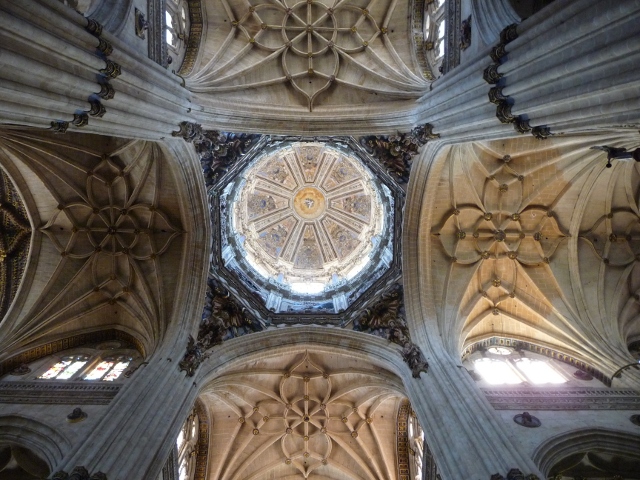
Finally, we arrived at Salamanca. An amazing city but, to be honest, a bit too “big city” for us. Don’t get us wrong – plenty of great sights (the Plaza Major in particular, but the New (15th century!) Cathedral, the Convento de San Esteban and the Casa Lys art nouveau museum, with a fascinating exhibition of the preparatory drawings of Hermen Anglado-Camarasa, also stood out) and atmosphere, but there was just that indefinable hum about the place.

Still, we rounded off a very pleasant day’s wandering with an utterly superb meal, sat outside a small restaurant watching the sun set over church spires and stork’s nests.

The worst bit about the meal was having to chose which dishes we couldn’t include in the three courses of tapas. All were slightly unusual – an inventive modern twist to old recipes – and absolutely delicious. The biggest surprise came when we got the bill. Surprisingly reasonable, and a chunk less than we could easily have paid for a much less interesting meal. Somehow, we even managed to catch the last bus out to our campsite – by seconds…

Avila next, home of St Theresa, one of Spain’s two favourites (St James – Santiago – being the other). Predictably, the pilgrim industry is well represented there, although low key. The reliquary was a must-see, containing her right ring finger, as well as the sole of a sandal and various other prosaic souvenirs. The finger itself was proudly displayed in a glass case – not just the bone we were expecting, but complete with dessicated flesh. Definitely a ring finger, since it was still wearing a ring, she must’ve been a big lass – it was much, much longer than you’d expect. The orange sea-anemone growing out of the tip was a little unexpected, too. Walking out from that, to promptly be faced with a row of thimbles in the gift shop, got me a sharp dig in the ribs from Ellie in response to a poor attempt to muffle spontaneous giggles.

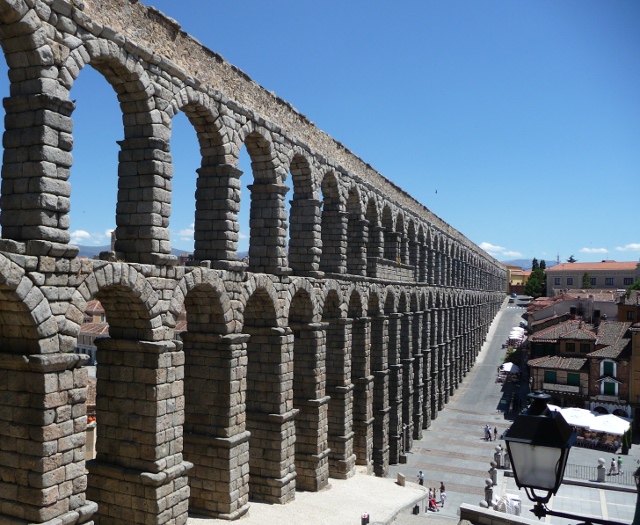
The final “name-brand” destination on this leg was Segovia, renowned for the Roman Aqueduct spanning the lower town. Effectively a dry-stone wall, held together solely with gravity and architectural genius rather than mortar, it was every bit as impressive as expected.

The old town itself contained plenty of other diversions, too – from the Alcazar, a 19th century exaggeration of a castle, immediately familiar through being the basis for the further hyperbole of the original Disneyland castle; to the last major Gothic cathedral built in Europe, with more than enough arches and buttresses to be recycled into several more cathedrals.

And so onwards again. The Cañón de Rio Lobos provided a spectacular backdrop to our night’s campsite, before Soria’s town hall and cathedral marked the end of scenery for a bit as we embarked upon a long, dry, dusty, flat, featureless plain; with only an unpleasant and steadily worsening clunking noise from the back of the van to give light relief.

As the noise became more distinct and predictable, we diagnosed it as a failing constant velocity joint on a driveshaft. It could be kept quiet, so long as no steep ascents or descents were attempted, and acceleration and deceleration were kept light. Not good, given that we were heading rapidly towards the Pyrenees… As the pass of the Puente de Oroel loomed in front of us, we started to fervently hope that it’d continue to hold until we got to Jaca then into France. If it died once over the border, at least recovery wouldn’t involve international complexities, and we could be a bit surer of reaching the 2cv meeting.

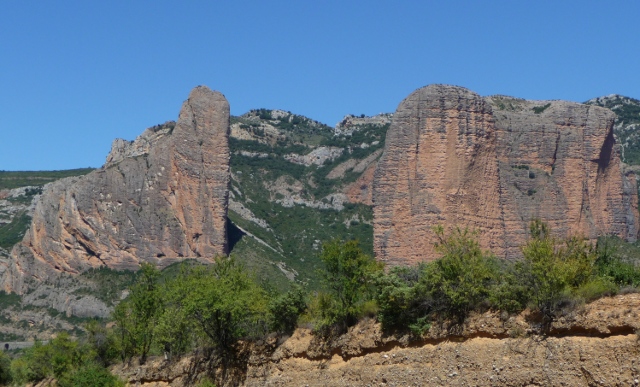
The Puente de Oroel gave us plenty of opportunity to question the wisdom of that decision, with steep narrow climbs and descents to provoke the joint into deafening us. The views were worth every gnawed fingernail, though – vertical fingers of stone in front of a backdrop of sheer rockface.

On reaching Jaca, we were surprised to find the campsite displaying a “Completo” notice – the first that had been even close on the entire trip. We quickly found another, though, much emptier, and with better views – it almost made up for the total lack of water for an hour and a half in the morning. No showers, no loos…

By the time that’d been rectified, and the queue died down a bit, we headed for the Somport pass into France. There’s a major road tunnel under the mountains, and with a van making death noises at every opportunity, that would seem a far wiser option than climbing across the mountains. But that’s not our style, is it?

Posted in By Country - Spain, Travel stuff, Van stuff | Leave a comment

Out of Iberia (part 1)

This one’s a long post-of-two-halves, to play catch-up and to help reflect the pace of this leg of the trip, covering more than a week’s travelling across two countries and a huge swathe of Iberia.

Leaving Lisbon and starting to cross the Alentejo plains towards Evora was a total contrast to the rest of Portugal. Not only in the short term, since crossing the Vasco da Gama bridge had almost immediately replaced the low, damp cloud with bright blue skies and a scorching sun, but overall – we’d not seen such flat landscapes, with the earth’s curvature almost visible across sparse parched fields dotted with cork trees. Speaking of which… Think of a stereotypical gnarled tree, with dark steely-grey bark. Now peel the trunk of bark, leaving the trunk and lower branches bright orange. That’s a cork tree. Over time, the bark grows back, ready to be peeled again. Now load an articulated wagon high with the peeled bark. One thing’s for sure – we’ll be trying to buy wine using proper cork-corks in the future, not these plastic or screwcap abominations. There’s not just a traditional industry at risk, but an entire landscape.

When we got to Evora, we were initially a little disappointed – we’d got it mentally flagged as a “Roman city”. It’s not, not really. There’s a fairly well preserved Roman temple in the middle, right next to the Cathedral, (and baths, in a basement under the town hall…) but that’s about your lot – the rest is the usual medieval mix. Having said that, though, there was something about Evora that was very pleasant. It’s not that there’s a lot to see or do – we felt we’d “done it” after a long sleepy Sunday afternoon – but there’s just a really nice atmosphere. There’s a couple of sights that do stick in the mind, though – the cathedral allows access to wander freely around on the roof, giving a great panoramic view over the whole city and surrounding countryside.
We’d cycled into town from the campsite, so the aerial view of the aqueduct (no, not Roman – medieval again) inspired us to follow it on two wheels. As it leaves the old city, the arches provide frontages for houses and vehicular access to car parks; before the ground drops away, leaving it to spear across a dip towards the ruins of a fort. However, the prize for wierdness goes to the chapel on the side of the church of San Francisco. The walls of the Capela dos Ossos are decorated entirely in human bones. Even the ceiling arches are trimmed with skulls instead of carved stone. Apparently, it was done to help the Franciscan friars reflect upon human mortality.

Evora was our last planned stop in Portugal, so the route from here on in was a question of expediency to get us across Spain to the French border. We’d planned to swing south of Madrid, seeing Toledo and Cuenca, but decided north of Madrid made more sense. Poring over the atlas and guide-book saw us head through a swathe of small towns towards the border. Arraloios – best known for hand-crafted carpets, the town’s consistent white-and-blue colour scheme gave it the feel of somewhere you could easily spend a few days doing nothing. Estremoz – one of the “marble towns”, with local marble ubiquitous for prosaic duties – windowsills, doorframes, even pavements. Portalegre – larger, but handy for stocking up on Vinho Verde before the border. All – and more – with walled hilltop citadels intact, surrounding sleepy old towns with nothing moving save for the occasional elderly man or dog.

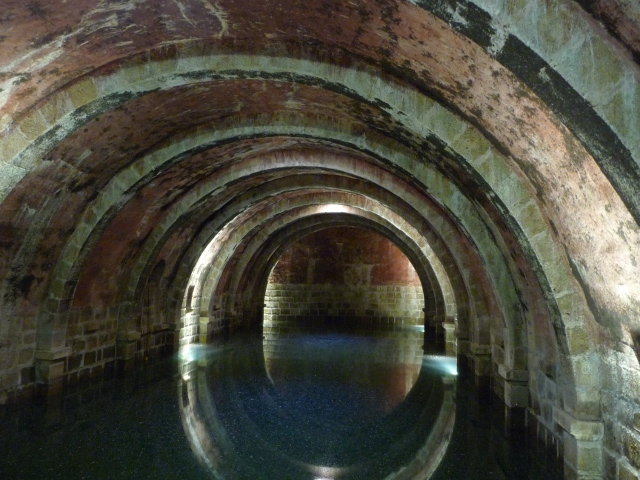
Then we came to Marvaõ. A small (~1,000 inhabitants) hilltop fortified village on the Portuguese-Spanish border, the entire place is within the walls. Just arriving is spectacular, with the walls appearing to grow out of the hill itself, visible for miles. After a very pleasant long meander around, we reached the castle itself – and that’s when Marvaõ changed gear to become a real gem. The castle’s extensive and intact, complete with the huge water cistern (Siege, for the withstanding of) – which still contains water.

I don’t think it’s actually used for drinking water storage (at least, I hope not, since there were slightly more flying-biting things in there than the Ferrol campsite) but the echo as you stood on the platform at one end was truly incredible. The views, though, from the castle walls… Standing, staring across foothills and plains – you could see exactly why this particular hill was used for border defences. Portugal must have been saving that up as a grand finale to say goodbye to us…

And so we crossed the border into Spain again, with heavy hearts to leave our first “completed” country behind. There’s more we want to see and do there, so we’ll definitely be back. I think that might become a regular recurrence on the trip.

Posted in By Country - Portugal, Personal stuff, Travel stuff | 2 Comments

Palaces. Lots of Palaces.

The outskirts of Lisbon sprawl gently right up to Sintra, and it’s impossible to tell (apart from looking at the signs on the retail parks) where one ends and the other starts. But when we did hit Sintra’s historic centre, there was no mistaking it. Horse-drawn carriages mixing it with large coaches, and the police wheel-clamping anybody who overstayed at the pay-and-display on-street parking, whilst street vendors of jewellery and art lined the footpath taking you towards the restaurants and craft shops.

The town itself may not have warmed the cockles of our hearts, but the Palácio Nacional did. It’s one of those buildings which you just can’t put a date on – there’s almost certainly been a palace of some kind on the site since Moorish times, and the current building has been constantly rebuilt and extended from the 15th century through to the 19th, as various monarches decided to tickle it to their tastes. What sits there today is a glorious mix, on the kind of scale where you could actually visualise it in use as a home, and slightly scruffy at the edges – intriguing enough that at the end of the circular tour, we ducked around the ropes and did it all again.

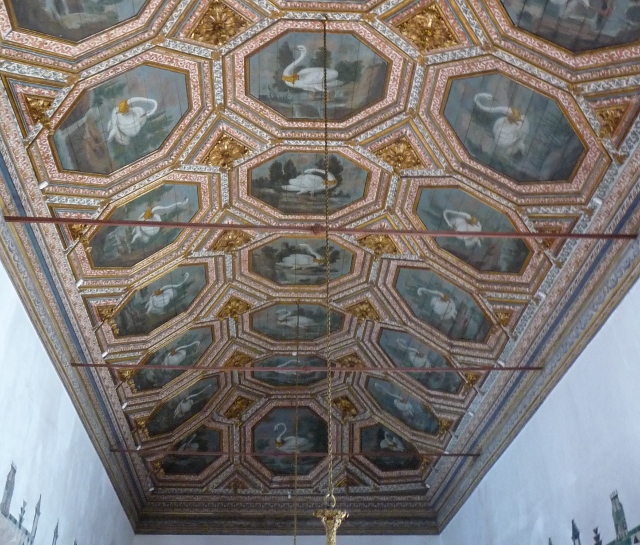
Most of the rooms were named so esoterically that you really couldn’t possibly follow the thought-lines. The Swan Room, the Magpie Room, the Galleon Room. Oh, wait. Look up.

The ceiling decorations were exquisite – apparently, the ceiling of the Magpie room was painted after a king was caught out whilst abusing his power with a lady-in-waiting – there was one magpie painted for every lady at court, giving a less than subtle comment upon their gossiping. There were two real stars for us, though – the Sala das Brasões, with a set of azulejo tiles around the walls which took the breath away even before you noticed the ceiling – domed, with the royal coat of arms in the centre, surrounded by those of the eight royal children, leading down to the arms of the 72 noble families; and the kitchens, which distorted perspective as they headed upwards into the two gigantic circular chimneys (not dissimilar to a Kentish oast house on steroids) which dominate the external appearance of the building.

Sintra’s much more than just the one palace, though. The town sits at the base of 500m high rocky outcrops, with views for miles in every direction – from the coast to the Tejo river. The Moors took full advantage of that, too, and built a castle across two of the highest and best placed outcrops. The road up the hillside is narrow, winding and steep, with various car parks tucked into little clearings. We dived into one at random, only to find that there was a very pleasant footpath around the hillside leading straight to the castle entry.

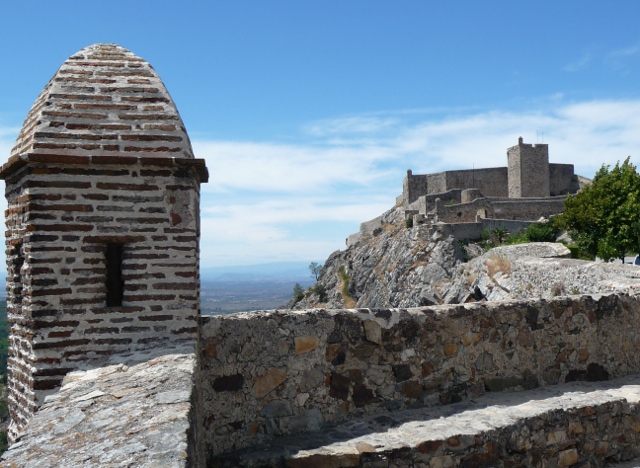
The castle’s walls are more or less intact, allowing a slightly nerve-wracking walk along the battlements from the watch tower at one end right across to the ruins of the keep at the other. Fortunately, the wind was calm, the day clear – and the views spectacular.

The 25km drive between Sintra and Mafra has already been described in another post

Mafra, when we finally arrived, was initially unprepossessing. Then we got to the middle of town, and all of a sudden were faced with the reason for our visit. If the palace at Sintra is on a human scale, the Mosteiro-Palácio Nacional is anything but. It is immense.

Photo taken from our pitch on the campsite, 4km away - about the nearest we could be and get the whole place in one frame...

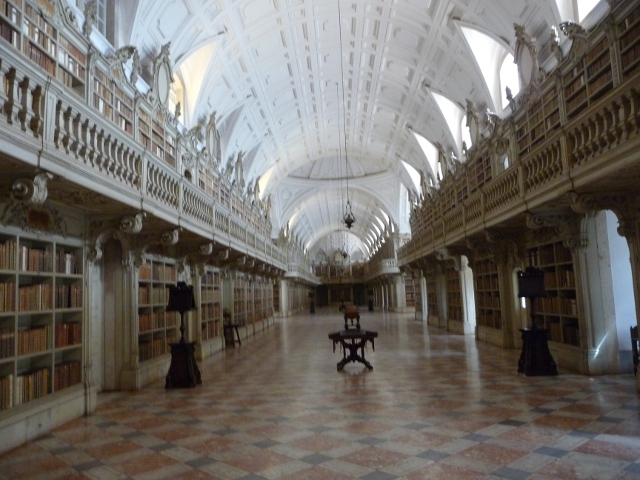
The construction very nearly bankrupted the country, at a time when gold was rolling in hand-over-fist from the New World. When the Flemish bellmakers queried the size of the order, and asked for payment in advance, the king retorted with a huff that if that was their attitude, he might as well put a second bell tower on, so he’d need twice as many bells – and whilst he was about it, he’d happily pay twice as much for them… We started our visit soon after the palace opened in the morning, and – given that there was a party of about a dozen ahead of us, including umpteen small children, we ignored the posted route and leapt out of sequence – which meant that we could enjoy deserted views down the full length of the corridors linking all the staterooms. It’s difficult to describe just how ridiculously large this place is – but much of the support infrastructure is doubled up, with one set for the King’s private use and one for the Queen’s. Not just private chambers (the towers on opposite front corners, a good 200m apart – although we couldn’t see hers, closed for restoration), but chapels and even kitchens. The one thing they seem to have shared is the library. Not really a great hardship, since it’s about 100m long…

Oh, yes, and the main Basilica. That wasn’t available for tour when we were there, either – but not because of restoration. It was in use for what appeared to be a rather posh Christening – of which we had a great view from the main royal Balcony.

Downstairs, we wandered around the justification for the building – the monastery (with several grand dining chambers for the Friars) and attached hospital, all 16 beds of it.

And, with that, it was back to Sintra, to see the other palace there. Clearly, access to the existing one wasn’t enough for the Queen in the mid 19th century, so her husband decided to extend the monastery on top of the next hill to the Moorish castle. Palácio da Pena is the result. If Mafra was actually quite tasteful despite the size, Pena is the exact opposite. Small enough that it should work, with low ceilings and cozy room sizes, it’s a riot of OTT. Every single (no shortage) turret and arch and mock-guard-hut was full of people gurning for their family albums – with a queue… However, the main impression we took away from the place was one of weather. Whilst the previous day had been gloriously blue-sky-sunshine, we lost the various turrets and spires of Pena behind fast-moving cloud. Don’t even ask about the views. I think there might have been some. Probably.

We’d bought a joint ticket at the Moorish Castle, giving entry to both that and Pena for a sizable discount (Pena’s far from cheap), which meant we had to go – both ticket and timescales meant it had to be that day. Thank goodness we’d done them that way round, becaue the Moorish Castle would have been thoroughly pointless (if not actively dangerous) in the cloud and gusts.

And so we headed onwards. We’ve turned a corner – ever since we left the UK, we’ve headed generally South-West. Now, it was time to head North-East, with just over a week to get to Orleans for the 2cv World Meeting. Back into Lisbon (or, at least, around the CRIL ring motorway again) towards the huge Ponte Vasca da Gama bridge across the River Tejo. The longest bridge in Europe – Ellie’s response to this useless factoid was “Nah, can’t be longer than Øresund”, but it is… Just shy of eleven miles long, it links Lisbon and the north with the plains of the Alentejo. And, of that, more anon.

Posted in By Country - Portugal, Travel stuff | 2 Comments

Lisbon

A less thrilling entry to the city than when we arrived in Porto maybe but Lisbon proved to be the slow burning on and off again romance to Porto’s impetuous fling. A regal elegant capital, much of the centre of which was destroyed in the earthquake of 1755. The central Baixa district was rebuilt on gridlines and has several spacious squares. The older quarters, like Bairro Alto sit on slopes or escarpments above, some of them reached by scarily steep streets with elevadors – rickety old tram-like funiculars or turn of the last century lifts. These became a feature of our meanderings together with the old trams on active service such as route 28 which takes you on a switchback ride through the centre of town out via the narrow winding cobbles of Alfama district and out beyond Chiado to the west. These aren’t just tourist curiosities but serve as key transport services for all Lisboetas.

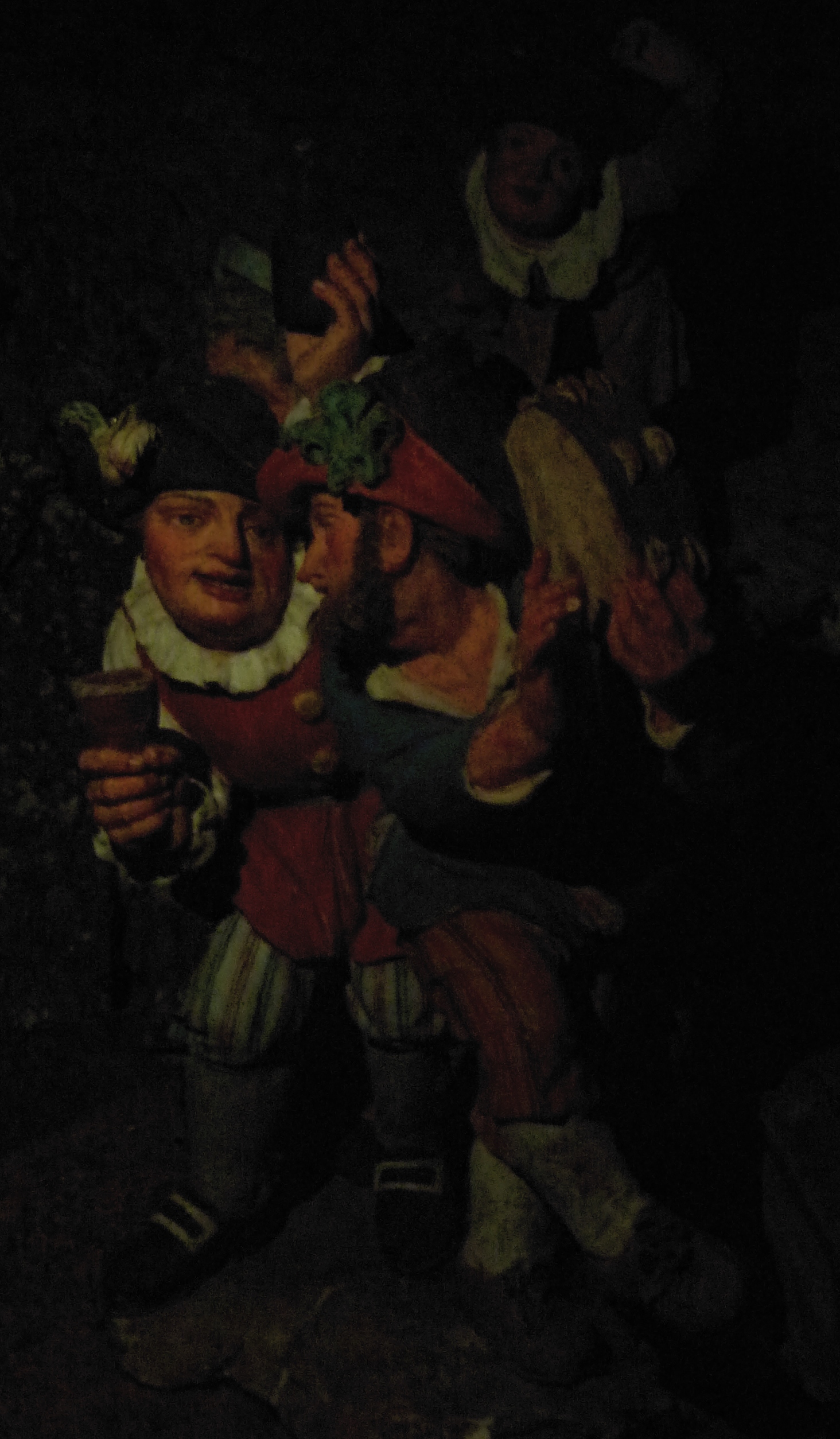
We spent our first day hopping on and off the 28 getting lost and found in the back streets, a late lunch at A Brasileira a notable art nouveau cafe with a statue of famed Portuguese writer Fernando Pessoa sitting at one of the street tables. The 28 later dropped us outside the Basilica da Estrela and we opened its doors to the sounds of an opera singer rehearsing for a concert later in the week. The singing in such a setting was incredibly beautiful and a welcome surprise. Another unexpected turn came when we found a tiny passage beside one of tombs at the rear of the church which lead us to a back room with the most incredible crib presided over by a very enthusiastic older nun. Dating from the 17th century, it showed the whole nativity story, complete with shepherds, kings, killing of innocents and characterful figures drinking and carousing in taverns.

A large chunk of a day was spent at the Gulbenkian Museum – a must-visit on any trip to Lisbon. A spectacular collection acquired by Armenian oil magnate Calouste Gulbenkian who was welcomed to Portugal when World War II Britain no longer wanted him. Exquisite Egyptian statuettes, Roman glassware, an Assyrian relief, carpets, clothing, illuminated manuscripts from Persia and Turkey, ceramics too. Also furniture from the reigns of Louis XV and XVI and art includes works by Rembrandt, Fragonard, Gainsborough, Turner, Monet, Renoir, Burne-Jones, all shown in spacious rooms. We chilled out afterwards in the beautiful park surrounding the museum, with its secluded glades, multicoloured shade tent, and water areas criss-crossed by square stepping stones and ducklings.

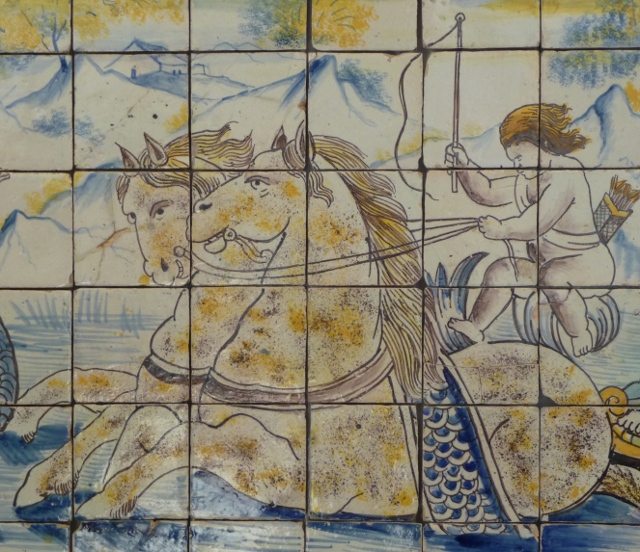
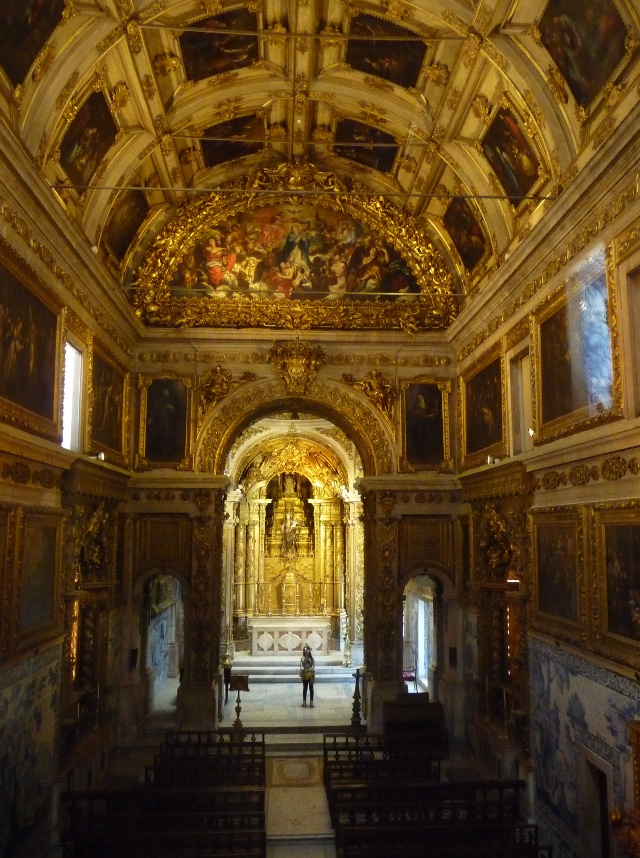
We also loved the Azulejo Museum (Museu Nacional do Azulejo) housed in the church and cloisters of a former convent. Azulejos are the decorative tiles that adorn so many Portuguese buildings, large and small, both inside and out and have done for centuries. Typically blue and white, but also with other colours, the tiles form incredible artworks that rival Italian frescoes in their beauty and craftmanship. This museum gives an insight into the techniques around different types of tiles and features several floors of tiled images collected from around the country as well as its own azulejos, particularly in the magnificent church which forms part of it. The museum also features tactile examples of some of the images so that people with a visual disability can enjoy them too.

The district of Belém is famed for its ‘pastéis’ – small custard tarts which should be bought from the Antiga Confeitaria de Belém. This cafe trades on its 100 years of serving these secret recipe pastéis and has opened every conceivable azulejo-adorned room it can. The result is rather like a maze of canteens, getting more and more like a motorway services cafeteria as you go further in. We had breakfast there in one of the original outer rooms and it set us up for the day. We needed the energy to see Belém’s other sights – St Jerónimo’s monastery and church (Mosteiro dos Jerónimos) built in the rather frilly Manueline style – after King Manuel I (1495-1521). It’s a rich ornamental Portuguese version of late Gothic architecture we’ve seen many examples of on our wanders, but Jerónimo’s is thought to be the finest. Explorer Vasco da Gama who opened up the sea route to India is entombed here (his remains moved from the church in Fort Cochin in Kerala, round the corner from where I stayed earlier this year). We were disappointed in the extent of what we got to see at Jeronimo’s. For the price of €7 per person our visit seemed quite short compared to our three hours or so at Tomar’s Convent of Christ. Entry charges have formed a significant part of our expenditure in Portugal.

We loved the delicate Tower of Belém – set in the water close to the quayside with a Moorish as well as a Manueline influence. It was originally built to guard the port of Lisbon and sat in the middle of the river until its course was changed by an earthquake.

In all, we spent three full days exploring Lisbon and could have spent much longer. Our stay was interrupted by our trip ‘home’ for our friends Kim and Luke’s wedding in Derbyshire. The wedding itself was a very special celebration with much joy and laughter, and dancing until the early hours. Adrian contributed by being one of the ‘alternative’ evening bridesmaids. Congratulations again to the happy couple. It was a great few days and good to catch up with friends and family again, as well as stocking up on a few essentials. However, returning to home ground still felt overly familiar and it was confirmed for us that we were doing the right thing when we found we were referring to the van as home … not our actual house which is now rented out. It was good to return to Lisbon to find our van waiting safe and sound for us and not least for the weather, now wonderfully warm.

Posted in By Country - Portugal, Travel stuff | 1 Comment

Houston, I think we have a problem…

Part 1 of a hopefully very occasional series.

So there we were, cruising gently down a fairly major dual carriageway, just left Sintra on the way to Mafra, 4.30 on Friday afternoon… and the van lost power. Totally. Change down. Still nothing. Neutral. Revs drop to zero, and the dash goes all Las Vegas.

Oh.

The fuel gauge was very low, but not as low as it (ahem) has been. But it was the most likely reason. We’d got momentum, and the gradient was with us. Hazards on, hard shoulder, and roll.

A couple of km, one slip road, a roundabout and a set of red traffic lights later, we came to a gentle halt outside a tyre fitter’s workshop.

In I wander, all sheepish, and explain the predicament we think we’re in. No fuel to hand, but the boss sends a fitter off with a jerrycan. We have fuel. The van still doesn’t run.

Oh.

It wasn’t a great consolation that it wasn’t an empty tank.

Some light fiddling later, we all decide that whilst there’s definitely some fuel getting to the injection rails, it’s nowhere near enough. And, yes, there’s a spark. Disconnect some more pipework, and the pump starts to sweat and shuffle Its feet. A mere dribble instead of a hearty jet.

Oh.

It’s now well gone half five, and where the wotsit are we going to get an injection pump and when?

Ten minutes on the phone later, and the boss has a source, and a price – and it can be collected now. Do we want it? A quick wince later, and the only answer possible is given. Of course.

By seven, we were on the road again. Not cheap (two hours of labour at €35/hour was reasonable, all in, and fuel at cost – but the pump must’ve been gold plated) but as painless as possible, excluding the financial aspect…

If you’re going to break down, there’s far worse ways to do it. Just so long as we don’t make a habit of it…

Posted in By Country - Portugal, Van stuff | 3 Comments