Through the desert in a van with no name

Ksar Ghilene is as far out into the sandy desert as you can easily go. Until very recently, there wasn’t even a tarmac road all the way there – just piste, compressed dirt – but the main route, the “pipeline road” – so called because it follows the route of the oil pipeline heading north from the Algerian and Southern Tunisian oilfields – is now surfaced.

As you head down the 75km or so of pipeline road, the landscape gets dustier and sandier, with not very much around apart from the occasional herd of camels in the middle distance.

Only one small cafe half-way down the road (renowned, apparently, for the purity of the drinking water from their well) and, in our case, a couple of nomadic types trying to hitch a lift to the cafe to phone for help for their hand-cart, which had decided to shed a wheel.

Other than that, the first person you see after turning off the main Matmata-Douz road is the soldier manning the checkpoint, to make sure that those without “serious desert” travel permits turn into Ksar Ghilene itself. The next people you meet are the couple of very friendly villagers who push your van out of the sand when you decide to leave the main track and “just go over that little ridge to look at the view”… If we had managed to peer over that ridge, we’d have seen the barracks.

The village didn’t exactly warm the cockles of our heart. It’s a bunch of concrete huts, without any shade or greenery. A couple of them are painted up with 4×4 and trail bike logos, with the inevitable stacks of fuel cans outside. Fortunately, tourists will not see the village other than when they drive between the road and the oasis itself. The oasis is easy to find – it’s the area with the lush green palm trees, probably 200m thick and a couple of km long, surrounded by orangey sand dunes for as far as the eye can see in every direction.

We headed in, and experienced the absolute novelty of having to choose a campsite from the several awaiting our business, before exploring the other delights of this vast metropolis. The central feature of downtown Ksar Ghilene is a pool, fed from a warm spring. Around this, there are a ring of cafes, perfectly positioned so that you can sit and watch dusty German bikers splashing around in the pool, as you determine that no cafe has any food available. There was a sign for a Boulangerie – but it was closed. As you approach the pool through the oasis, there are several quadbike rental outfits lining the road. In the other direction, there are several more quadbike rental outfits on the edge of the sand. At nightfall, the campsites fired up their generators – and we had electricity for a few hours. In the morning, we headed into the showers, fed directly from the warm spring. Warm is a relative term.

In a nutshell, that is Ksar Ghilene.

Actually, that’s not quite true. There’s one other place we didn’t mention – the Ranch Nomade. They rent quads of a different kind.

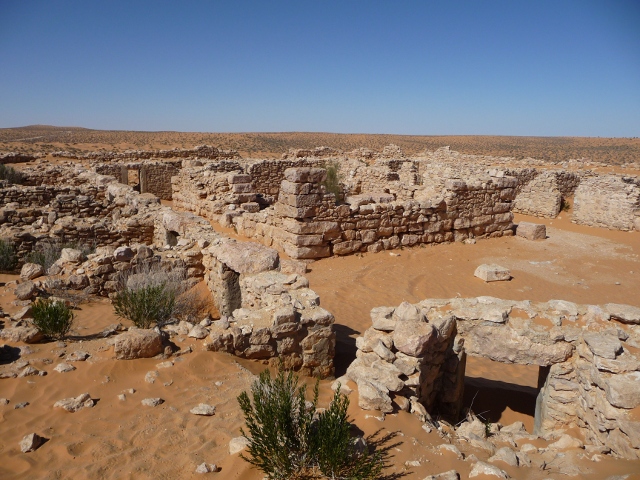
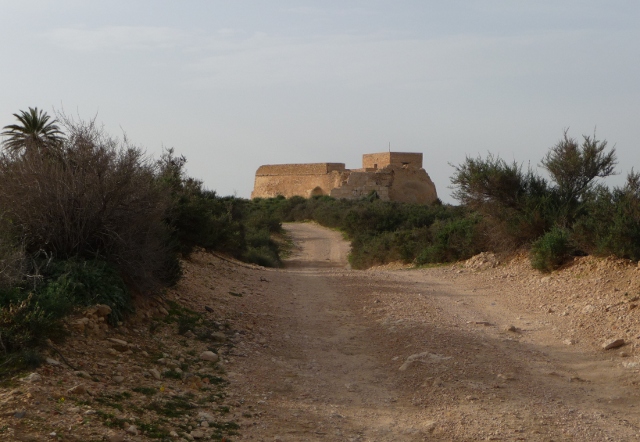
It was too good to resist, really. Several kilometres out into the sand, almost visible on the skyline, there’s a Roman fort – one of a chain which protected the southern edge of the empire. We could have walked there, I s’pose.

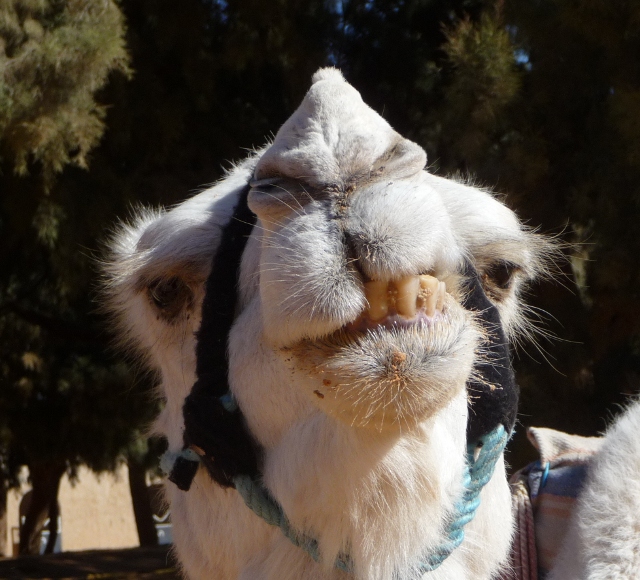
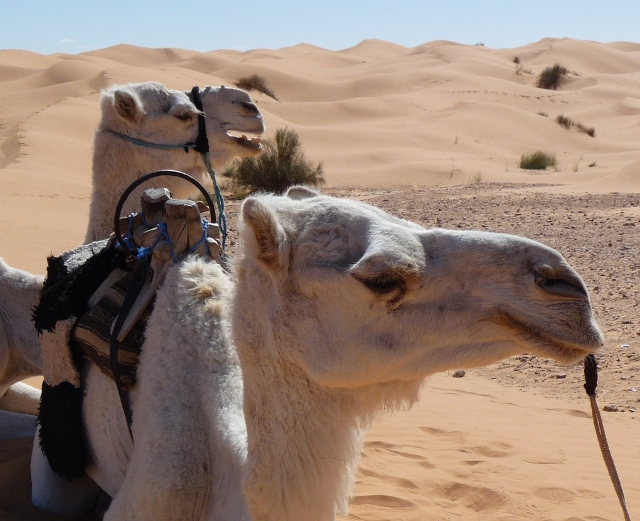
Our steeds for the trip were a pair of white camels – Méhari – the fastest of the various breeds, used for racing.

Ours didn’t seem particularly keen on racing, preferring a mild amble, stopping to chew at the odd bit of protruding greenery as our guide led them up and down the dunes, whilst the odd complaining noise issued from both ends. Perched on a rug-covered wooden saddle just aft of the hump (racing jockeys apparently sit in front), this was about as good a situation as we could hope for. At one point my camel’s lead came untied from Ellie’s, in front. A brief moment of panic as I pictured the beast bolting quickly passed, as it just came to a stop and looked around… Mine was friendlier than Ellie’s, occasionally catching up with her for a quick nuzzle, rewarded by a stroke of his fluffy head. Every time hers was approached, though, it gave an evil glare and a gargling snort.

The fort itself isn’t huge – a series of small rooms inside the outer wall, around a square guardroom – but it does remain in decent condition, despite the best efforts of the sands to reclaim it.

As well as our trek out to the fort, the Ranch offers short “tasters”, popular with the day-trip-from-Djerba crowd whose liveried 4x4s filled the oasis up for a couple of hours in the middle of the day.

If you fancied more, you could take an overnight trip out into the dunes or even a week long trip to Tatouine, Matmata or Douz. I think our choice was about right – an hour or so either way was just about enough to leave us only spending the rest of the day walking like an Arabic John Wayne – and, to be honest, a bit of the romance of an overnight camel-camp in the Sahara would be lost through the bog-standard modern tents we saw strapped to saddles, rather than evocative carpetted nomadic tents. I can see the logic, sure, especially with the February nights getting down to almost freezing – but who goes camel trekking for logic?

The sand itself is the reason people go to Ksar Ghilene, of course, and it did not disappoint.

The dunes are not high, maybe only a couple of metres at most, but they are truly magnificent. They curve and dip like the waves of a choppy sea. When the breeze gets up, the air around their leeward sides becomes gently blurred, and all footprints quickly become obliterated. When you walk across them and disturb an edge, the extremely fine sand slumps downwards gently, like slow-motion water. Without modern navigation equipment, clues or landmarks to get bearings, it would be almost impossible not to become disorientated almost immediately – yet to the people who live here, it’s been second nature for centuries to navigate across vast distances.

And, yes, as we headed north on the pipeline road a couple of days after arriving, that hand-cart was still at the roadside – albeit with a bunch of guys working to put the wheel back on…

Posted in By Country - Tunisia, Travel stuff, Uncategorized, Wildlife stuff | 3 Comments

This place is the pits…

The road from Metameur wound up and down through spectacular scenery and views into the mountains, taking us through Toujane – semi-abandoned ancient dwellings tumbling down across both sides of a gorge, with the ruins of old forts high above.

A large amount of touron-tat stalls, however, betrayed the fact that the road was heading towards Matmata, one of the Tunisian towns we’d most been looking forward to, but also another of the main day-trip destinations for those on Djerban package trips.

The final couple of kilometres towards Matmata saw no sign of the town itself, and it wasn’t until we’d more or less arrived that we realised it was even there. That’s largely because Matmata is the centre of “pit dwellings” – the terrain is a soft stone, with many rolls and folds, so that the ground looks almost like the surface of a giant brain.

Into this, a pit is dug – typically 10m diameter and 7m deep – with an entrance from one of the folds in the ground. Off the perimeter of the pit, rooms are then excavated. As and when finances and needs dictate, the back of one of the rooms is dug through, providing a corridor into another pit, with rooms similarly radiating. All you see from above ground is a door and a hole. As with the troglodyte dwellings around Tatouine, the natural insulation is superb, keeping the rooms comfortable across an immensely wide range of ambient temperatures.

Some of the sci-fi geeks amongst you might think this is all sounding a bit familiar – and you’d probably be right. One of the pit-dwelling hotels in Matmata was used as the set for Luke Skywalker’s home on the desert planet of Tattooine (can you see what they did? can you?). Many of the other locations in the Star Wars series of films were also round the area. As you can imagine, there’s a fair bit of living off those past glories to be done. The hotel still has some of the sets in place (shabby bits of plywood hung round the walls), and there’s plenty of tacky merchandising going on. It was all a bit, well, cheesy, to be honest.

Matmata was also going to be our last opportunity to stock up on food and drink before heading south towards Ksar Ghilene and the “proper” sandy desert – so it came as a bit of an unwelcome surprise to find that there weren’t really any shops in Matmata. A couple of fruit-and-veg places, and one hole-in-the-wall Alimentation Generale, but none of them great (even by rural Tunisian standards – we weren’t exactly expecting a Waitrose superstore!) and no sign of a butcher or petrol station – we’ve yet to brave the jerry-can-and-funnel roadside vendors of what we now know is referred to as “Essence de Libye” – it’s a small saving weighed against the potential expense and inconvenience. Nouvelle Matmata is about 15km away, so a quick detour was taken. We did manage to find a chicken-and-egg shop, and to fill up, but it was hardly any wider a selection than the old town.

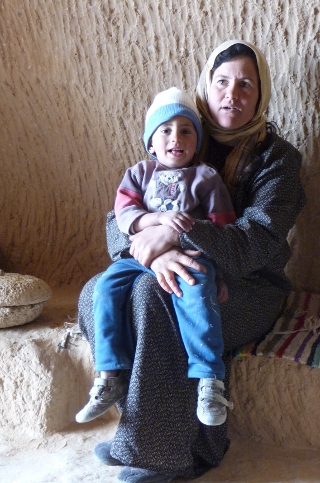
We found our campsite – the forecourt of a local hotel (with museum of local life attached), our only neighbours being a couple of donkeys, some shaggy and dog-eared white dogs, and a couple of cats (called Di and Dodi – no, seriously). The welcome was warm, though, and we settled in for the evening. We had a visitor as night started to fall, a local lady collecting firewood – over a quick chat, she told us that she lived in a pit dwelling next door to the hotel, and would be happy for us to come and visit. Inevitably, all of the obviously open dwellings were marked by a tourist coach parked outside, so we were delighted to accept. Seliya’s family excavated the house in the middle of the 19th century, and have been living there ever since. She’s clearly making best advantage of the proximity to the hotel, with some tourist trappings around the place – an Italian 4×4 trip t-shirt, signed, hanging on a wall and photos of the house in use for filming – but it didn’t “feel” tacky or false at all. Just her and her little boy, with very few concessions to modernity around the place. Her other son lives 15km away, so that he can get to school more easily. We were shown around, given tea and bread with honey, and generally made to feel right at home, as we chatted and whiled away an hour or two.

Eventually, we parted, and headed on to the next village of Tamezret – again, semi-derelict, but this time built “normally” around the top of a hill.

Not much in particular to see – just a pleasant wander around, with some great views of arid not-very-much for miles around in all directions, before we hit the only route available to non-4x4s wanting to go to the desert outpost of Ksar Ghilene, the long and empty “pipeline road”.

Posted in Art & Culture stuff, By Country - Tunisia, Travel stuff | 1 Comment

Of ancient villages and ksour

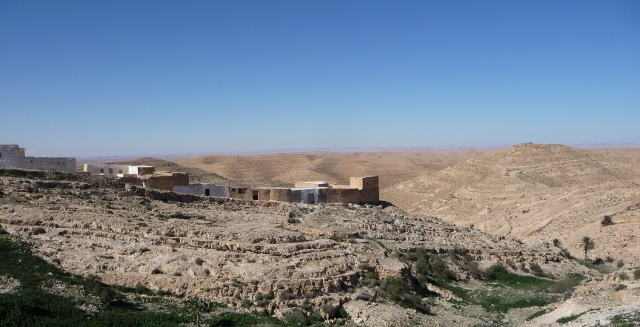
Driving west and then south after leaving Djerba, the scenery continued to change gradually and we were in the desert. The south east of the country is hamada, or stony desert. Not knowing quite what to expect of the hamada, we thought there would be more of the emptiness that we’d experienced since heading south from Sfax. The rugged beauty of the landscapes south of Medinine and into the mountains west of Tatouine are truly stunning. Adrian has already written in a separate post about some of the accommodation we’ve been lucky enough to stay in, which also made this part of the trip such a treat.

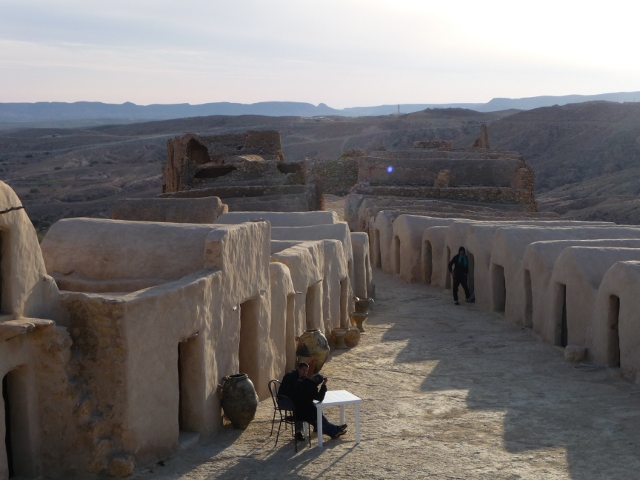
A common theme of our trip during the last nine months has been our many visits to ruins of human settlements dating from ancient times to relatively recent remains. Villages destroyed by war, areas abandoned because of migration, unsustainability or natural disaster, from the ancient pre-Christian citanias of Portugal, Roman Pompeii and Herculaneum, all the Roman and Punic sites we’ve seen here in Tunisia to Oradour-sur-Glane in France, a tragedy of the Second World War, and L’Aquila‘s recent earthquake damage. They all have their stories to tell. In southern Tunisia we’ve been captivated by the ancient, now mostly abandoned or in the process of abandonment, Berber troglodyte villages and Ksour (ancient communal, often fortified, grain stores and meeting places for the nomadic community – singular is ‘ksar’). Villages so part of their particular mountainside it’s hard to make them out at all from a distance. Usually it’s their white painted mosque that stands out from the terracotta landscape. Once formidable, they have been abandoned largely due to the promise of better conditions and houses with more space built on the plains nearby, although these seemed to us rather bland and somewhat soulless compared to what has been left behind. It’s not just a change of housing though, but a whole way of life that is on the brink of disappearing forever, but who can argue with the desire for electricity and running water?

At the village of Metameur just west of Medinine, we stopped at our first partly ruined ksar to a warm welcome from the lady guardian. We found that although the guest accommodation was no longer open, we could camp there. It was very cold, but magical to be able to sleep surrounded by such a wonderful building, and silent except for the call to prayer from the mosque next door. During the afternoon we had a walk around the village and had chatted to a few people we met along the way. One of them was a slightly down at heel chap who showed us a couple of local houses of note, such as a derelict house that had belonged to a Jewish family, and invited us to come to his house later for some tea. I was sure I’d smelled alcohol on his breath, but discounted this as impossible in a dry country. We didn’t really feel like going to see him, but I felt that it would be rude not to. So after we’d eaten, we walked down to where he said he lived. His wife and daughter, we assumed they were, answered our knock but didn’t understand any French. We understood that he was sleeping so we tried to say not to worry we’d see him another time. The daughter ran to another house and we were to follow. In a bare room, our friend was indeed asleep, and the girl was trying her best to wake him up. From the way he could barely talk or walk, and the general air of neglect, there was no doubt. He was absolutely off his face. We made our excuses as best we could and left, our eyes opened to the fact that alcoholism does exist in Islamic countries.

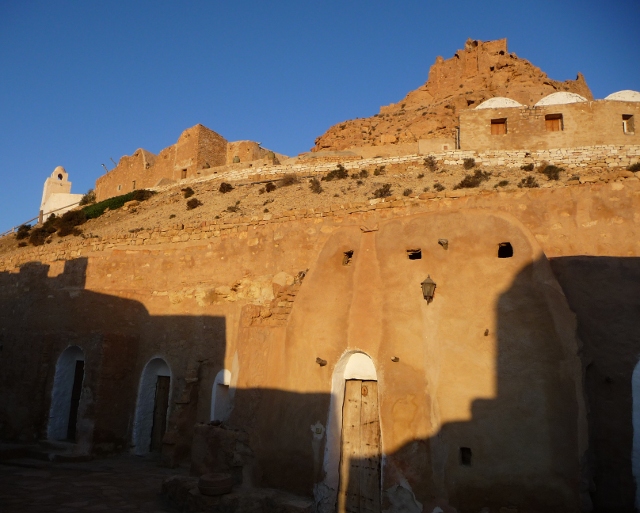
The next morning we took to the hills, looking back across the plains to the sea from the top of the ridge. Our first stop was Ksar Jouamaa perched high on a crag. We ended up staying the night here in one of the ghorfas (individual storage rooms of the ksar). When we first arrived there though, there was another campervan, Slovenian registered, parked up outside. We stopped to say hello to them and were immediately invited for lunch. It was great to spend time with Dian, Karmen and their son Martin, and swap travellers’ tales. They were taking some time out from their tourism-related business in Slovenia in the low season. Independent travellers are thin on the ground in Tunisia so it was a welcome interlude.

After our chilly but beautiful night at Ksar Jouamaa, we headed south, visiting another Ksar – Ksar Hallouf a short detour off our route.

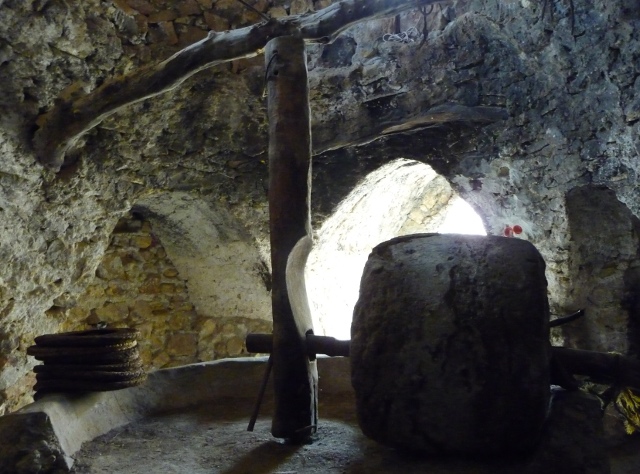
It was different in feel to the other two, sitting on a hill above an oasis, and completely disused. We were ‘guided’ around this one, whether we wanted or not, for a small tip of course, and saw the old olive press and a precarious mosque that looked as if it was about to fall down at any minute … we didn’t linger inside.
Douiret makes an immediate impression as you can see it for miles as you approach.

It was blowing a gale as we climbed the outside steps of the troglodyte residence up to our room. The space stretched deep into the mountain and was wonderfully cosy. The huge benefit of living in a home dug into a mountainside is that the temperature is constant so it is warm in the winter and cool in the summer. We ate dinner in our van, and when we emerged to go up to our cave room, we were starstruck – we had forgotten how wonderful the stars are in the desert.

With no windows it was so dark when we awoke, it was hard to believe a beautiful sunny morning awaited us outside. The light was magical and I ran out to the outer terrace with its magnificent view over the mountains and the desert all around. This was one of those special places that make the soul sing. It had been cold overnight though, there was a thin layer of frost on the van roof.

After breakfast we wandered following the line of the village at its lowest level. Apart from a couple of guest residences, Douiret is abandoned.

The new village, built in the 60s, nestles discreetly in a fold in the plain, while Douiret Ancien gently crumbles. Dating from the 13th century, it was quite a big village that stretched a way along the hillside as well as upwards and we walked most of the length of it before finding a winding route up the mountainside until we were on a plateau above. Another path lead us to the precarious pinnacle of the village, that hadn’t looked possible to get to from below. In Britain it would have been fenced off as a hard hats only area, so fragile did some of the buildings look. It was joyous to wander at will without the trappings of tourism and to picture the village as it must once have been, not that long ago.

Douiret is that bit further away from the tourist day trips from Djerba that it has escaped the detrimental effects of tourism that have negatively affected the nearby village of Chenini. Chenini is still partly inhabited, very much on the tourist trail and the inhabitants of the old and new towns are out for the main chance, our van was literally stopped several times by would-be guides. Although we recognise that people are just trying to make a bit of money in a poor country, they foist their attentions on you and then expect a tip way in excess of what could possibly be any local going rate. We stopped at a marabout shrine on a small hillock nearby, but in spite of our protestations of not needing or wanting a guide and not having the money to pay one anyway, a young man was so persistent that we ended up running back to the van! This repeated harassment tactic put us off from visiting the village itself, not as impressive as the other less visited villages anyway!

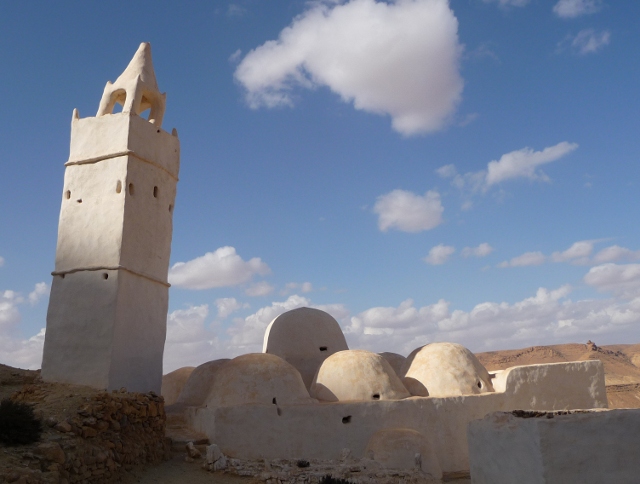
We did get to the wonderfully whimsical looking mosque Jemaa Kedima, once part of an older long gone village close by. Its leaning minaret, like a candle left too long in the sun, presides over the tombs of a holy man and of the seven sleepers.

The legend goes that there were seven Christians imprisoned here by the Romans. When their bodies were discovered centuries later, they awoke having meanwhile grown several metres, only dying again when they converted to Islam. Their long tombs are in the cemetery. Here the visit was rewarding and hassle free, the guardians more than happy with a couple of coins in their tips plate. Luckily Chenini was an exception and we didn’t experience any such trouble at other villages in the region.

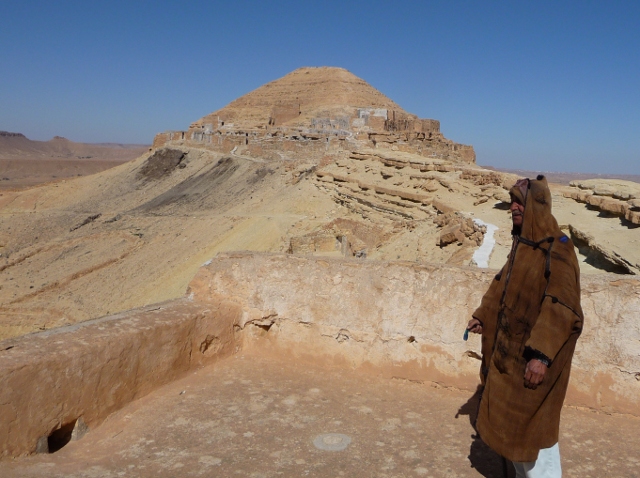
Guermessa, is another silent lost troglodyte village like Douiret. Our guide book, printed in 2008, said that families were gradually moving to the new town below and the old village would be abandoned within a decade. Well, it has been completely abandoned now, within four years. We were the only people there, save for an old man in a threadbare burnouse (a traditional cloaklike garment), who ushered us in to keep warm for a moment by his charcoal fire in an alcove underneath the mosque, before leading us off cackling gently and rather disconcertingly.

Afraid of yet more enforced guidage, we followed him. He showed us where the old olive press was and a couple of other old buildings we wouldn’t have seen otherwise and then left us alone. The village spiralled round two hills and we walked upwards towards the main ruins. Houses are in a very bad condition here, and obvious rock falls from the crags above must have hastened their abandonment.

On the other hillside the ruins have been ‘tidied’ with cement on the edges of all the walls to prevent further decay.

We saw this being done at Beni Barka, a hill top village, where the work force was tidying the walls and cementing in quite a slap dash manner. However, the hard work they were doing was saving the buildings from deteriorating further.

It seems that there is more awareness of the historical and cultural importance of maintaining what’s there now – arresting the decay. Also their value in attracting visitors isn’t yet being tapped into, but there is that fine balance between sensitive tourism and preservation and turning it all into a theme park.

The visit to Beni Barka, was part of a loop south of Tatouine, which also encompassed many ksour in various states of preservation, usage, or almost just rubble. They were perched on rocky ridges, or in the middle of villages, like Ksar Ouled Soltane, still acting as meeting places for villagers and nomadic peoples.

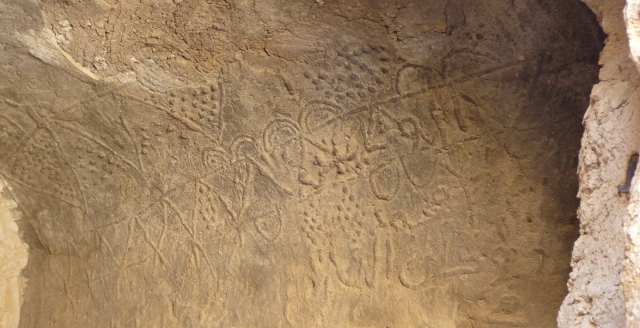
Some were really easy to spot and visit, some were locked, some we found after several kilometres of piste driving (ie non surfaced desert tracks ‘motorable with care’, our guidebook said). Some dated from the 9th century, some from the 19th. Some we gave up on finding. In many you can still see images and symbols made by the families – hand prints, small circles indicating rain, quotes from the Koran and so on.

The ksour fell into disuse when security improved under French rule and there was less need for fortified storage. Villagers were encouraged to have their own stores by their fields. These old ksar compounds hold a charming fascination for us. Some of them blend in so well you can’t tell if it’s a ksar or just the continuation of the rocky hill top, like one of our favourites, which we found west of Tatouine – Ksar Mourabtine.
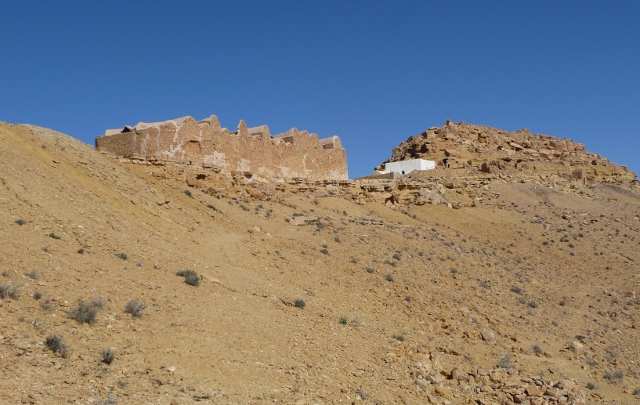
We walked all the way up to it, given tea by a couple of workmen on the way, and it was well worth the climb with wondrous views. It was very pretty inside too, partially preserved with cement, with four storeys of ghorfas reached by precarious steps. Next to it there were abandoned rock dwellings.
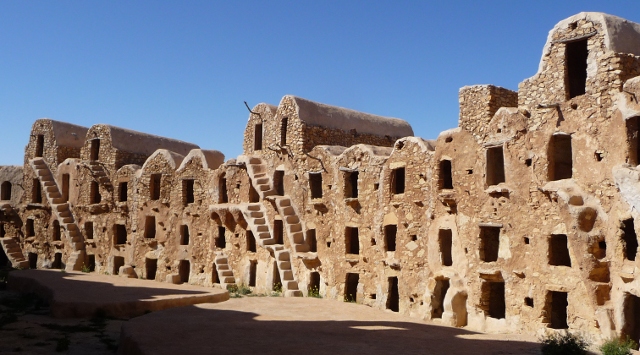
We stayed in the area a few days, based at our mountain hideaway at Douiret and were sad to leave. We didn’t have a clue as to the existence of these remarkable places before coming to Tunisia and yet they are some of the most impressive both visually and culturally that we have seen on the entire trip, and to be able to wander round most of them unhindered by guides or usually any other people has been a real joy.

This is as far south as we will go in Tunisia, there isn’t anything to see beyond here. It’s oil related industry and military zones to the southern tip of the country. South of Ksar Ouled Soltane we’d seen the flat nothingness stretching into the infinity of the hazy horizon.

We retraced our trail northwards, passing Ksar Jouamaa and spending another night at our Ksar at Metameur on the way, luckily without spotting our drunken friend. In spite of all the ksour we’d visited, Metameur was still as lovely as we’d remembered.

Posted in Art & Culture stuff, By Country - Tunisia, Personal stuff, Travel stuff | 3 Comments

Landmark accommodation

In the Djerba post, we mentioned that we spent our last night on the island “treating ourselves” to a night in a Fondouk, an old inn or caravanserai. In a way, it wasn’t much of an extravagance, since hotels here in Tunisia tend to be inexpensive, certainly by European standards – our en-suite room, including breakfast, was no more expensive than many European campsites charge – even off-season. We’ve been staying in other hotels here – but mainly when there were no campsites within easy reach of a city centre. Yes, we could wild-camp in the street, something many of the people we’ve met on the road do regularly – but it’s a lot easier for them, having “proper” motorhomes with loos and better washing facilities than we have.

On Djerba, that clearly wasn’t the case – we’d had several nights in a perfectly respectable campsite just a few miles away. What really swung it for us was the opportunity to stay in a traditional type of accomodation, something we’ll never be able to do again – a “landmark” to the area. We’ve long discussed having some time away in the UK in Landmark Trust property, rather than a B&B or pub or whatever, but (partly given their premium prices) haven’t got round to it yet – we will one day. It’s a lot less certain that we’ll ever come back to Tunisia, so it seemed rude not to have a night in a Fondouk.

Similarly, as we’ve started to head inland into the deep south, we’ve been coming across plenty of Ksour. A Ksar (Ksour is the plural) is an old fortified grain store, used for many hundreds of years by the Berbers to store their produce in safety. Each family or tribe would have had one or more storage units (Ghorfas) in a Ksar. A guardian would have been responsible for the safety of the Ksar, in return for a small percentage of each harvest as a safe-keeping fee. The Ksour are located in easily defensible positions, and had various defensive measures to help protect against nomadic raiders and thieves.

Our first night’s stop after Djerba was in a small village, Metameur, near Medenine. Our guidebook said that there was a Ksar there with Ghorfas converted into hotel rooms, but you could also camp in the courtyard itself. It turned out that the hotel had long since closed, but camping was no problem.

The lovely little old lady who ran the Ksar (there was also a handicraft exhibition, as the Ksar is a regular on the day-tour circuit for those in Djerba package hotels) gave us a guided tour, including the rooms which had been accomodation. Very simple and plain to the point of austerity – just a mattress on a cement bed base – I think we’d probably have opted for the comfort of the van anyway, since the courtyard was so dramatic.

Not far outside Metameur lies Ksar Jouamaa, described by the book as “dramatically perched on (a) scarp, with sheer drops on three sides” but near derelict. Certainly, the location is absolutely fabulous, but when we arrived, we found that a good chunk of it had been recently restored for hotel use.

Since it was barely lunchtime, we had no intention of staying – but the rooms looked so welcoming, divided into a living and sleeping area, en-suite showers and sinks all sympathetically incorporating the original structure of the Ghorfa with traditional materials, that we succumbed. The fact that the place is very newly opened, and we were their first paying clients, had a little bearing, we will admit.

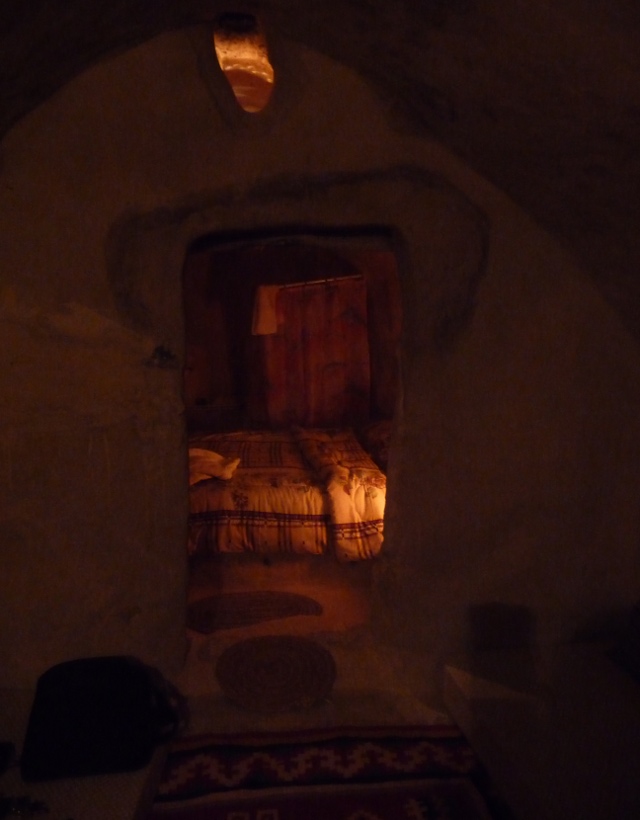
Finally – for the moment – I’m typing this in a Ghar, a troglodyte cave dwelling in Douiret near Tatouine. Not dissimilar to Matera, in Southern Italy, this is a village composed of a series of caves dug into the soft stone of the hillside. Mostly abandoned now, several have been restored by the <deep breath> Association pour la Sauvegarde de la Nature et Protection de l’Environnement de Douiret (ASNAPED), a local not-for-profit heritage group who’ve also been restoring the region’s other landmarks, agricultural terraces called Jessour with a series of clever and complicated mechanisms to retain, store and manage the limited rain water for the crops. A series of steep steps lead up from the dirt track to the courtyard of the residence, where small doorways open straight into the sheer rock face.

One of those opens into our room – which would originally have been one family’s home. Again, treating the space very sympathetically, a living area passes through an archway into the sleeping area, with walls gently curving through strata of rock into the ceiling.

More on all of these in a post coming soon.

Posted in Art & Culture stuff, By Country - Tunisia, Personal stuff | 3 Comments

Farewell to the coast – for now

The drive towards Gabès was a long one, with nothing on the way, and after the boat from Kerkennah docked and we fought our way out of Sfax, we knew we were a bit tight on time. So when we arrived in Gabès, about ten minutes after darkness had fallen, we were glad that we had a definite destination to head for – the Fella Park campsite was alleged to be only 1.5km out of the town centre along the well-signed road to Matmata. So when we headed along the Matmata-signed road out of town, and didn’t find anything after a good chunk more than that, we started to be a bit concerned. No, it’s OK – there it is. Oh, wait. It’s locked up tight, all doors chained and padlocked. And nobody’s answering the phone.

We’d found out about it through one of the web lists of campsites, which also listed a mobile number. After checking the list (with the last of the laptop’s battery) and calling it (with the last of our phone credit) we received a promise to arrive immediately. Sure enough, we were soon let in – we knew that the next day was the holiday of Mouled, the birthday of the Prophet Mohammed, but hadn’t realised it started that afternoon…

Gabès is a pleasant city, and the impression that immediately grabs you is one of cleanliness – the rubbish which is strewn across so many streets (not just in Tunisia – virtually all points Naples and south) was almost entirely absent. Given that it was a public holiday, it also seemed a very lively city – plenty of bustle and activity. Very little of it touristy, though, despite the myriad of tat-stalls lining the road into town. The souk itself also had more than its fair share of tat stalls – and I mean _utter_ tat, gawd knows who buys it, since this isn’t a major tourist destination at all, with an almost total lack of “sights” – but was also clearly the main retail centre of the city. Again, plenty of life – and not just on the food stalls, but even down the back streets where the noisier and smellier trades were carrying on, away from the Great Mosque. The Rue des Forgerons is little changed, full of knife-makers and -sharpeners, blacksmiths with open hearths roaring away and anvils being hammered against, and small holes-in-the-wall with umpteen decrepit Mobylettes and other old French mopeds in various stages of dismemberment spilling out.

Our return to the campsite soon gained a fantastic soundtrack. From the patch of wasteground from over the wall, drumming started to swell, soon joined by voices chanting. This continued, growing in volume and enthusiasm, for well over an hour – unfortunately, we couldn’t see what was going on – the wall was too high, and our return had coincided with a visit from the management to the site – they’d since left, locking the gates again!

On the way out of town, we stopped in at the village of Chenini, on the edge of the palm-filled oasis that marks the city’s northern boundary. The village itself was low-key, but there were apparently some wonderful gorges a short walk along a footpath. We found them, again a bit low-key, surrounding the remains of a deserted holiday camp.

The road from Gabès to Djerba crosses the WW2-era French defensive line at Mareth. There’s a military museum there, run by the defence ministry with freshly polished and painted field guns outside the door – we didn’t stop in, though, and continued on to the ferry which provides the best approach from the north to the island. As we joined the line, wondering where to find some lunch, a guy was just walking down the vehicles selling fresh Metabka – the same “Berber Pizza” we’d enjoyed on Kerkennah. Perfect timing!

Along with the resorts we went through a bit further north, Djerba is one of Tunisia’s main package-tourist destinations, and most of the east coast of the island is “Zone Touristique” – Club Med, quad bike hire, golf courses, thalasso spa hotels and tat shops a-go-go. The capital, Houmet Souk, is a small town on the edge of the zone touristique – the souk suffers a bit from that, but on the whole, the place is as unspoilt as the rest of the island. As well as the souk in the middle of town, there’s a bi-weekly “Libyan” street market – so close to the border, barely a hundred km away, traders from Libya would originally have brought goods otherwise unobtainable in Tunisia to sell. Nowadays, it’s very similar to any other street market – including fresh fruit and veg piled high straight onto the ground or overflowing from the back of pickups. Nearby, a large area seemed to be devoted to stalls selling second-hand clothes, brightly coloured material being picked through and strewn around, from table to ground.

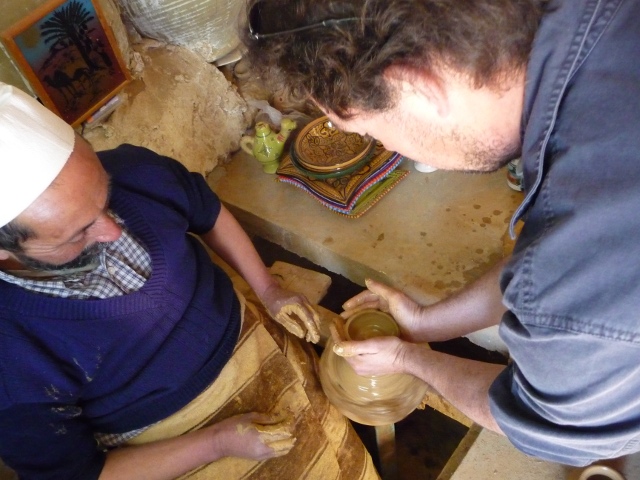
At one end of the island, the small town of Guellala is a centre for pottery, with many pottery workshops and shops to show for it. We stopped in at one, half-buried to provide a more even temperature the year round and prevent the clay drying out prematurely. At one end, the palm-wood fired kiln sat, looking more like a hobbit’s cottage than an oven capable of a thousand degrees centigrade.

The proprietor kindly demonstrated his skills, making it all look so easy. So easy, in fact, that when he offered a go I couldn’t possibly refuse. Let’s just gloss over my results, shall we, and say that it really wasn’t as easy as it seemed?

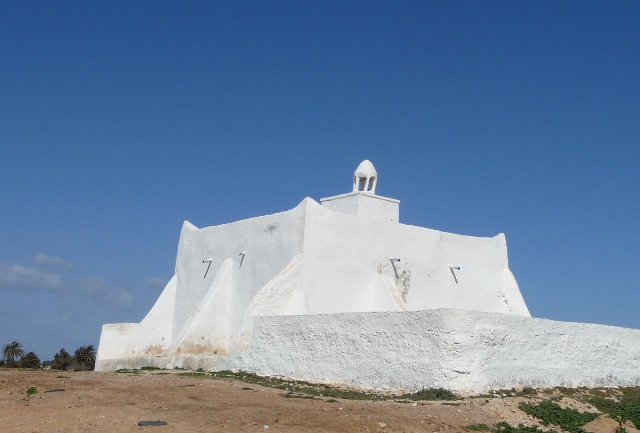
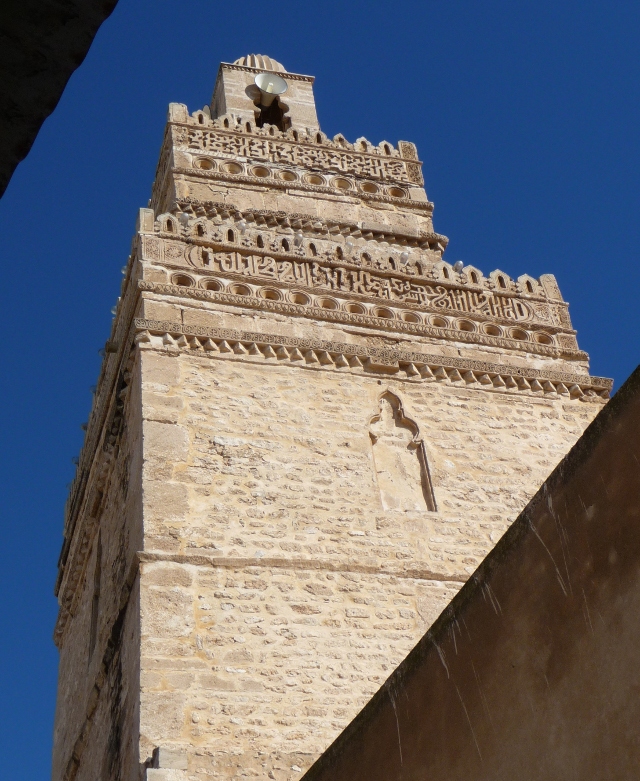
Guellala also has one of the island’s ancient mosques – this one’s relatively new, “only” being fifteenth century – others go back to the ninth century.

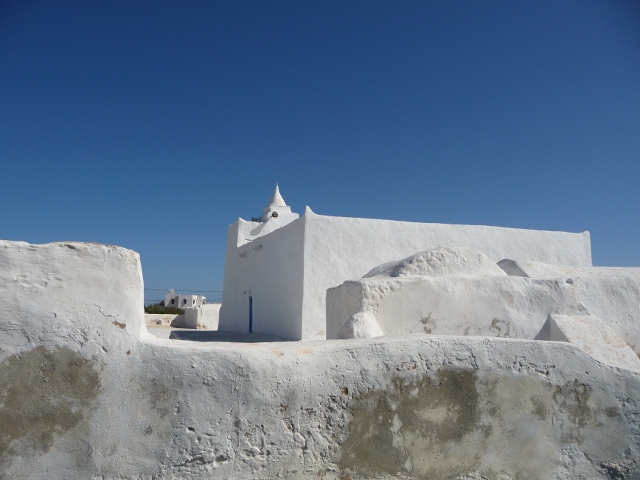
Many of the mosques, along with some of the older houses, are lightly fortified, with high windowless walls surrounding their compounds – and all sat, whitewashed, in the sun against a backdrop of bright blue sky. Wonderful.

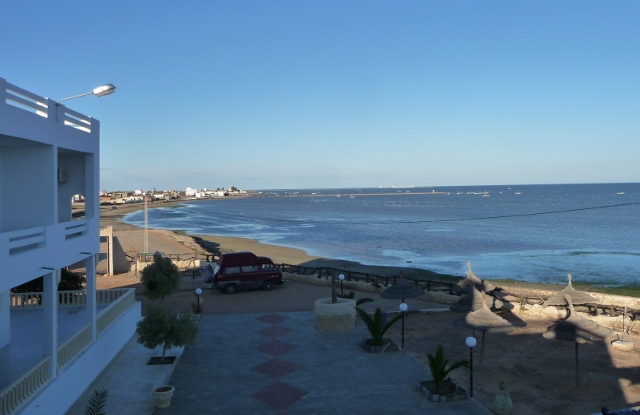
For most of our time on the island, we camped at another Centre des Stages et Vacances, at the other end of the zone, and got a fantastic sea view from our plot right on the edge of the sand.

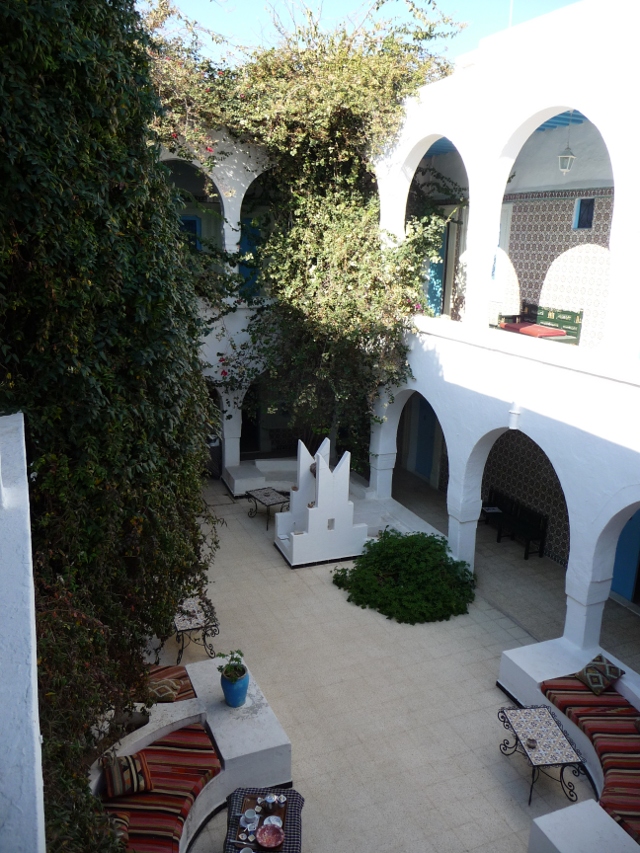
However, for our last night, we moved from the campsite into Houmet Souk, and treated ourselves to a night in a hotel in an old “fondouk” – originally, offering shelter and food to traders, pilgrims and other travellers, around a central courtyard where their camels and goods would have rested the night. Brightly coloured patterned tiles were everywhere, even around the bed structure in our room, whilst large climbing plants in the courtyard were thick with loudly chattering roosting birds. Breakfast, of course, was served in the courtyard – a bit chilly before the sun climbed high enough, but so pleasant as to be irresistible.

Canadians Jacques and Simone, who we’d met in Palermo, turned out still to be on Djerba, too. They were staying at a different campsite, near to a sandy spit of land known as “Flamingo Point”, in the middle of the zone. A very newly opened site, the boundary wall was so freshly built that there was no signage at all – when we went to say hello, we only realised the site was there by spotting the roofs of a couple of motorhomes over the top of the wall. When it’s finished, it should be a nice site – but for the moment, we preferred our sea view to the freshly built loo! Mind you, they certainly had a lot more flamingos than we did – the shallow water just the other side of the main road from their site was thick with the big pink waders.

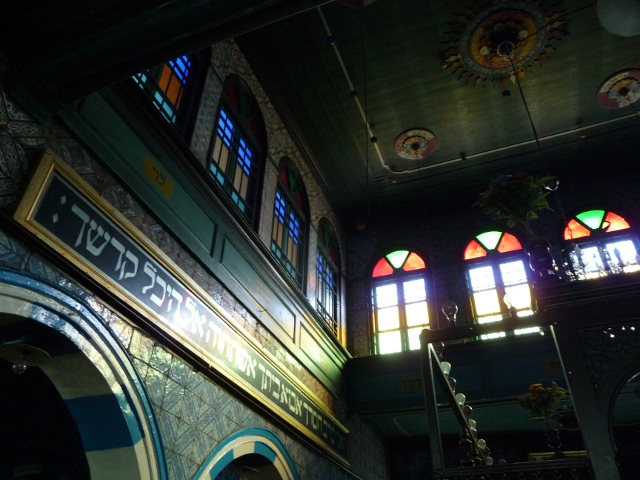
Djerba has also long been renowned as a base for the Jewish community. Here long before the Arabs arrived, bringing Islam in the eighth century, there’s still a couple of Jewish villages, one of which is home to a large synagogue which acts as a point of pilgrimage to many. After being on the receiving end of a fundamentalist bomb attack in 2002, security is tight – an airport-style X-ray machine has to be negotiated before you can enter, but it’s well worth it – once you’ve donned a borrowed skull-cap, the main hall is bright and colourful, with ancient Hebrew texts on the walls, and chanted verse filling the air around you.

As well as the ferry, there’s a causeway – originally built by the Phoenicians – linking Djerba to the mainland, and that’s the route by which we left the island, heading south and inland, towards the desert.

Posted in By Country - Tunisia, Travel stuff | Leave a comment

A short stay on the Kerkennah Islands

Our next stop after El Louza was the Kerkennah Islands. These tiny islands lie an hour by ferry off the coast at Sfax, so it was back on the road south from El Louza.

It took us a little while to figure out how to buy a ticket for the ferry or even when the next one was, having just missed one. After an hour or so, all became clear and we drove onto the ferry to the front of the open car deck.

It was a blowy crossing, but the sun was shining as Sfax disappeared in the distance. After about 40 minutes, and not seeing land, the boat stopped abruptly and started turning. Thankfully it didn’t return to Sfax, the captain was just making a left turn presumably due to shipping channels and sandbanks. The sea is very shallow in this region. We were relieved to spot the islands in front of our new direction.

They are low lying slivers of land, not reaching more than 13 metres above sea level at their highest point and about 30 miles long. Their separation from the mainland means that the local customs and traditions are slightly different, but it is essentially a berber population. It has also served as a place of exile, illustrious figures include Hannibal and former president Habib Borguiba.

As the boat neared the dock, all the foot passengers crowded the front of the car deck making it difficult to return to the van, and then to drive it off when we arrived. There seemed to be a competition to see who could be first off!

There are two main inhabited islands and several uninhabited ones. These two are joined together by a bridge. Our first impression was of a flat desert island with a multitude of palm trees. This landscape was punctuated by salt flats. There was a strange charm about the place. There wasn’t much on the first island apart from this, so we crossed over to Chergui quite quickly.

There was a small coastal Zone Touristique, where all the hotels were. We were headed for a hotel with camping, but it appeared closed.

Just down a dirt track from this stretch we found the ancient fort Borj El Hissar. Its honey-coloured stone basking in sunshine above the turquoise sea. We had read that there were also Punic/Roman ruins to be seen below the fort and that the guardien was friendly. We parked the van and headed up the stone ramp into the fort itself.

The guardien, Mohamed, greeted us like the long lost travellers we sort of are and insisted we come and drink herb tea with him. He led us into a little room in one wall and poured glasses of exotic tasting sweet tea. He had whole bunches and branches of herbs drying on the table and tried to get me to name them in English. Apart from Rosemary, the others are a mystery. There was music playing on the radio, the lilting melody transported us into a timeless interlude that could have been now, 2012, but could easily have been centuries in the past.

After a few glasses of tea had been pressed on us, Mohamed lead us through the gates at the side of the fort and gave us a guided tour of the ruined settlement with the usual cisterns, baths and walls.

It was a wonderful setting, and although more tea was offered, we said we had to move on to look for a campsite. Mohamed waved his hand in the direction of the shoreline and said that people often camped there.

So into Remla, the one slightly bigger town,  for some supplies and then back out to our wild spot for the night. There were a few people around but we felt safe and no one bothered us. After dark, two sets of car lights suddenly appeared over the rise and we were visited by the local police, with the police chief of Kerkennah himself in fact. They were really friendly and welcomed us to the islands but would rather we didn’t camp, it wasn’t safe, the country was still unstable and so on. They didn’t move us on though, and provided us with the emergency numbers for their station and the one at Sfax should we have any trouble. Their concern made us slightly edgy about being there, but equally reassured that we had friends in the right places.

We passed a peaceful night and set off to explore the outer reaches of the island. Although it is a holiday destination, the island remains largely unspoiled, but there isn’t a whole lot to see, and less to do off season. We stopped off at the museum in El Abbasia, which is usually closed on a Friday. The curator welcomed us warmly. He had a small group of Algerian women museology students on placement and insisted on giving us a full guided tour with them in tow. We felt a bit like royalty. The museum showed traditional life on the islands with tableaus of various quality showing the sponge divers and fishing techniques as well as other crafts. It was interesting to see, but the tour went on a bit, especially as the curator kept stopping to answer his phone!

By now we had decided to leave the islands, having done the main points of interest and with nowhere legitimate to camp. On the way back through Remla to the ferry port, we were flagged down by our police friends who enquired about our night. We also stopped to pick up our delicious lunch snack – metabka or berber pizzas which are rounds of hot soft unleavened bread with a spicy tomato and vegetable filling.

Luckily our van wasn’t too far forward on the car deck on the return crossing as it got very wet and blustery with huge amounts of spray coming over the front and sides of the boat.

Back into Sfax, and it was a long drive to Gabès, further southwards.

Posted in By Country - Tunisia, Food stuff, Travel stuff | 1 Comment

Loose ends around El Louza

We reached the area near El Louza towards the end of the afternoon and the last rays of the sun were just catching the fishing boats moored on the shore at the edge of the village. We could see our destination – the hotel and camping El Kahena just up the road. As we were taking photos, a man waved heartily from a passing car. It was Ismail, who together with his wife Sonia gave us one of the warmest welcomes we’ve received in Tunisia, and that’s going some.

The hotel is fairly new, and beautifully appointed, and you can camp in the car park but the camping area isn’t fully fledged as yet. Ismail showed us round the hotel and it didn’t take much persuasion together with his reasonable prices for us to opt for a room with ensuite and superb view. We only intended to spend a night or two here but it was so comfortable, pleasant and relaxing that we ended up staying four nights. The washing machine was also a huge benefit for us. The weather was still very mixed and on our first morning it was bright and sunny. After doing all our laundry and hanging it all out, it poured with rain. This nearly always happens when I do the laundry, but we do need to attempt to have clean clothes.

After struggling with wet washing, the day was spent lazily. Our second day was also very mixed weather wise, Ismail invited us to take coffee with him in the nearest larger town, Jebiniana. In general, a lot of the cafés one sees around Tunisia tend to be quite barely decorated, smoky and crowded with men talking over strong coffee or sweet mint tea. Not attractive places for women to enter or linger. This one was no exception, but being with a Tunisian I was able to get over the hurdle of sitting and talking with Ismail and his friends (and Adrian too of course), although I did feel a bit conspicuous.

After our coffee, we accompanied Ismail on his errands around town, and we stopped off to pay a visit to a carpet weaver. This lady proudly showed off her traditional weaving and her family of several generations gathered around, the great grandmother in traditional dress. Again it was a heartfelt warm welcome.

Just down the road from here was the local marabout of holy man Sidi Abou Ishaq al-gebenyani, the son of the man who built the city walls at Sfax. The door was locked, but Ismail rounded up the keys from Fatima, a woman living nearby, and we also met Sara, whose ambition is to be a professor of English. She was so enthusiastic to meet us and to practice the language. They invited us for lunch, but it was a bit early and Ismail had other plans for us.

We headed back to El Louza and called in at Ismail’s family’s shop where we met his mother and sister who were also pleased to see us.

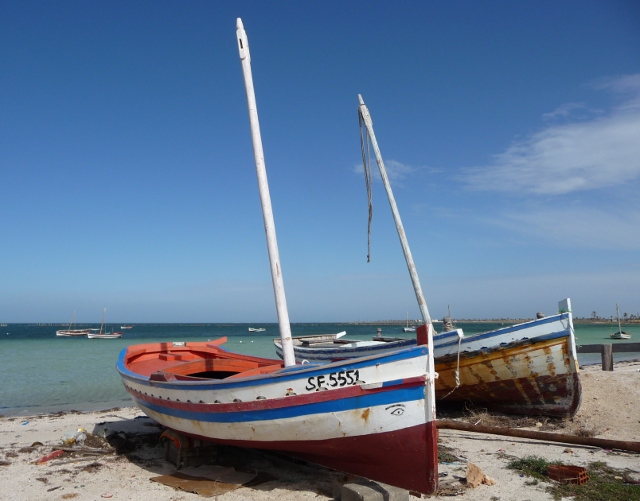
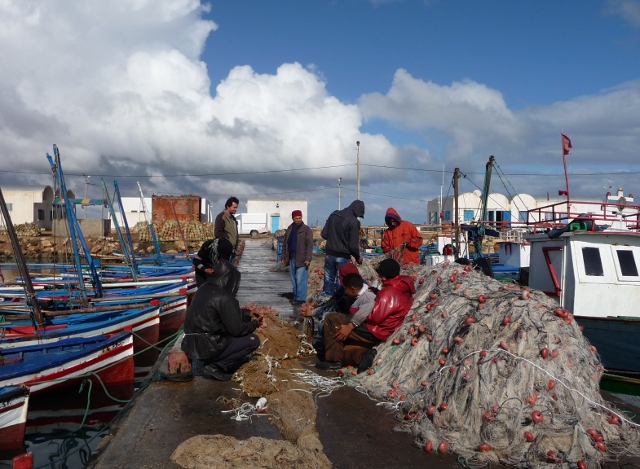
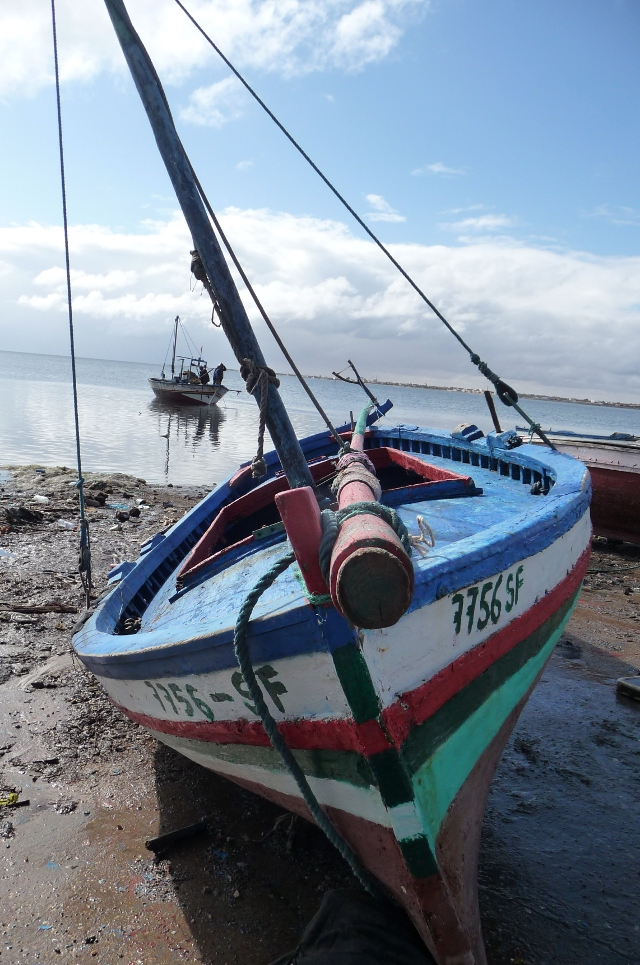
Ismail then showed us the fishing port a few kilometres away and the sun shone on the brightly blue painted boats, and the fishermen mending nets and making repairs. There were piles of clay pots at the edge of the quayside. Octopus is one of the biggest catches round here, and the pots are left at the bottom of the sea for the creatures to crawl into overnight. The fishermen then haul them up the next day.

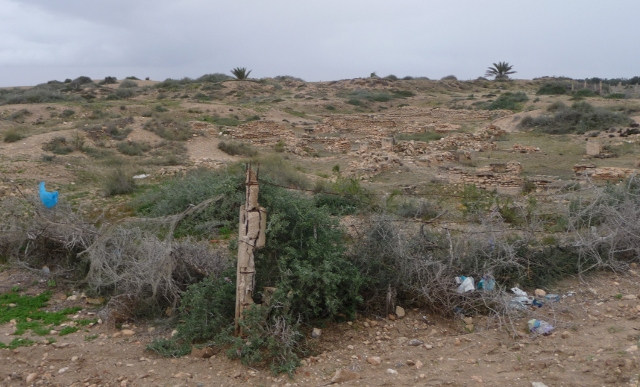
Later we went to local Roman ruins. Acholla was a settlement by the sea, and its remains are literally a roughly fenced off area in the middle of a ploughed field. We would never have stumbled across it on our own.

There are remains of houses, baths, a cistern or two and glimpses of what were once stunning mosaics. Apparently other mosaics have been taken to the Bardo Museum, or have disappeared. No one’s quite sure. There are shards of pottery, mosaic tiles, and fragments of frescoes everywhere, including being ploughed into the field around.
As Hugh mentioned in his recent comment, Tunisia has so much ancient heritage, it can’t keep tabs on it all. Minor sites, like this one, which haven’t been properly excavated let alone protected run the risk of further decay and damage. And who knows what lies under the soil?

We had tea at a café in the village and then looked forward to our dinner … couscous with octopus of course.

Our third day was forecast for dry sunny weather all day … and it proved to be right for once. We headed south to the city of Sfax on the coast, which is an affluent place, less heavily touristy than some of the towns we’ve visited further north. We admired the city walls, surrounded by palms and explored the souks, with their ancient mosques almost hidden away until you look up.

These were more workaday than touristy for once and as ever we loved meandering along the narrow lanes and alleys. We caught glimpses of the everyday here, the sheep being skinned in the street, children milling around during their long midday break (from ten until two), craftsmen hard at work, from tailors to knifemakers.

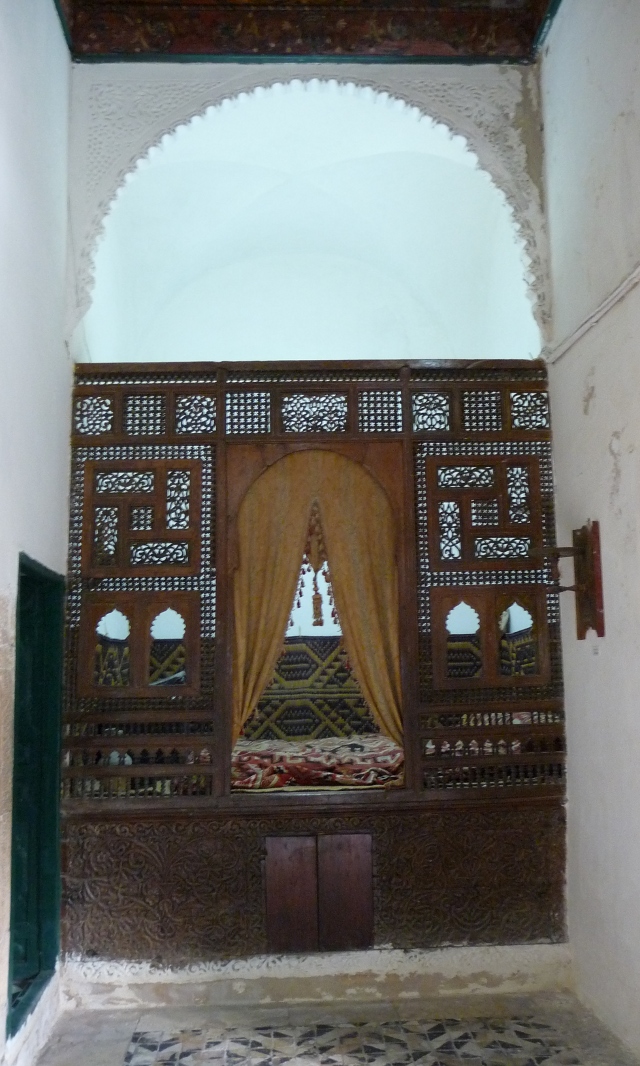
We visited the Café Dirwan, a beautiful atmospheric place, frequented by both women and men. We loved the Dar Jellouli museum of traditional crafts housed in a 17th century town house, galleried around a central courtyard, with original carved screens, tiling and all the details we’ve come to love.

We also visited the Museum of Architecture, housed in the Kasbah by the city walls with its interesting examples of local architectural details.

For lunch we dove into a small local eatery packed with souk shoppers with an Arabic only menu. We didn’t know what to have or what there was, but after queueing to wash our hands at the central sink with everyone else, we were seated and some suggestions were made to which we agreed. Along came some of the most delicious soup ever. We are fast learning that Tunisian soups are really some of the best we’ve ever tasted. They’re hot, spicy and filling, and very yummy. Then some salads and bread, and then Kamounia. A cumin lamb stew with a thick sauce, again really quite hot but so delicious. You can eat so well here for so little, especially at the little hole in the wall places.
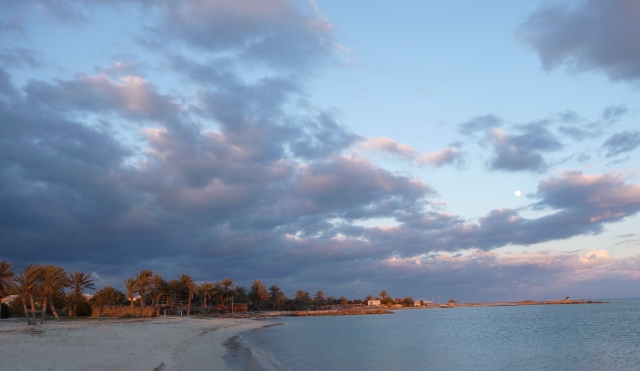
Back at El Kahena, we took an evening stroll with Ismail along the beach as the sun was setting and he shared his concerns for the future for those involved in the tourism industry. Last year’s revolution has kept foreigners away and discouraged further investment, and the economic situation across must of Europe also affects visitor numbers.

We were sad to say goodbye to Ismail and Sonia as we’d had a wonderful few days at El Kahena, but the road was calling us to move onwards again. We felt we’d gained a deeper view into Tunisian everday life off the beaten track and we’ll treasure the memories of the people we’ve met.

Posted in Art & Culture stuff, By Country - Tunisia, Food stuff | Leave a comment

An absolute Jem

After a predictable stretch of road – olive trees and small settlements spaced apart by the odd rural grey-market filling station, no more than a pile of grimy 20 litre plastic drums of diesel and a funnel on a stand by the roadside – we arrived at El Jem. The town itself is utterly unprepossessing, with somewhere in the region of not-very-much reason to stop by, apart from one building in the middle.

And that one building is astonishing.

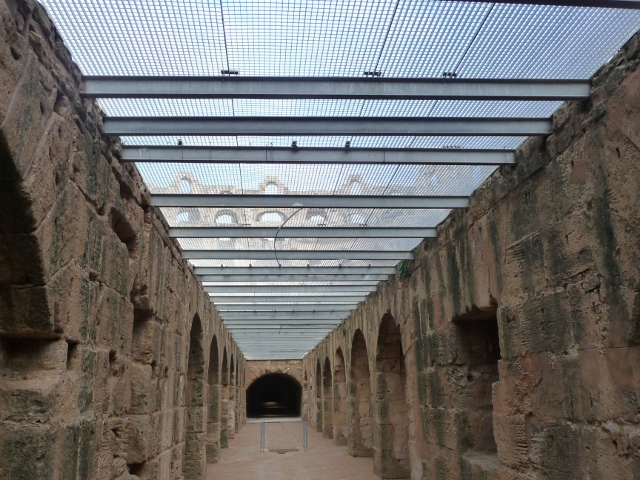
Probably the best preserved Roman amphitheatre in the world, it knocks spots off the Coliseum in Rome. Arles and Nimes and the various others we’ve marvelled at on this trip are distinctly poor relations.

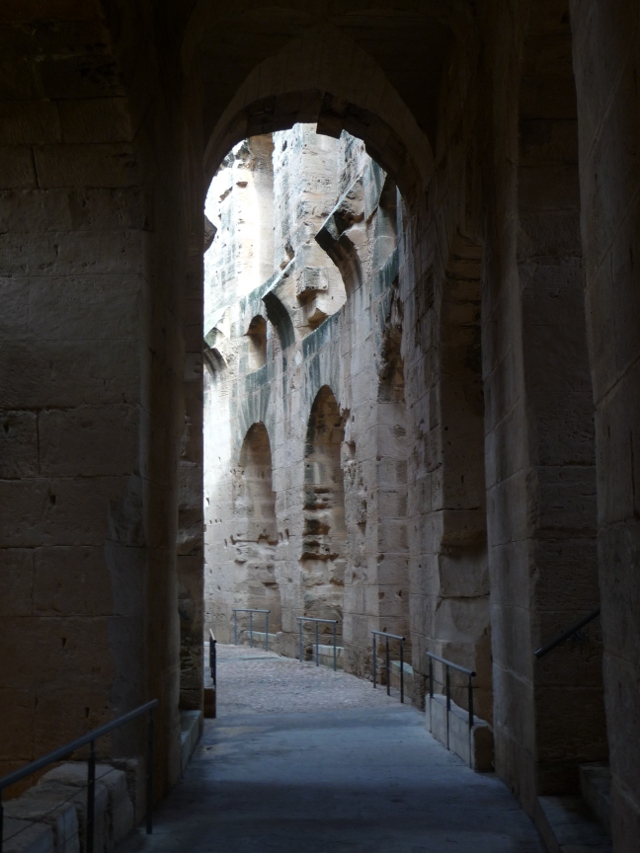
You wander around freely, climbing tier after tier of the passageways that originally led spectators up to the very highest seats in the house.

After you’ve stared down at the Japanese tour group standing in the middle of the arena itself, you then head back down and into the arena, staring back up at where you’ve just been. Then you find the passageways which lead down under the arena’s surface, with small compartments for the various combatants-to-be to wait to be sent up to glory or doom.

The cheers and cat-calls of a capacity crowd of nearly 50,000 people – more than the entire population of the Roman town, such was the draw of a good line-up – are not at all difficult to imagine.

What was most amazing about our visit, though, was that we managed to avoid gaining a friendly “guide” during the whole tour… Others didn’t appear to have been so lucky, so maybe we’re getting that “we’re-not-that-green-so-find-an-easier-target” look about us? Or, more likely, we somehow just slunk under their radar whilst they were looking the other way?

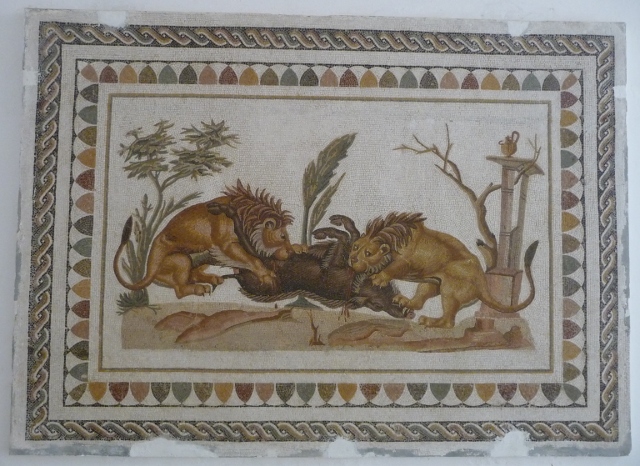
We were less successful with the museum in town, though – we’d barely wandered through half of the rooms chock-full of beautiful mosaics and statuary when we got collared, and ushered through the side door, “specially unlocked” for us.

Outside, there’s the ruins of a residential quarter, together with a fairly complete house. This was moved to the museum’s grounds and reconstructed after being excavated elsewhere around the town, as a demonstration of what a Roman villa would have really looked like. As such, it was very successful – you might think that you’ve got an idea from wandering around knee-high walls, but when you can actually walk into rooms (after your “guide” helpfully moves the restricted-access barriers, of course…) it definitely feels much more comprehensible.

Still, after we ignored a couple of our new friend’s suggestions – we wanted to wander about the quarter a bit more than he thought we did – he got into a bit of a huff, and wandered off to have a ciggy with a mate, talking himself out of his “fee” in the process…

Back to the van, and Ellie made the fatal mistake – she asked a free-range postcard seller how much his faded and dog-eared fold-out-multi-card-thingy was. Too much was the unsurprising reply, not that we’d have bought it anyway, but interest had been shown, and no amount of “La, Shukran, Beslemmah” (No, thanks, goodbye) was going to get him to give up on us.

We reversed out of our parking spot with his big eyes giving us a reproachful stare three inches from the passenger door window.

Posted in Art & Culture stuff, By Country - Tunisia, Travel stuff | 6 Comments

Mahdia

The skies opened as we arrived in Mahdia and looked half-heartedly for the supposed unofficial camping place between two closed hotels… we didn’t find it and made for a hotel in the Medina instead. The first one we looked for was highly recommended by our guidebook, however it never did finish the renovations they were talking about in 2008 and was still closed, work part done. We went for the next option – Hotel El Medina, and found it delightful and cheap.

The room gave out onto the first floor of the central courtyard and by now the rain was pouring in. We didn’t relish the thought of going out again, waiting some while for a lull so we could go and get our stuff from the van, thankfully parked not faraway. It kept on coming though and we were hungry. Where was going to be open on such a horrible night? We asked the reception chap for some recommendations and started to make our way to where we thought the restaurant was. Water was teeming down the streets and the cobbles were slippery. In spite of the rain, we were approached by someone purporting to be a member of the family running our hotel. He took us straight to the restaurant … possibly it was the only one open in the town? Worth a small tip to get there quickly althiough we arrived absolutely soaked through, and cold as well as wet. We had a pleasant meal there though for very little money.

Back at the hotel it was freezing in the room in spite of our hosts’ best efforts to provide a portable heater, which he had to swop around the different rooms. I think the European cold spell has made its presence felt on the southern shores of the Med, and they’re not used to it, and we’re not used to it any more either!

What a difference the next morning. The sun was shining brightly. We had decided not to stay another night in Mahdia though and our friendly hotel staff were worried that they’d done something wrong. We couldn’t fault the service, we just couldn’t face another cold night.

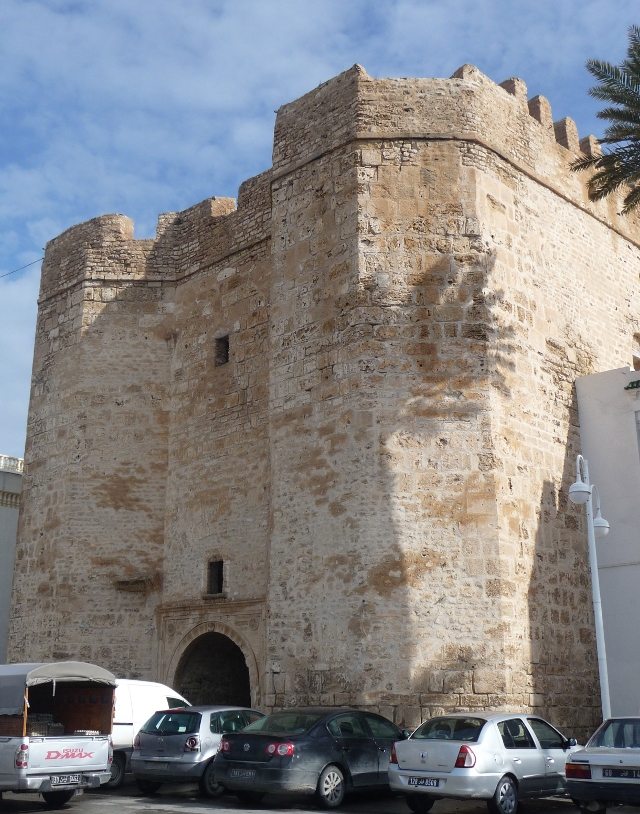
We set out to explore the Medina, which was starting to dry out. As with the other towns along this stretch of coast the new town boasts many faceless hotels and complexes, but Mahdia’s Medina sits apart from this, on a spit of land not as much as half a kilometre wide. It is small and beautifully formed with its Skifa el Kahla (meaning: the dark passage) – a 16th century rebuilding of a 10th century fortified entrance.

The deep tunnel like gateway was described by Olfert Dapper (translated by John Ogilby) in 1670 as “so dark that it is terrible to strangers, seeming rather a murdering den than an entrance into a city”. It is an impressive building but much friendlier now, with trinket stalls and not a murderer in sight.

Looking down into the entrance tunnel.

Next door to the Skifa, we visited the archaeological museum, which was impressive. Not large but airy and bright and showing off mosaics, statuery and traditional wedding costumes amongst other things. As so often in this country, we were approached by a member of staff, or just their friend, who opened up rooms for us and then promised us a special view of the city. We were dubious, but followed along nonetheless expecting to be led up to the roof of the museum. Instead he took us through the backdoor and up the Skifa – right to the top of the fortification. We were thrilled and there were great views as promised.
We strolled through the fish market, and the rows of live chicken and egg shops, and up through the narrow streets past the delightful Place du Caire with its cafés. A meandering cemetery stretches across the sea end of the Medina down to the shore where there are  fishing boats moored in the remains of a ancient port. There is also an imposing fort and a huge mosque, though this latter was rebuilt in the 19th century.

So really we had done Mahdia and although we felt a pang of guilt at leaving a charming place so soon, we also wanted to head on to El Jem while the weather still held good.

Posted in By Country - Tunisia, Travel stuff | Leave a comment

The tourist coast

Our arrival at Sousse saw us fighting traffic and a seeming total lack of signage to try to find the Maison de Jeunesse. These institutions are government run, and provide a mix of extra-curricular education for kids and cheap/cheerful accommodation for travellers. Our first night in the country was spent at a similar establishment, but that was much more like a rough-and-ready campsite. This resembled nothing much more than a sprawling ’60s urban school – but they were happy to have us kip in their car park and use their showers and loos.

Once installed, we unloaded the bikes and headed off round a massive one-way system through the main “zone touristique” of the city. Hotels and restaurants of wildly varying levels of flashness, salubriousness and closedness lined the road, but we were soon at the heaving main square which marks the edge of the Medina and the main hub of the city. A real mix crowded the square – everything from mobile exhibition stalls for each of the three mobile phone networks to a slightly scruffy houseware and clothing market, via the ubiquitous tourist tat. As we headed in to the Medina itself, we were soon reduced to just one of those – yep, the tat. The hard-sell here seemed to be more marked than Kairouan or Tunis, and as we headed along the main passageway through, we were hailed in most major European languages by shopkeepers. After a short wander around the inside of the walls, though, to find that the museum in a tower-fort is still closed for restoration several years after our guidebook suggested it was due to re-open, we headed back in on a different passageway – and the whole feel changed completely. No tourist tat, no hawkers – just a feel of being in a proper “locals’ area”. The shops were completely different, selling gold jewellery, clothing and other items aimed at residents. Other doorways opened onto small workshops containing cobblers and other artisans. A food cart provided us with a delicious “chapatti” – nothing like the eponymous Indian flatbread, but a round leavened bread toasted and filled with a made-to-order herby omelette, salad and harissa. As we wandered back to where we’d left the bikes, we stopped in at the Ribat, the old fort and barracks on one corner of the Medina – a wonderful shell of a building, with great views of the town – including the lovely and unusual fretwork-like minaret of one of the nearby mosques.

The next day, we headed out to a couple of villages north of town – Hergla, with a wonderful old centre on a small rise overlooking the sea, which seems to be surviving unscathed despite the outskirts expanding massively with hotels and apartment buildings. The village has long been the centre of weaving a coarse grass into filters for olive oil pressing – and, of course, has now developed that into a tourist trade. However, it’s done so in a very low-key way, retaining dignity and integrity. Many of the women in the village were dressed in colourful and flowing traditional costumes, including those running a couple of small shops on the main square. We couldn’t resist adding a few of their woven items to the van’s interior – a hanging pot for keeping veg in, and a colourful fish to protect us against the evil eye. Don’t ask why, though, but we seem to have taken virtually no photos!

Our next stop, Takrouna, was a small village with an old centre occupying a tiny outcrop on top of a large rock.

We’d seen postcards, and it looked fantastic – but our guidebook dismissed it with a slightly scathing comment about it being ruined by tourgroups, with the attitude of the residents being a mix of hostility and opportunism. We found nothing of the sort. It’s a fantastic location, far far smaller than we were expecting. There’s not very much at the top, once you’ve wound your way up the steep access road – just some rough pathways straight onto the rock, a couple of ramshackle houses, and the ubiquitous shrine.

We were greeted with enthusiasm and curiosity by the guys hard at work on a retaining wall and on restoring the shrine – they stopped work for a chat, insisted we took photos, and seemed generally delighted to see some visitors – with no hassle or pressure to buy anything at all.

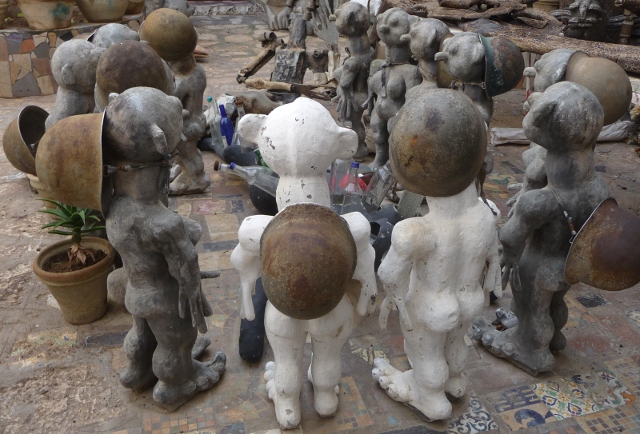
After another night in the car park, we headed down the coast – but not before stopping off at a private contemporary art museum in the house of a local artist. As we pulled up near a long line of plastic chairs lined up along the pavement, we were greeted by the son of the artist with the bad news that they were closed for the day due to the death of a neighbour – the chairs being for visitors and mourners to sit in whilst paying their respects. Our disappointment was short-lived, as the artist – Taïeb Ben Hadj Ahmed – said it was OK for us to come in. I’m not quite sure what we were expecting, but this definitely wasn’t it. It’s not really a museum or gallery as such, more of a cross between a house/workshop and Aladdin’s cave. Room after room, courtyard after courtyard is _rammed_ with artworks made from all sorts of recycled materials, together with items which may one day be used in other works.

Beautiful abstract marble sculptures sit next to a line of caricature people made from old gas bottles, next to a circular staircase made from old bicycles. We were guided through, and just stared open-mouthed as we rounded each corner or passed through doorways lined with hundreds of household electricity meters or sunglasses or watches.

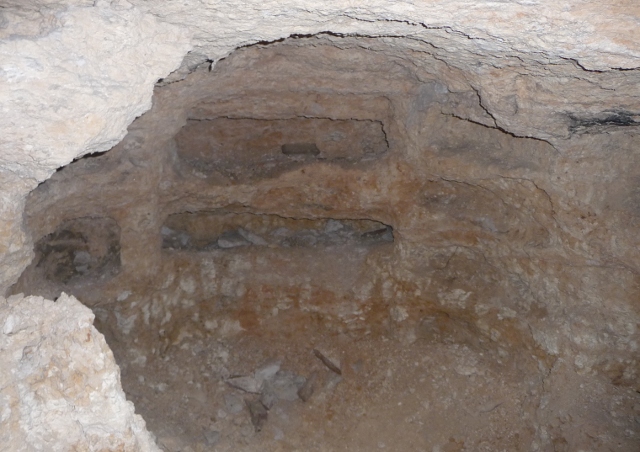
After that, the nearby early Christian catacombs seemed somewhat flat. It’s difficult to believe that we’d say that about a 5km network of underground passageways containing tombs dating back to the third century, but true. Sure, the few hundred metres of “public” passageways are massively heavily restored, and totally different – much taller, and very differently constructed to the rough-hewn few areas you can peer through to the unrestored passageways. We had an unofficial guide latch onto us as soon as we entered, as ever. When he asked us if we’d like to see one of the unrestored sections, we anticipated a door being opened and a bit more of a peer through – maybe to a single chamber just around a corner. But, no – we were led on a long tramp around damp and dank passages, so low that they were barely accessible bending almost as far as you could whilst walking, and lit only by a tiny candle each (the guide was a bit better prepared, and was using the light on his mobile phone!). I’m really not sure it’s in the best interests of the preservation of the catacombs – especially the demonstration of how soft the rock was, by just grabbing handfuls of wall and crumbling them – but it did make for a more interesting visit…

Monastir, just down the coast, was another disappointing tawdry mess of a tourist resort. It was also the birthplace of Habib Bourguiba, the first president of Tunisia after independence from France. Deposed in a coup in the late ’80s by Ben Ali, himself ousted in last year’s revolution, Bourguiba’s fondly remembered by many Tunisians, it seems – we’d had a chat with the caretaker of the Maison de Jeunesse in which he explained some of the reasons and the failings of Ben Ali, whilst lauding Bourguiba to the skies. The presidential mausoleum is just off the centre of Monastir, a luxuriant mini-palace with two huge minarets and a golden dome – very impressive, and adding to the theme-park like feel of the rest of the centre of the town (but more positively!). There’s also a tacky golden statue of a school-age Bourguiba, celebrating his school days in the town.

Shame they ripped down the actual school to give the statue a prime location, though…

Fairly quickly, we were on the road again, heading down the coast towards Mahdia. Monastir had seriously dampened our expectations – and the darkening skies weren’t helping much.

Posted in Art & Culture stuff, By Country - Tunisia, Travel stuff | 3 Comments