From the Alps to the coast

We woke up to bright sunlight and the anticipation of exploring our first new country for a while. The campsite at Vinadio charged extra for showers – €1.50. You put the token into a machine outside the two showers which backed onto each other. However, there was no guessing which shower would come on. So to make the most of my shower time, I tried to second guess and got undressed and ready to dive under the shower head in shower number one, with Adrian poised outside with the token. Yes, that’s right, of course the water started in shower number two and I had to run round the corner to it clutching my clothes and toiletries to my half-nakedness! Adrian assures me that this was really quite amusing.

From Vinadio we took the last few winding lanes in the mountains we could before heading across a plain towards the coast at the top front of the Italian boot. More verdant valleys greeted our lunch detour south of Mondovi. We picniced in a glade at the side of the road before getting lost trying to re-find our main route, which snaked through tunnels and over high bridges in the hills towards the coast at Savona. We were disappointed to find that our shiny new Michelin road atlas to Italy didn’t show many road numbers. Then we realised that the road signs, when there are any, don’t tend to show them either. Navigating this country is going to be challenging! We’d read that the coast west of Genoa is very developed and busy. It is the Italian Riviera and the grey sand and pebble beaches were crammed with bodies basking in the sun of the last weekend that could be considered summer. Although not our usual choice of environment, we were keen to visit Genoa and points on the coast east of the city. We’d avoided the French Riviera, so it was fascinating to see the Italians at leisure, and on the roads whizzing and weaving on mopeds, and in Apes and fast cars. One snag. Very few campsites that we could see – certainly not signed from the coast road. It was getting to be late afternoon as we got closer to Genoa, and it was obvious we’d have to go through the city and try our luck on the other side of it.

East of the city the road climbs up and around and down beautiful hillsides with cypresses, pink or yellow terracotta roofed houses with green shutters and stunning sea views. It all has a much plusher feel. There are several resorts where the rich people come. Lots of yachts. The evening light heightened the affect as the sun seemed to set all too quickly. And still no campsites. Then we ended up turning down two … a precarious choice given that we’d seen so few. But the price demanded and the standards on offer just didn’t match up. We were keen to find one within easy reach of public transport to the city. So getting quite anxious as the light was fading, we kept on going through town after town. Eventually tracking down an over-priced cat litter tray of a campsite by the sea but under the railway line at Chiavari, where we shoe-horned ourselves into the last pitch. Wine was opened and dinner cooked immediately and we started to feel a bit more relaxed!

I went to hand over our passports at reception (Italian campsites insist on this), and asked the manager/owner if there were any discounts available. No madame, it is already discounted … Are showers included? Oh no. You’ll need 50 cents for those. Somehow I managed to wangle a couple of 50 cent pieces from him, and was relieved to find that the token box was in each individual shower cubicle this time!

Deiva Marina and the cycle race
We were relieved to leave our cat litter tray and continue onwards along the coast road. Giving up the idea of being close to Genoa, we aimed to be closer to our other goal for this part of the trip, the Cinque Terre, of which more later, and a campsite at Deiva Marina. Thinking we were following the main trunk route along the coast, the SP1, we were actually on a smaller road which clung more closely to the sea’s edge when it wasn’t hurtling us through around 10 km of narrow tunnels on and off, thankfully traffic lighted. We came out of the last bit of tunnel at Deiva Marina only to find the road into the town closed for an event. No choice but to turn round and wait ten minutes for the next timed green light. Had there been a sign telling of this road closure earlier on? Don’t think so as we were far from being the only ones.

We then found the main road and headed towards Deiva Marina through the hills instead. We came across a traffic jam. It was another road closure still preventing us from reaching Deiva Marina. This time we could ask what was happening. It was a huge annual cycle race, the Granfondo de Cinque Terre, and the official said that the road would open in an hour’s time. A phalanx of about 100 cyclists came through shortly after this. We were then one of a handful of vehicles waved through and we headed down the steep windy hairpins towards town. The race was still continuing though and we were overtaken at every turn by more and more cyclists whizzing past. And at midday we managed to nab the last spot at the campsite. After some lunch, we strolled the 3 km into town to see what was happening. The place was heaving as the start and end point for the race, which covers 150 km with more than 3 km altitude difference and with up to 20% of gradient. Cyclists were continuing to pour in for the ‘ultimo chilometre’, while others were already packing up and heading home.

Genoa by train
We took the train from Deiva Marina into Genoa for the day. It took us two hours on the way in because the train we thought we were getting only ran on Tuesdays and Wednesdays and this was a Monday. Our train terminated at Sesto Levante and we had to wait half an hour for a connection. There are other trains that run on every day except Tuesdays and Wednesdays and other such mischievous timetabling to fox the tourist. Also there was no information on the platform, or the train. One could assume that Italians must automatically know what’s happening, except that everyone was asking us!

We know that Monday is not the best day to visit a city. Some attractions are closed on a Monday. We took a chance, and well, Genoa was pretty much all closed on a Monday. That’s when we could find the tourist office, which was not at the main train station but deep in the heart of the city, and we had to get a map in Russian from a nearby hotel to find it. We found some nice streets and the cathedral, which was closed for lunch until 3pm, and another important church which was closed for lunch until 3.30pm. We looked in to the courtyards of several former palaces on Via Garibaldi, most now banks (or closed museums!). By this time we were slightly disappointed and frustrated… so we had lunch too, at a tiny crowded trattoria in one of the many dark narrow alleys near the port. We wandered around some more of Genoa’s very grubby streets until the cathedral opened. San Lorenzo was worth waiting for, as was the Gesu church, both of them crammed with paintings and frescoes, including a couple of Rubens.

The alley we took back to the station was vibrant with the city’s African population, the lilt of as many languages as there were grocery stores selling cassava and plantains, and it came closer to conjuring up the essence of this port city. More fun at the station trying to find our platform. It may be difficult to find out which train is going where, but they run exactly on time so that helps!

So unfortunately Genoa comes low down on our list of places to return to, it lacked the wow factor of so many of the other cities we’ve visited. Perhaps one day, Genoa and some other major European cities will decide to open on a Monday.
Posted in By Country - Italy, Travel stuff | Leave a comment

Arrivederci, Francia – Bonjour, l’Italie

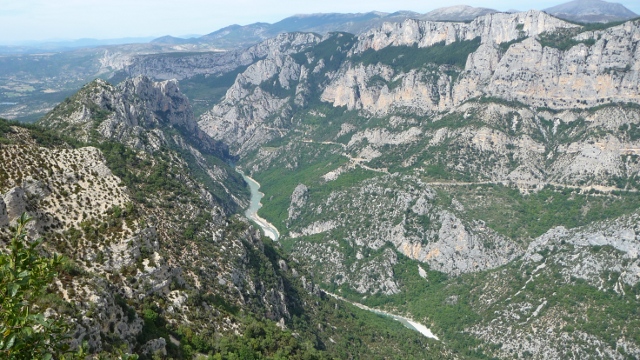
After leaving Aix, we wound our way along yet more narrow mountain roads towards the gorges du verdon – described, perhaps slightly optimistically, as “Europe’s Grand Canyon”. Not quite sure they live up to that – what could? – but they were certainly mightily impressive.

We took the road around the southern edge (described confusingly on the road signs as the “rive gauche” – left bank. perhaps in the direction of flow of the water, but that wasn’t obvious from that distance above it…), and managed to resist temptation to complete the loop, since – as ever – we needed to be onwards.

The views from the gorge were truly astonishing – sheer rock face, plummetting down several hundred metres, to a narrow twisting river, barely visible on the floor. In places, there were even boats moored up – the gorge feeds into a vast lake for a hydro-electric power station. Along the way, one hotel advertised a “Panoramic Restaurant” – we thought that slightly hyperbolic, and it’d be difficult not to be panoramic, given the scenery – then we saw from higher up exactly what they meant. One side of the hotel was actually cantilevered above the edge of the gorge…

At the very top of the road above the gorge, we’d parked up and were standing staring at the view, when we saw our own van coming up the road towards us – an absolute identical twin, with the sole exception of the Michelin man not being present… Half an hour later, we pulled in to a layby to do a quick map check, and found ourselves pulled up behind a very, very close triplet – this time a subtly different shade of red… (and, as I type this in a campsite a couple of days later, our neighbours have yet another hightop Westy – older than ours, air-cooled, and bright green – positively common!)

After Verdon, the road continued upwards – both on the map and in altitude. There’s not that many ways across the southern part of the French – Italian border, leaving us the choice of a couple of pages north on the map or the Cote d’Azur. The lure of high mountain scenery and Alpine passes won out over the people-watching cruise through Nice, Cannes and Monaco.

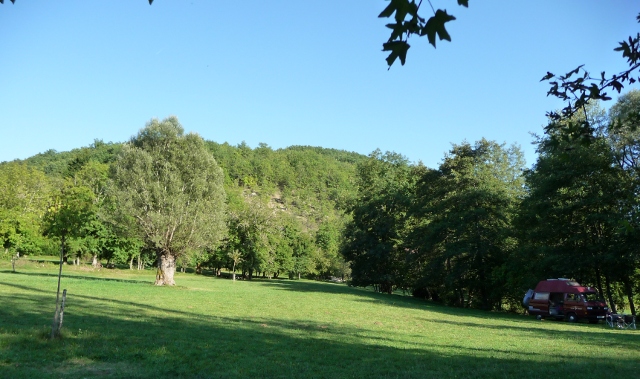
Our last overnight in France was a pleasant little campsite, on the edge of the village of Castellan, just as the road started to get properly steep. The village presented a dilemma, however – there were signs towards a Citroen Museum, but it wasn’t open until the following afternoon. What to do, what to do? We managed to resist temptation – it seemed a shame to, but let’s be honest, if we don’t know what the exhibits would look _exactly_ like by now… Next time, maybe.

The first pass – the Col de Allos – was the lowest of the three, at a measly 2,250m… As we started to climb up out of the upper part of Allos village, the ski resort of Val d’Allos, we had our first glimpse of Alpine wildlife, as a marmot padded across the road ahead of us. They’re surprisingly large – a good couple of feet long, and very rounded – probably most similar to a beaver, but without the big flat tail.

From Allos, we continued to the town of Barcelonette – one of the major crossroads in the region, a small and unpresuming town. There appeared to be a contrast between Barcelonette – which our guidebook glowed gently about, yet didn’t appear to be anything particularly exciting or interesting to us – and Allos – which had been dismissed curtly, yet (especially taken with it’s neighbour, Colmars) seemed to be lovely little places, easy to wander through, staring gently at wonderful architecture (Colmars’ fort, especially) whilst their real life unfolded around you. Barcelonette gave a couple of different routes to Italy – the major road Col de Larche, or the minor Col de Bonette to Isola then the even more minor Col de Lombarde past the Isola 2000 ski resort. Since the Col de Bonette is billed as “Europe’s Highest Road”, the choice was made for us.

At 2,802m, we have no idea if there are pretenders to the crown, but if there are, then please point us to them… The scenery was truly jaw-dropping. Right in amongst the peaks, with bare jagged rock in every direction. Looking across, and seemingly down, in high-20s degree heat in September, on snow glinting in the sun – it’d be very easy to run out of superlatives.

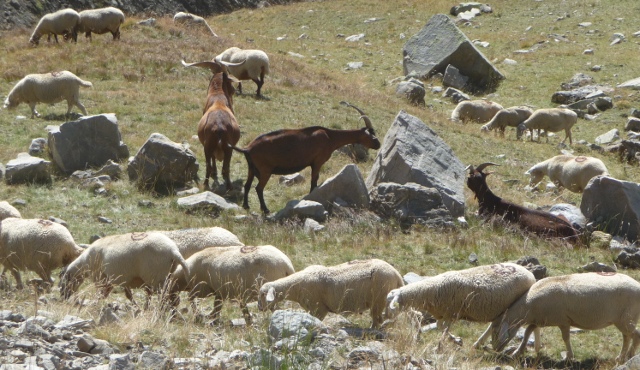
Another treat – curling round another bend to find a huge huddle of wiry mountain sheep grazing on a pasture – and to then realise there were curly-horned Ibex looking like extras from an African safari mingled in amongst them.

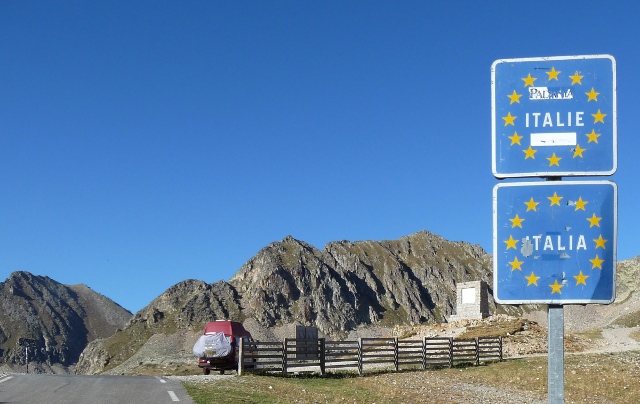
The third pass, the Col de Lombarde, should have been an anticlimax after Bonette – at “only” 2,350m, nearly half a kilometre lower – but it was probably the most dramatic of the three. As we wound up out of Isola 2000 (named after the altitude of the resort itself), the mountains behind us had been landscaped to within an inch of their lives, numerous ski runs carved through the wooded slopes and lifts spidering around in all directions. To then reach the peak of the pass and find that long-awaited sign reading “ITALIA” was a real treat.

The road down was easily the most demanding of all of them, too. They’d all had very, very different feels – and the scenery changed around every single bend (plenty to choose from!).

And so we arrived in Italy. The first town we came across was a familiar name, although we’d not been at the time – host of the 2003 2cv World Meeting, Vinadio. I suspect it had been a great deal less sleepy then than we found it, although one thing hadn’t changed – The baker’s shop that we bought a loaf from had a window display of model 2cvs, including two big cuddly cars embroidered with the meeting’s logo.

Posted in By Country - France, By Country - Italy, Travel stuff | 1 Comment

Expectations versus Reality

It’s been a most educational leg of the trip, to be honest. It’s not that we’re exactly neophytes at this lark – bimbling along, finding our night’s accommodation as the afternoon starts to turn into evening, and figuring out day-by-day which way next. Even before the last few months, we’ve done exactly this for holidays for years.

Red rag, meet bull.

But the last week’s been somehow different. South-West France was somewhere that we had preconceptions and expectations of, but neither of us had any prior real experience.

Let’s start with Carcassonne. It was one of the non-negotiables of the trip. Must. Go. There. Anybody who’s read Kate Mosse’s “Labyrinth” can’t fail to have a mental image of the place, both in terms of the historical framework and the present-day reality. So, when it started to fall into place that we’d arrive there the evening before Ellie’s birthday, spend the day and a second night there, it seemed like everything had lined up.

Gawd, were we in for a shock.

The Cité – the Cathar castle/fortified city – is, when you view it from a distance, exactly what you expect. Except it isn’t real. It’s a 19th Century “restoration”. We’ll come back to that later. The campsite’s very handily located for it – just a short wander along a little side stream, then up the hill. The guide book suggested we wanted to go round the back, and enter in the main entrance, rather than the riverside gate. First off, the back lane up there was just, well, a bit shabby – before taking you into the far end of the main car park. Finally, the main entrance hoves into view. In you go. Within seconds, our spirits were sinking. We’ve been in some over-touristy places, but this was rapidly heading into theme park territory. Honestly, it’s just dire. There isn’t a single square inch that isn’t aimed solely at the deep exploitation of the further reaches of the passing touron wallet. I s’pose it should have been expected, but somehow it just headed way beyond what we’d steeled ourselves for. So bad, in fact, that after a quick once round we left and headed down the hill for the Ville Basse. That went the other way. Just a bit dull and nothing much to see. By lunchtime, we’d headed back to the campsite, and were rummaging through the tourist office bumf for something, somewhere local and circular to do in the afternoon…

Would you like fries with that?

In a way, it’s utterly ironic. The Cathars are the whole backbone of the tourist industry of this corner of France. They were a 12th-13th century religious sect, who pointed at the established church and said “You guys, you’re just living the high life by exploiting religion”. (You have to admit, they’d probably got a point… Especially after seeing Avignon’s roughly contemporary Palais du Papes…) Of course – this aroused just a little ire. Enough to get a whole crusade (the Albigensian), which the ever-so-slightly ruthless Simon de Montfort (of the University, in Leicester) launched on them, taking the Cathars to the point of absolute extinction. Maybe they did go a bit far, in proclaiming the entire physical world the work of the devil, but one thing’s for sure – they’re spinning in their graves at the way in which they’re being exploited now.

About those “restorations”. Viollet-le-Duc is the man we’re pointing at here. He rapidly built himself a reputation as THE guy to go to for restoration projects in early-mid 19th century France, just as the whole heritage idea was starting to take off, and with the aftermath of the revolution (never mind the guillotines – cathedrals, chateaux and anything “establishment” were being plundered and demolished in the name of Liberté, Égalité, Fraternité) still fairly fresh, there was a lot needing restoring. V-l-D, though, quite quickly started to move into the realms of embellishment. Whilst we’re talking about Carcassonne – those pointy towers, crenellation and arrow-slits in the walls? Nope. All his idea. It turns out that there’s barely a medieval site in France which didn’t get passed by his nose at some stage, fortunately with varying degrees of completion.

Of course, this all raises another question, one which Oradour touched upon – if you’re looking at some historical stasis, where exactly do you draw the line? Nobody ever flomped down a set of architectural drawings for any of these buildings and said “Right, lads – this is what we’re doing – get started on the foundations”. They evolved, they metamorphosed, they changed. Across centuries and centuries, styles and styles. So, just as the buildings of Oradour are propped up by steel frameworks and strappings in order to remain just-derelict-enough, is Viollet-le-Duc’s “restoration” any less “authentic” today, heading rapidly for two hundred years later, than anything else? Where IS the line in the sand to be drawn?

Again, an example. The Atelier Cezanne in Aix-en-Provence. Paul Cezanne built a house on a hillside just outside the city, as a studio. He worked there until he died of a fever gained by painting in the garden in the rain. The door was then locked for 15 years. Over the next couple of decades, it drifted in and out of the edges of preservation until it was saved from demolition in the 1950s, when the city started to seriously climb that hillside and engulf it. Now, it’s preserved “exactly as it was”. But exactly as it was when? And in a few more decades, what then? The ceiling plaster’s looking cracked. There’s alarm wiring and the like which I’m fairly certain wasn’t there back in 1906. And then there’s the expectations of modern tourism – access for the disabled, parking, lighting, information provision.

But – somehow – the Atelier Cezanne “gets it” in exactly the same way that Carcassonne doesn’t. You stand there, and you look at “Cezanne’s Easel”, “Cezanne’s Paint Pots” and “The Vase In That Still Life”. As Ellie put it, it’s kind of like seeing your favourite celeb in the street. A link.

And that’s why some of the places that have surpassed our expectations have worked. Albi – we knew from the guidebook that it was Henri Toulouse-Lautrec’s home town, and had a museum dedicated to his work (but without actually containing any major paintings). But the whole way that the cathedral and the museum fitted in to the life of the real live 21st century city just worked. A 12th century cathedral, with a BMX competition – French-language rap blaring from large speakers – right outside. Sure, there were no major HT-L works – but there were a huge number of his preparatory sketches, his workings-out, and his minor stuff, across his entire life. It just gave far more of an insight. The same with Arles – never mind Van Gogh, the way in which the town just spread out around the Roman arena and amphitheatre, in which the gorgeous architecture was just in real use instead of being gently pickled in heritage aspic.

Albi’s cathedral gave a great example of the way in which modern technology could massively enhance a “sight”, but needed marketing carefully. The main body of the cathedral’s free to enter – and very impressive. But if you wanted to get access to the Grand Choir, it was €2 each – but with a free audioguide. After a bit of muttering, we decided that we would – and it transformed what would otherwise have been a pleasant 15-minute wander into an hour and a half of absolute absorption, with a few chuckles too. On the other hand, the audioguide in Avignon’s Palais du Papes was just dull. We listened raptly to every single side-track in Albi, but barely finished the main descriptions in Avignon. A story was conjured, and the historical framework was brought to life. Nime’s arena did the same – but a bit too far. Avignon? I could probably tell you exactly how many pillar stanchions were on the East Wall of any given room. If I knew – or cared – which the East Wall was.

Then there’s the little unexpected pleasures. As we headed towards Millau, we descended into a small village called Roquefort – not an uncommon name, having been through several Rocheforts and similar. The first building we came across was light-industrial, sign-written as a cave. Must be another co-op winery. Then another, then another. Then a building with a large mural of blue cheese on the end wall. Finally, light dawned – it was _THAT_ Roquefort… Similarly, heading through the Corbieres wine region, we saw a sign for a village called “Camplong”. That rang faint bells, since we’d had a supermarket wine box of “Chateau Camplong” for the big 2cv meet. At the time, we thought it was just an amusing name, since we would indeed be camping long, and assumed it was just the product of some light branding brainstorm sessions. But, no, suddenly we’re faced with tractors towing trailers laden with grapes, heading for the village co-op winery… There was that link again.

Another totally unexpected sight greeted us at the very end of the Camargue – in itself, every bit as wonderful as we expected. Wide open, flat and slightly unearthly landscapes, not unlike the fens – but with fields full of black bulls for the local fights (non-lethal, with the aim being to grab ribbons tied to the animal’s horns); with wild white horses meandering around – complete with egret riders; and also the sight we most wanted to see here – marshes of flamingos, bright pink against blue water and sky. Then we got past the salt fields of Salin de Giraud, towards the Plage de Piémanson and found the usual handful of fridge-freezer camper vans parked on the hard packed sand. Then some more, and a caravan or two – some embedded firmly into the sand with all the encumberances of permanent encampments around them, others long derelict. Then more, and more, and more.

We’d clearly stumbled along some kind of alternative town, a refuge against the world in this end-of-the-world location. As we drove around, heading towards what appeared to be the main body of the town, two sights caught us roughly simultaneously – a naked backside and a scrawled sign “Ici on vit nu” – “Here one lives nude”… Ah. According to the long standing tradition of the finest gutter journalism, your correspondents made their excuses and left. Not (honest!) out of prudishness, but just to avoid being thought of as voyeuristic gawpers – which brought us back to another one of those recurring themes. If people choose to live outside the norms of society in this way – and why on earth shouldn’t they – what motivates those around the fringes? I’m thinking here particularly of those in £50,000+ all-mod-cons campers, whose primary motivation (as presumed from some of the other overnight camping spots they choose) seems to be to avoid spending a tenner on a campsite for the night. There’s a system of Aire de Service de Camping Car throughout France and other countries. One corner of a carpark will have facilities for chemikhazis and sink waste tanks to be emptied, and for fresh water tanks to be replenished. Then there’ll be a few spaces available to park in overnight. And they’re nearly always rammed full. They really are just carparks. You can’t “camp” – open out an awning, or get your table or chairs out. You just park, in the middle of a row of other campers, squished in so tight that you can just about get to the door. We stayed in one in Leon – it was handy for the centre of town, and we weren’t going to be around the van other than to sleep – whilst the nearest campsite was a fairly desolate place in the middle of building sites for urban sprawl. But to go to one through choice? It’s not even as if the camping site cost is the greatest expense of this trip – that’s fuel, by a long chalk. Even where there are lovely campsites – you’ll find a fridge-freezer or three parked up in a layby half a mile down the road, curtains closed.

Nowt so strange as folk, eh?

Posted in By Country - France, Personal stuff, Uncategorized | 4 Comments

Cutting a swathe through Southern France

So what have we been up to over the last week? I’ll keep this latest installment of the blow-by-blow travelogue fairly brief and factual – we’ve done too much and been too many places to do much other than split the reflections off into a separate post.

After leaving Paul and Janice’s, we headed through the Dordogne and Lot valleys again – just south of where we’d been a month before when the driveshaft had a little lie down. Fortunately, this time it was much less eventful…

St Emilion, with militarily-precise rows of immaculately tended vines. Rocamadour, with its shrine perched high above the valley. Limeuil and Cordes-sur-Ciel – two little gems of villages, so beautiful that they shone through the (fortunately thin) layer of Cotswold-style smugness which could so easily have taken them over. The Grottes de Peche Merle, with prehistoric cave paintings so fresh and vibrant that it was difficult to grasp just how ancient they were. A campsite sent directly from heaven, with 50% more large fields to choose from than camping units there – we finally chose the banks of a stream, and sat watching ducklings.

Other campsites which just soared above the average – a meadow of wildflowers directly behind our pitch, under one of the best sunsets so far (and complete with bouncing kitten).

And so we got to Albi. One of the surprises of the trip, we thought it’d be a basic in-and-out job, to see the Toulouse-Lautrec museum, but turned into a very pleasant meander around a vibrant city, where heritage and life sit comfortably side-by-side. Then on to “must-do” Carcassonne, which turned out to be the diametric opposite. Still, the afternoon circular bimble around the area was rewarding – the “book town” of Montolieu, the sole survivor of a number of water-powered paper mills in Brousses, then the four ruined castles of Lastours high on a ridge.

Happy Birthday, Ellie!

Another wonderful campsite – which allowed us to have Ellie’s (slightly delayed) birthday dinner sat right on the banks of the Tarn – then on to Millau, the other “must-do” of this stretch of country, and it didn’t disappoint – the viaduct really does live up to all the superlatives aimed at it, sitting comfortably amongst outstanding scenery which could so easily have been trashed by a motorway being cut through.

East of the viaduct, the Tarn cuts through a series of gorges, giving rise to dramatic cliff faces. The road winds along the bottom of the gorge – beautiful. Then we reached one end, and turned onto the road cutting past the end of the Gorges de la Jonte and on to the Corniche des Cévennes – and climbed, climbed, climbed. All of a sudden, we were at the top of the gorge, staring down at the road we’d just left – we’d been one of those model-railway scale toy cars minutes before.

Donkey-less, the Cévennes played hide-and-seek with us through low cloud as we wound our way towards Nîmes – the Roman Amphitheatre is definitely worth the visit, still heavily used for 20,000 capacity concerts and other events – which means a summer tarmac base and tiers of wooden seating on steel frames, but they were easy to mentally erase as you imagined the gladiatorial battles far below – and a small price to pay for the venue fulfilling its designed purpose two thousand years on.

From Nîmes, a great comparison in neighbouring Arles – which surpassed our expectations – and down through the Camargue, before heading back to the Pont du Gard – the €15 parking fee nearly putting us off completely. It was worth it, though, especially with our encounters with other aqueducts in Tomar and Segovia to compare with.

Then Avignon, and on to Aix. This is where we sit now, in the shadow of the Sainte Victoire mountain immortalised in paint by Cezenne many times, trying to play catch-up after a fairly non-stop week.

The delays of the last month mean that we’re seeing the first approaches of autumn, and are having to continue to press on a bit, as the inevitability of winter – where will we go? – starts to become ever more obvious.

Of course, the other problem has been that there’s always just so MUCH to see and do!

Posted in By Country - France, Travel stuff | 1 Comment

Oradour – two personal reactions

Adrian says…
Now we’ve been there, what did we find? Well, the broad reality was everything we expected and more. It’s a ghost town, with a terrible story to tell. It does that – with the help of the visitor centre – well. Not perfectly – the visitor centre concentrates a bit too much on the back story of the Nazi party and the build up to war, with very inconsistent and incomplete translation.

But it’s not just about that, is it? It’s about the village itself. And, in the event, we found that much less affecting than we expected.

Maybe it was the fact it was a hot, sunny day with a flawless blue sky.
Maybe it was all the similar stories we’ve already experienced – Mont Mouchet, Tulle, Brive.
Maybe it was the fact that we were far from alone there – there was, of course, a constant stream of other visitors.
Maybe it was the way in which so few of those visitors seemed to have the most rudimentary understanding of the concepts of respect and appropriate behaviour.

When we first pulled into the car park of the visitor centre, the “Camping Interdit” sign seemed monumentally unnecessary. Surely nobody would even contemplate it? How wrong we were. Having experienced people holding mobile phone conversations, flouting the (again, surely unnecessary?) signs barring smoking and photography, and just holding normal volume conversations – joking and laughing – we could only remind ourselves of George Santayana’s maxim that those who do not remember history are doomed to repeat it.

Similar episodes have already been repeated – many times. Vietnam. Rwanda. Bosnia. Iraq. Afghanistan. And they’ll be repeated again, many many many times.

Sorry if this post’s been a bit of a downer. Normal service will be resumed shortly.

Ellie says…

Walking in bright sunshine among the ruins of a village is something we’ve done several times during this trip, but those settlements were thousands of years old. To walk through a village that was ruined less than 70 years ago is very different. Oradour was so obviously like so many French villages we’ve been to. Several cafes, a couple of garages, a doctor, a dentist, hairdressers, stonemason’s workshop, a pretty church and so on. Even a tramline.

Today, it’s mainly parts of the outer walls and anything metal that survive to tell the story of the people who used to live here. Nearly every building has a shell of a sewing machine, many have the tangled springs and twisted pipes of what was once a bed, a bicycle, an old stove, a cooking pot here or there, garages full of rusting car hulks, a mess of chairs and tables in one of the cafes.

Plaques show what the businesses were and the name of the proprietor or family. Plaques also show where people were shot.

Before coming to Oradour, I was worried about how I would feel – I felt sure it would be very emotional and poignant. It was, but it didn’t affect me anywhere near as much as I expected it to. I tried to blot out the other visitors… I tried to imagine what it must have been like to be forced into a village square, to be separated from your menfolk and to be one of more than 450 women and children locked in the tiny church, into which grenades were thrown and which was then set alight. Perhaps your mind protects you by detaching you from such atrocities.

I wish that we could have visited on a less sunny day, early with no one there and I wish I hadn’t gone to the (not inexpensive) museum to read yet again about the rise of Nazism. Although there was information and pictures about Oradour before 10th June 1944, there was little to connect you with the people. With so few direct survivors, there are few eyewitness accounts. However, I wish we had got to the bookshop before entering the museum. We would have found the book by one of the men who escaped, written together with a man who was not in the village that day, but whose family were all killed. They record as much as they can remember about the village and its inhabitants, and tell about the terror of the 10th June and its aftermath. You can buy a short version of this and to read this while walking the streets of the village would give a clearer personal insight into the events that happened here.

The cemetery and official memorials show poignant fragments of the lives lost … the crushed pocket watches stopped around mid to late afternoon. The piece of a child’s letter to her mother. A child’s toy.  A pair of spectacles. And the ashes … all that was left after the SS obliterated the existence of so many ordinary innocent people.

Posted in By Country - France, Personal stuff | 11 Comments

Oradour-sur-Glane

Early June, 1944. It’s the week after the Normandy Landings. The German Army are desperately trying to mobilise as many troops as possible, to reinforce those attempting and failing to quell the invasion. Troops across all of France, especially the portion under the Vichy government, are trying to get there, but meeting heavy opposition from the Resistance.

One unit, the 2nd SS Panzer division (known as “Das Reich”) were instrumental in recapturing Tulle, in the Correze, from the Maquisard resistance who had briefly liberated the town. As a reprisal, they hanged 99 townsfolk from lamp posts on the 9th June.

During the early afternoon of the following day, the 10th June, around 200 members of the same division entered the small town of Oradour-sur-Glane, just west of Limoges. They split up, encircled the town, and searched thoroughly. The nearly 650 people they found were forcibly taken to the main town square. There, the men were lined up on one side, before being split into several groups and locked into barns and garages. The women and children were taken to the church. They thought the village was going to be searched for weapons – confident that the disruption would be temporary, and that no weapons would be found. They underestimated Das Reich.

Only one woman and five men escaped to watch the town burn that night.

In 1946, the French government decided that the remains of the town should be preserved as a memorial. Today, it is in a state of suspended animation. A bare minimum of repairs and upkeep are made to preserve the ruins as close as possible to the way they were left. Oradour has been rebuilt nearby. A “centre of memory” has been built to help visitors understand the background before they enter the “martyr village”.

Posted in By Country - France, Personal stuff | 2 Comments

On the road again…

After our extended pause, we’re glad to be back on the road again. We’ve spent a couple of days heading westwards, from John & Steve in the Correze towards Paul & Janice in the Charente. 2cv friends, their house was our intended destination when the van had its little sulk.

With one exception, the route has been pleasant if not memorable, other than for the fact that it’s just the four of us together again. Ellie, me, the van, the map. A tight-knit little family group, not without our disagreements (especially the map – it can be a mischevious so-and-so…)

That one exception has to be dealt with separately – Oradour-sur-Glane, the “Martyr village”. It’s somewhere we’ve long wanted to visit, and now we have. We knew what to expect, in broad terms, of the village but not what to expect in terms of our emotional response. We won’t go into it in this post – read more about Oradour itself here, and our response to it here.

So, onwards we headed. One campsite was all but deserted – necessitating a trip to the Mairie in the village in the morning to inform them we’d been there, and would like to pay… Along the Charentes river, and past vineyards through into the town of Cognac, before heading to the tiny village of Chatenet. When I say “tiny village”, it should be remembered that this is the seat of the local Commune. It’s difficult to miss that fact, when fully one half of the buildings in the village itself is the local Mairie… After going round the village three times, we remembered that Paul had told us they were next to the church. Except there isn’t a church in the village. There’s one up on that hill, though – and there’s a tiny sign in the verge towards “Chatenet Bourg”…

So we’re currently having a few more days stationary. Yes, we’re waiting for some van bits again – one thing we found when changing the CV joints was a missing plastic bung on the gearbox output shaft. Apparently, it’s an oil seal, keeping the gearbox oil from washing the molybdenum disulphide grease from the joint – so not something to omit lightly. Whilst waiting for that to arrive, ready for a small and hopefully straightforward fitting, we’ve molished a special tool or two to change the gearbox oil, so we should be fully prepared and ready to head off again.

In the meantime, we’ve got the stropogram in the post to ADAC about their service and to reclaim the expenses. Any bets on whether it’ll achieve results? We shall – of course – keep you posted. That apart, we’ve had some very pleasant time here so far – a visit to the local night market (a bigger affair than that in Sarran, with food stalls and other vendors filling the streets of the nearby town of Montendre, and a live band in front of the old market hall, now the tourist office), a delicious pasta meal (Paul’s half Italian) with the families staying in Paul & Janice’s three thriving gites, the weekly farmer’s market, a wander through the other local town – Jonzac. The combine harvester has taken in the very dead and blackened sunflowers – to get the most oil, they must apparently be allowed to wither and rot thoroughly. In return for all this hospitality, the freshly ground spices of one of Ellie’s curries have wafted from the kitchen, and we’ve been helping with the turn-around of the gites between guests.

It’s been a(nother) very pleasant little break from the road. We’re now definitely fully refreshed and ready to go again. From here, we’re looking to head towards Carcassonne, then the Millau Viaduct and the Tarn Gorge, before heading through Provence and into Italy.

Posted in By Country - France, Travel stuff, Van stuff | Leave a comment

Killing time in the Correze

We didn’t intend to visit this area other than simply driving through. Our 10 or so days at Sarran, near Égletons – although far from planned – has passed in a most pleasurable and laid back way, tempered by a few anxieties when delivery of the ordered van parts was delayed by the bank holiday. The beautiful gentle hills, forests and farmlands of this department of the Limousin region have really grown on us. Lush green fields decorated by brown Limousin cattle, pretty grey stone villages, quiet sleepy places in scorching weather and John and Steve, our hosts and rescuers who’ve made us so welcome and at home here.

So what have we done? We’ve caught up with a huge pile of laundry and other chores, helped drink lots of beer and wine, and cooked and eaten some fine meals, as well as enjoying constant access to the internet. We’ve also visited some local beauty spots.

Gimel Les Cascades is a pretty village above a steep valley, which, as its name suggests, has created a magnificent series of waterfalls, the tallest one at 60 metres. You climb down the wooded valley on precarious paths and it is very impressive.

The village itself is very pretty and has narrowly escaped being too touristy. There is a newly opened craft shop – “Au fil des création” – selling pieces by local artists and run by a very enthusiastic funky young woman – we offered encouragement by buying (some of?) my birthday presents there. Lunch was a cepes tortou (local word for galette or savoury crêpe made with black sarrasin flour), followed by a myrtilles crêpe and washed down with Correze cider.

After lunch we visited Château de Sedières, a delightful place on a more human scale than some, and hosting an enjoyable exhibition of portraits on tour from the Louvre with insights on the history of portrait painting.

We’ve visited the busy Sunday market in Égletons and eaten giant buttery croissants from the local boulangerie, and had a stroll around the nearby small town of Correze itself – with its pretty church and 16th century houses clustered above the Correze river. Above Sarran sits the hill – Puy de Sarran – with its calvary of three crosses. As it was so hot we cheated and drove most of the way to the top. The views were splendid in all directions.

Sarran boasts the new Jacques Chirac Museum. JC is from this area and lives at a secret chateau near here. The smart purpose-built museum on land bought from the village, displays the gifts he amassed as head of state – items from all over the world. It’s a motley but fascinating collection. Introduced by an incredibly enthusiastic chap, the main floor shows just some of the best of the collection from original antique Japanese prints to huge Moroccan urns, via hand crafted artifacts from French Polynesia, a beaded chair with JC’s name and some funny plastic sumo wrestlers. Memorial medals from summit meetings, carved leather cowboy boots from Bill Clinton and gaudy golden palm trees from Saudi Arabia with mother of pearl nativity scene given by Yasser Arafat’s wife.

Downstairs is the Aladdin’s cave – a huge basement darkly lit with miles of glass cases filled with more of the gifts. A huge wrapped Dodo, carpets galore, No.10 stationery case and John Major’s autobiography (signed). Lots of models, busts and caricatures of JC himself. There was a temporary exhibition of Chinese metal artifacts not connected to the gifts, which was mediocre compared to the gifts collection. We would never have visited if we weren’t trying to kill time – but this turned out to be time well spent.

Giselle’s cafe and shop is an institution in the centre of Sarran. Step back fifty years or more as you walk up the steps of one of the prettiest stone houses in the village. The room to your left is the shop, to the right is Giselle’s living room with giant TV screen. The back room is the cafe/bar where you can stop a while and take an unhurried aperitif or two – perhaps of Salers, the local gentian drink – brown vinyl floors, simple bar and walls with old photos and new posters. Life slows right down and you are greeted warmly by Giselle, still going strong at around 80 years old. It’s open if she’s there and as she doesn’t go far, it almost always is.

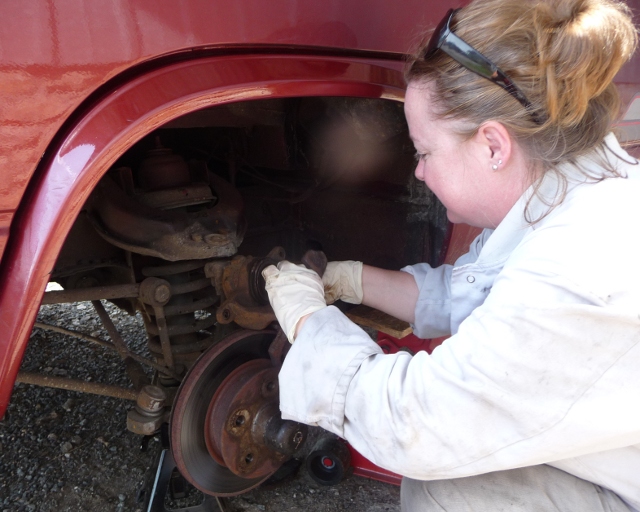
And so, by the end of the week our van parts finally appeared, and the tires came in to LEHM, the tire fitters in Égletons so Adrian and I set to on severing arms and legs to pay for tires, fitting, balancing, tracking, environmental disposal of the old ones (ok that part was only 84 cents), and VAT. We fitted new brake pads and a new speedo cable (the old one has only worked intermittently since Portugal) in the heat of the afternoon sun.

On Saturday morning, Steve and Adrian took the van to Franck’s farm near Tulle to use the wonderful facility of a variable height pit and full range of tools. With an audience of cows in the lower part of the barn, and a helpful kitten, Steve fixed three new CV joints out of the four on the two driveshafts. The fourth one was new, we had been told by the vendor of the van, but it turned out only the outer gaiter was new and the CV joint was not. We did some swapping around and one of the other joints was used for this one instead. The joint we had replaced by the garage in Salbris was the wrong one – and the fitter had also butchered many of the bolts when he fitted it. Steve has become an expert in fixing these joints as this seems to be the reason for many a T25 breakdown.

Meanwhile Adrian changed oil and filter, and did a few other odds & sods – the gearbox oil change will have to wait a while, as poor access meant that without butchering tools we just couldn’t get enough welly on the drain or fill plug – which don’t appear to have been touched for years. By the end of the day we had a van running properly again and all went out for a celebratory Turkish meal in Égletons to thank Steve and John for our rescue, their hospitality and huge amounts of help with the van they’ve given us.

And now it’s all about doing the last few bits of laundry and van fettling and then we’re ready to pack up the van again. It seems ages since we’ve been on the move and we can’t wait to get going to find wherever the road goes next.

Enormous thanks again to John and Steve who are our heroes and new best friends.

Posted in Art & Culture stuff, By Country - France, Food stuff, Personal stuff, Van stuff | 5 Comments

Are we making your forecourt look untidy? (part 2)

For part 1 of the saga, see this post…

After the van was left at the VW dealer on Monday afternoon, awaiting “diagnosis” and attention, communication dried up somewhat.

Throughout Tuesday and Wednesday, we called ADAC periodically – to be told that the dealer either hadn’t diagnosed the fault yet (or, rather, hadn’t even bothered to look at it) or that ADAC were just about to call them then would ring us back. Three guesses how often that actually happened?

So, by the end of Wednesday – with just one more night of ADAC-funded accommodation left, and no news – we were quite surprised to be called and told that the dealer had indeed got back to ADAC. But that the bits weren’t available. ADAC had apparently also tried sourcing them in Germany, with similar lack of joy. Well, excuse me, but you could try…Oh. Well. Umm… Did I want to order them, then? No problem. Order them for delivery to the dealer, who’d fit them. And if that didn’t happen by the end of Thursday, then we could invoke the repatriation clause, get transport for ourselves back to the UK, and await the arrival of the van to a garage in the UK in about – oooh – three weeks or so.

Umm, no. Sorry. I’ve got a better solution. Why don’t we stop fiddle-faddling about with a dealer who I wouldn’t trust to give me the time of day, and instead of paying for flights and transportation across the Channel, just put the van on a transporter the 200km or so to some 2cv friends in the Charentes, who’d kindly offered workshop facilities in their barn? The ADAC rep couldn’t agree to that, but thought it sounded reasonable. They’d have a word with their manager, and call me back.

Surprisingly, they did indeed call back. Yes, that’s all agreed. And, yes, they’d confirm it in an email.

You know what’s coming next, don’t you? Not an email, that’s for sure…

So, Thursday morning arrives. We check out of the hotel, and call ADAC. Yes, they’ve got the details of the previous evening’s conversation – and no problem at all. We can get the van transported to the Charentes – all we need to do is to organise it ourselves, pay for it, and ADAC will refund us. With, of course, a limit.

Hold on a mo. That’s not what we agreed. Tough. That’s what’s on the table.

So – after several hours, and a couple of mobile credit top-ups later (don’t even ask about the price of French PAYG calls – I’m not sure it wouldn’t have been cheaper to make roaming calls from a UK mobile), we’re no further forward. Actually, that’s not quite true. We’ve had one quote, €1,300… Several friends had kindly put time and effort into trying to hire trailers, but hit stone walls due to the weight of the van or insurance issues.

Back on to ADAC. We’d more or less given up on getting the van shifted outside Brive, so let’s find a better solution in Brive. ADAC would have a look into the options and call us back after lunch. (No, of course they didn’t. Do you need to ask?)

Meanwhile, the real fourth Emergency Service came to the fore. Never having met them before, I’d dropped John a line on the VW forum – being about an hour from Brive, he might have some suggestions.

John’s son, Steve, was on holiday from work, and before we knew it he’d pulled in some favours to get their local garage to collect the van, well within ADAC’s budget. Not only that, he was in the car and on the way to us – our accommodation problem for the night was sorted, and he’d have a good look at the problem to see exactly what was going on. Time to jump in a taxi to the VW garage, then, and try to extricate the keys and paperwork from them. When we arrived, it was not a great surprise to see the van exactly where it’d been on Monday. The one consolation was that they held on to the keys and logbook with the same diligence and enthusiasm that they’d applied to working on the van.

Within minutes of slithering under the rear of the van, Steve had figured out that the problem wasn’t as serious as we’d thought – the new joint hadn’t broken up, but the bolts had all worked loose and escaped. In to the workshop, and would they mind putting the van on their ramp and just rebolting it. Nope. No way. The joint was definitely broken, and the bits weren’t available. OK, fine… Could we at least borrow a couple of tools (not in our own toolkit)? Begrudgingly, yes. After a few attempts, Steve removed the entire driveshaft – only to find that whilst the joint was definitely still intact, it was the wrong one – and that the reason it couldn’t be bolted straight back on was that one bolt was bent right over (and our friend in Salbris had thoroughly butchered the heads on several others, somehow). No problem. A hacksaw will quickly solve that. Except that being hardened bolts, our small hacksaw wouldn’t touch them – and the dealer didn’t possess such a high-tech and specialist piece of equipment.

As the afternoon was drawing to a close, it was easiest to head to John and Steve’s place with the shaft – within minutes the bent bolt was removed, and the shaft ready to be refitted, so we could spring the van from its imprisonment. But first, Thursday evening happened to be the village’s weekly evening market. Local food producers had set stalls up on the grass behind the Mairie, whilst the yard between the stalls and building was full of trestle tables – and a stage, barbecues, frite stands and a bar. How dreadful. We hated every second of having to buy paté, sausages, cheese and honey direct from the farmers, then have the sausages cooked for us, whilst we tucked into cheap bottles of good red wine and excellent chips. But we had to force ourselves to do it, you understand. It’s a hard job sometimes. Especially with the entire village singing and dancing to such an excellent live band.

Eventually, the morning had to be faced. Steve and I headed back to the van in Brive, fitted the shaft with ease, and drove the van away – to the surprised glares of the dealer mechanics…

And here, back at the house, we sit.

Service Reception

Not only infinitely more competent and welcoming than the VW dealer, but a lot more scenic...

And here's your courtesy car, Sir.

The right parts to do the job properly are on order. After spending some time giving the van the service it’s about due – including a good once-over of the brakes and a set of tyres (the set of off-brand Thai-made all-seasons which came on it didn’t much like 35 degree Celsius Portuguese weather, and rapidly developed alopecia of the tread) – we’re going to shift the van to a barn (with a service pit) belonging to a friend of theirs, then remove both shafts to give them a thorough overhaul once the parts arrive. Sod’s law, of course, says that today is a public holiday… After all that, we’ll be ready to hit the road again. Delayed, emotions having run the full range, pockets thoroughly hit – but our spirits are unbroken.

There’s one thing we must do in this post – and that’s to publicly repeat the thanks already given in private. Steve, John, Paul, Mark – you are all total and utter heroes. Then there’s all the people in Brive la Gaillard who did their best to smooth our wait and to lift our spirits. Their kindness and generosity – even if all they could offer was some sympathy and encouragement – helped no end. The staff of the hotel La Crémaillère, particularly – we couldn’t have made a better choice. The kindness of the lady running the Lady Leone tearoom. The sheer entertainment value of the guy in the SFR mobile phone shop. The above-and-beyond-the-call service of the girl in the tourist office. If it had happened anywhere else, it would have been even more trying.

Let’s just hope that reclaiming from ADAC just some of the expenses incurred goes a fraction as smoothly…

Posted in By Country - France, Personal stuff, Van stuff | 3 Comments

Out of the Auvergne… and into trouble

Sunday morning saw us waking up to a rather soggy field after last night’s heavy rain. We strolled down to the farm house to pay for our camping, fabulous value at six Euros! Madame was sitting in a large kitchen with a huge range, and cats and kittens all over the place, and rabbits in cages, and hens and geese pottering in the yard.

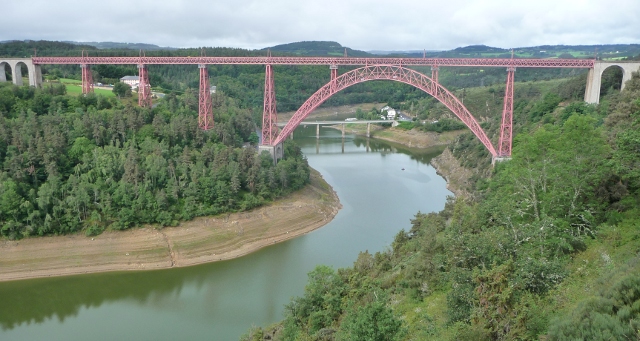
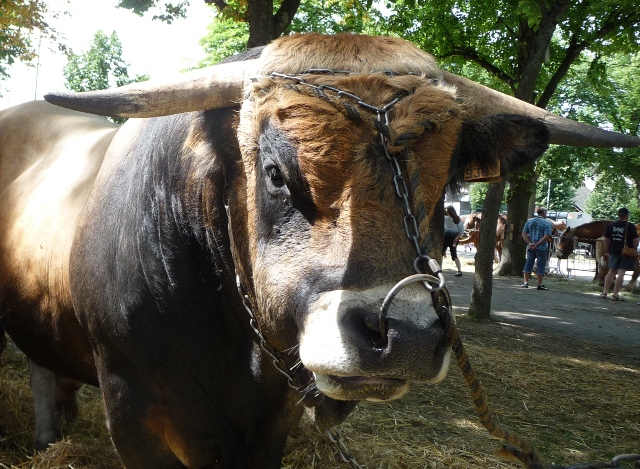
We then picked up croissants in Clavières, and headed towards the Viaduc de Garabit to eat them overlooking the view. The bridge is one of Gustave Eiffel’s works, which was a trial run for the engineering techniques later used in his eponymous Tower. Next stop St Flour, a town perched atop an oblong hill, which was full of life with the local country show right in the middle of town. Being still quite early in the day, we managed to park up right next to the show and strolled in beside prized animals. Newly washed, brushed and polished – huge bulls, chunky heavy horses and their foals, goats, sheep, tiny ponies with tiny children on them, all gloriously chaotic … and the wet ground underfoot soon dried up as the sun came out and blazed on the day.

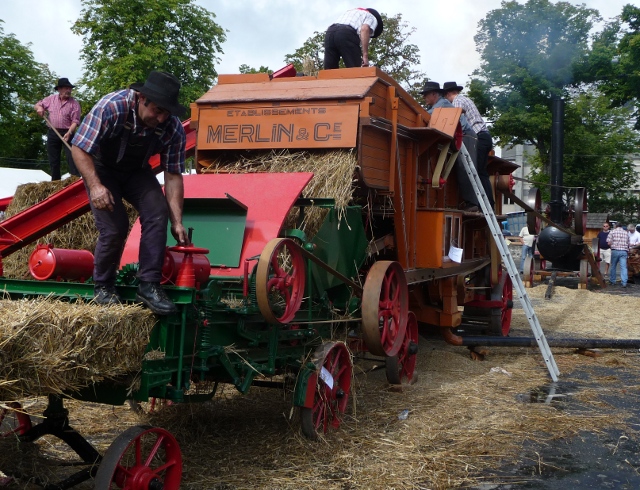
There was lots of activity in the centre of the square show area with steam driven contraptions of all sorts just getting going. Traction engines’ shrill whistles and everything from a 1950s threshing machine and baler to a band saw turning tree trunks into planks. A huge display of tractors, old and new, all with their engines left running. A rope making demonstration, a blacksmith and his trainees playing with giant bellows. And round the edge of the fair, craft and regional food stalls, with lots of tastings which we freely partook of (as ever). Most notable was our lunch snack of Cantal cheese crêpes and tasty micro brewery beer served by the brewer himself.

It was hard to tear ourselves away from the buzz and fun, but we wanted to make progress towards our next date with friends in the Charentes.

The road took us through some stunning scenery as we climbed westwards into the Cantal mountains and over the Pas du Peyrol. Luckily most of the traffic was coming towards us as this was one of the busier stretches we had come across. We were making for picturesque Salers (a cheese and breed of cattle), but we were put off actually visiting this small place as it was so totally surrounded by huge crammed car parks it looked to be more like a theme park than a working village. A Sunday afternoon in August was definitely the wrong time to visit!

We camped in the valley of the Maronne river by the Enchantet reservoir at the Plage de Longayroux, where we met fellow Brit, Patrick Murphy, who was installed in his caravan on this municipal site with his missus where they had spent the last 31 summers.

Early on Monday morning, we climbed the hill out of the valley through some very pretty sleepy hamlets. Boulangeries (in this area at least) are closed on Mondays, so it wasn’t until we reached the larger town of Argentat over the border into the Dordogne that we had our breakfast pains au chocolats by the river.

On the way there we had followed a sign towards Tours de Merle not really knowing whether it was a geographical feature or what, but we came across this magnificent almost hidden ruined castle glimpsed through trees.Beyond Argentat … it all started to go wrong as we headed out of town on the D12 alongside the Dordogne river. We pulled into a tiny layby to check the map, and as we started off again … the Clunk of Doom struck.

Posted in By Country - France, Food stuff, Travel stuff | Leave a comment