Up Pompei

After leaving Abruzzo and the snow behind us, we headed south with the sun rapidly warming. We’d decided that going through Napoli itself was likely to be a thoroughly daft move, and jumping on the autostrada isn’t really what this trip’s about, so we took an inland route which took us past Cassino – famous for the Abbazia di Montecassino, a hilltop monastery which the Axis forces used as their command stronghold in the later days of the war. As a result, it spent several months being bombed into smithereens, although it’s since been rebuilt. It’s a superb position, but the sprawling ugly town beneath wasn’t exactly conducive for photographs…

The wisdom of that route started to be questioned, though, as we reached Avellino – and spent over an hour sat in lunchtime (school run in Italy…) traffic trying to find a route, any route, out of town. Even a route in the right direction was becoming negotiable. The timing didn’t much help – we know by now that, if lunch is late, any issues get magnified as we get a bit snippy at each other, so by the time we escaped we were growling at each other almost as loudly as our stomaches.

As we started to approach the urban sprawl of Napoli, with the bulk of Vesuvio looming imposingly, any lingering doubts as to this being the wrong route were thoroughly confirmed. The outer satellite towns were plain godawful. Rubbish piled high, abandoned buildings mixing with corrugated tin huts like something out of South African shanty towns – and, just to remind us gently of the fact we were getting into Godfather territory (The Camorra for Napoli), the odd bit of conspicuous wealth – a Maserati parked outside a scruffy small shop, then a Bentley carving through traffic.

Modern Pompei itself is a company town, with the ruins being the only reason for existence. At least that meant our campsite was very handy for the entrance and the station for the “Circumvesuviana” train. But, as with so many “attraction” sites, they know damn well you’re not there for the site, so the facilities were a bit bare-minimum, and there were some odd goings-on. Here, it was the local alky who seemed to be living on an “I’ve got some cash today, so I can afford tonight” basis in one of the bungalows. A nice enough chap, if a bit unintelligible – although his arguments with his pink-stretch-tracksuit-clad missus did get a bit loud on occasion. We got chatting quite quickly to our direct neighbours, a wonderful German couple – Philipp & Melanie – who’ve been on the road for a similar length of time to us. An invitation to have a chat over a sundowner turned into a shared dinner, and a few bottles of wine – a formula which repeated itself over each of the nights we were all there…

The ruins of Pompei are huge – the town itself isn’t completely excavated, but most of the space within the walls has been. From the entrance by the Forum to the Amphitheatre at the far end must be a good half hour walk.

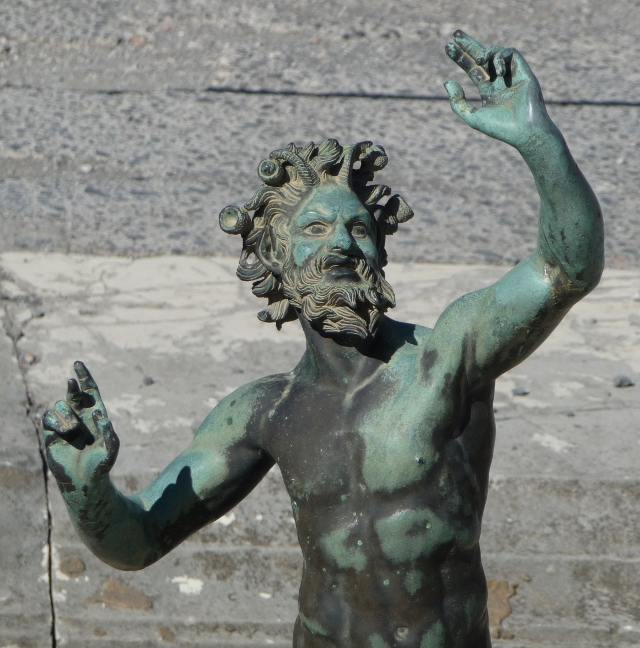
There’s information leaflets giving suggested routes of various lengths, but we treated the shorter routes more as warnings of heavy tour-group congestion than anything else! There’s a real feel in the city of what it must have been like. Not many of the buildings have much left vertically, with only the odd roof and column over much of the site. The ones that are more complete, though, are massively evocative. The baths, the theatre, the amphitheatre, the “House of the Faun” – some real gems, although you definitely got to the point of wandering streets barely looking at the more ordinary ruined buildings on either side.
In a way, that helped to reinforce the fact that this had been a real live city, not just a few isolated buildings. On one edge of the city, outside the walls (but inside the site boundaries) was the “Villa dei Misteri” – a substantial house, very well preserved, with intact and colourful frescoes depicting the initiations of a young woman into one of the “secret societies” that flourished underground in the city.

The myriad of personal stories involved were also reflected in the presence of some of the recovered corpses. A couple were on display in glass cases just off the forum, but the single most poignant was lurking in a shady and dusty storage area, behind iron grilles. Surrounded by smashed amphorae and other bric-a-brac was a corpse of a person sitting up, cowering, with their hands up and covering their face. Life, interrupted.

Overall, we found a feeling similar in some ways to that in Oradour-sur-Glane, of a town forcibly and suddenly terminated. The very different historical perspectives, of course, gave very different atmospheres to each…

The great size of the site meant that any kind of effective guardianship would have been near-on impossible, but the total and utter lack of any staff once inside did catch us by surprise. Some people seemed to regard this as a bonus, especially the Israeli woman who we saw dipping into one of the buildings for a pee, despite there being plenty of public loos available.

Napoli itself was exactly what we expected, a total contrast… A city full – overfull – of life. Ellie reckoned it felt like a cross between an Indian city and New York in the ’80s, before it was cleaned up. Leaving the station into Piazza Garibaldi, a massive building site full of traffic and people and noise and bustle and chaos, we headed towards the Forcella quarter. The heart of the old city, it’s a maze of narrow streets with tall buildings shading any direct sunlight from reaching the washing hung several stories above your heads. People threaded through the blankets covered in hooky designer sunglasses and handbags, somehow avoiding the scooters seemingly buzzing in several different directions at once.

What else to do for lunch in the home city of Pizza, than to find a superb example? And we did. There are several Pizzeria known for being almost reactionary in their traditionalism – and the one we found, Da Michele, is apparently a fine example. It certainly did us proud, once we’d figured out the table etiquette (go in, tell the guy at the till how many in your party, then wait in the throng outside the door for your number to be called – once, and once only…). The menu was far more straightforward. Marinara (tomato, garlic, oregano) or Margherita. Small or Large. Beer or no beer. End of. The result was predictably delicious.

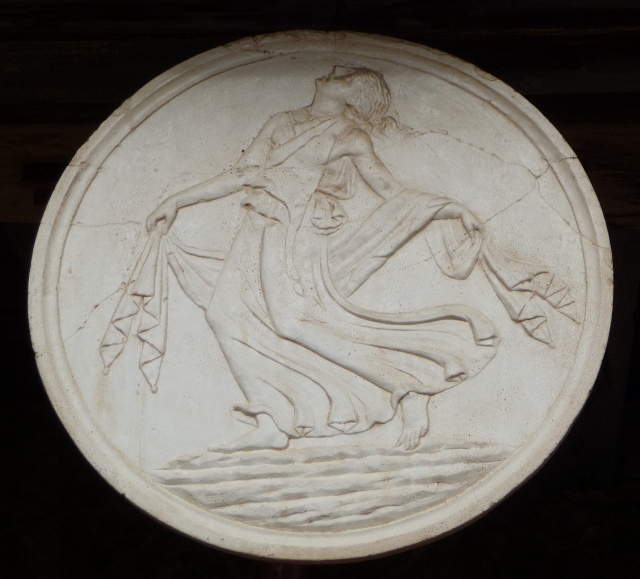
The chaos of the city continued when we arrived at the archeological museum, home of many of the best finds from Pompei & Ercolano. Many of the mosaics and frescoes still on site at the ruins are copies, with the originals preserved in the museum.
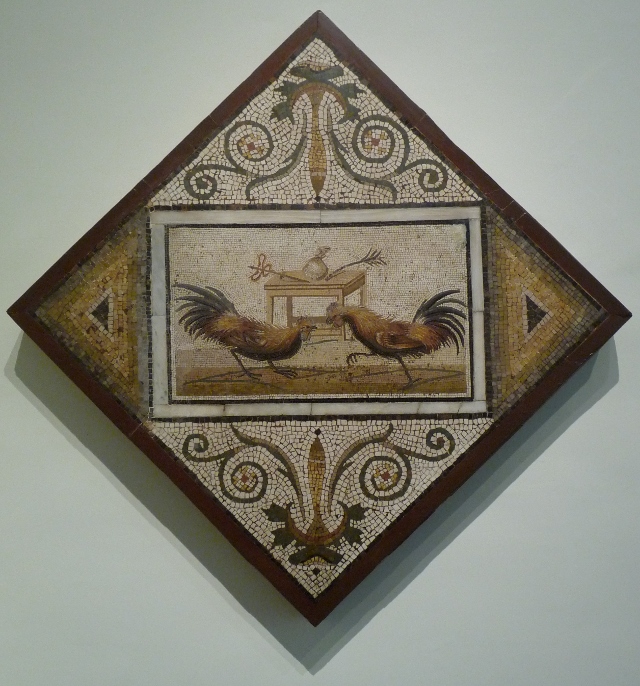
I’m not convinced that “preserved” is the correct word, since the floors in a couple of the rooms had collapsed, leaving large holes protected only by flimsy barrier tape, whilst in another room, the decorators were hard at work on the window shutters – barely a metre or two from priceless works… Then, of course, there’s the “secret room”. It’s not the best-kept secret in the world, just follow the tour groups, and you find yourself surrounded by ancient Roman erotica and phallic talismen, deemed unsuitable for unfettered public access for many years. From the comical grotesque and massively over-endowed stone dwarves, to the beautifully carved marble statue of Pan “enjoying the attentions” of a goat – with no detail spared – it’s no great surprise that the 19th century aristocracy were a bit wary of their wives and servants being allowed in.

After a substantial scrambled-egg farewell breakfast with Philipp & Melanie, we headed to the other town killed by the volcanic eruption at the same time as Pompei – Ercolano. It’s a very different affair to the better-known neighbour, a small residential town rather than a large commercial centre, and much less excavated. That’s primarily because it’s surrounded by modern residential suburb, with concrete flats right on the edge of the site. The location gives a much better feel of what’s meant by “excavation”, with the ruins surrounded by cliff-faces of earth up towards the present-day surface level.

The houses are much better preserved than Pompei, too – multiple floors still standing and, in some cases, original wood still intact, carbonised by the heat of the volcanic mudslide, but still clearly identifiable, even the wooden partition doors of one house.
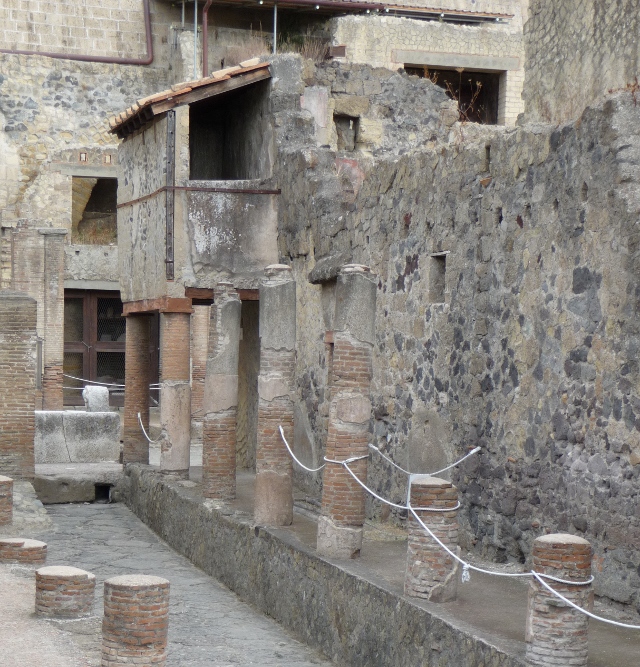
Unfortunately, the “House of the Carbonised Furniture” was closed for restoration when we were there – a massive ongoing project, the difference between our roughly decade-old guidebook’s description and the current situation is clear. At the time the book was published, about two-thirds of the structures were unsafe to enter. They’ve been restored to the point that very few are now closed off, although signs around still warned of ongoing deterioration from visitors themselves – backpacks and bags scuffing frescoes, walls crumbling from being sat on.
Posted in By Country - Italy, Food stuff, Travel stuff | 2 Comments

Are we making your forecourt look untidy? (part 3)

You may remember the saga of our breakdown in France over the summer, made worse by the lack of communication we had from ADAC, our breakdown recovery service.

When we got a chance, we wrote a letter to ADAC outlining the problems we’d had. The letter contained times & summaries of all conversations, with copies (not originals, in case the postal system did its worst) of the receipts. Because of the confusion over what their “nightly allowance” covered, we’d put in for meals and accomodation. The taxis were a bit over their allowance, and we’d claimed for the cost of the mobile calls to chase them. All in all, though, it came within the hotel allowance alone. The letter went into the French post in mid August, with a request for them to reply by phone or email. Just over a month later, we’d heard nothing, so chased by email with PDF copies of the letter and invoices attached.

The following day – a reply arrived! Of course, it was just a form response saying that they didn’t pay for meals or phone calls, and needed original receipts… Still, at least there were signs of life.

Another email went straight off to them, requesting they actually bother reading the letter.

Finally – another three weeks later (now two months from the original being sent) – we get a reply from a real live person within the customer service department. Yes, our treatment had fallen below their standards, and they’re very sorry – and they’re happy to reimburse our expenses in full. Result! Case, I do believe, closed. Phew. Let’s hope that we don’t need them again – and that if we do, it’s all much smoother next time.

In the meantime, if anybody’s got any suggestions for another pan-Euro breakdown service that doesn’t run screaming at the first mention of an over 20 year old campervan, we’re all ears.

Posted in By Country - Italy, Personal stuff, Van stuff | 1 Comment

After the news, the weather

On the final approach to Assisi, we’d jumped on the autostrada and skirted Perugia – a highway of tunnels and viaducts, with fleeting glimpses of suburban sprawl heading steeply upwards towards where we presumed the city centre lay. So it was no great surprise when the bus from the railway station to the town centre groaned almost vertically for what appeared to be several miles. The centre of the city – the capital of the Umbrian region – was a buzz of life, not least because of the unmissable presence of not just the Italian media, but a good swathe of that of the anglophone world. With impeccable timing, we’d arrived the day after the appeal court (right next door to the tourist office, in one of the two main squares of the city) freed Amanda Knox and Raffaele Sollecito from their prison sentences for the murder of Meredith Kercher. TV vans were triple-parked, generators running and satellite dishes erect, as cables snaked towards makeshift studios under gazebos. At the whiff of a rumoured sighting, camera crews sprinted from one part of the town to another, dodging the waiters bringing the scriptwriters and producers endless coffee and wine.

Other crews recorded “flavour pieces”, a euphemism that seemed to be an excuse to indulge in a large lunch solely to record the waiter arriving with their food. We needed no such excuse, but we weren’t trying to justify the expense account. Still, the truffle risotto was superb, as were the chocolate confections in a renowned specialist cake shop, Pasticceria Sandri – Perugia is the capital of chocolate for Italians, and we’d missed the annual festival by a scant couple of weeks. Probably as well…

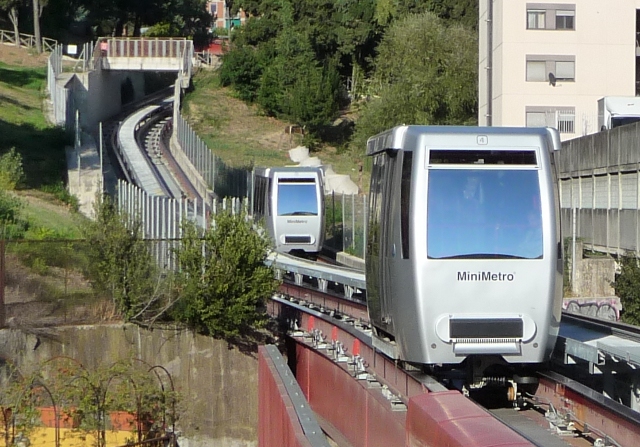
The rest of the city was almost as lively, too. A large student presence meandered through narrow streets and alleys, arches framing steep climbs and striking views across many miles of countryside stretching into the distance. We eventually returned to the station, reluctantly – but via a rather wonderful small urban tram system, the unfortunately named “MiniMetro”. Fortunately, reliability did not live up to the echoes of British Leyland…

Our next stop was – for once – north. The town of Gubbio is renowned as one of the most completely medieval in central Italy – and sits at the base of a large mountain, with a basilica high above it. This provides the excuse for what our Rough Guide described as an event second only to Siena’s Palio for “exuberence and bizarre pageantry“, with “mind-boggling” rules and rigmarole together with hours of “involved ritual” and drinking around it. The Corsa dei Ceri was not, of course, happening whilst we were there – but we got to see the three Ceri themselves, tall thin wooden totems of about 5m height and 350kg weight, together with their wooden carriages allowing each to be carried on the shoulders of eight men. They represent three saints, with the most important representing St Ubaldo, to whom the Basilica is home – he lies, gently withering after 900 years of death, in a glass case on the high altar. His Ceri always wins the annual saint race, with the other two merely having to arrive at the basilica before the doors are slammed in their faces. The DVD we watched in the museum showed an event that appeared to be alternating between exhilirating action and unwitting high comedy, as the three teams sprinted the several kilometres up the narrow hairpin streets inside and above the town, three times around a fountain or square, the bearers and runners changing frequently, with the Ceri toppling towards the crowd on many an occasion.

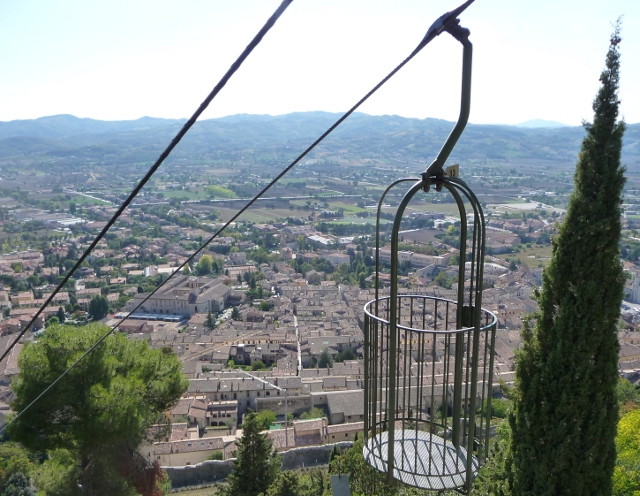
We did not feel like repeating their exertions, even to the extent that we took the funicular up to the basilica rather than walk. But, once you saw the funicular, you knew that no excuse was needed. It’s not really a funicular at all, but sort of a cross between a ski-lift and a series of wire umbrella stands. Each one held just two people, standing squished tight up to each other. As your carriage approached, you were pointed to two large red spots on the pavement. The front person then took a running jump at the fast-moving basket, followed by the rear person. The door was then slammed, narrowly missing your fingers, and you were off, soaring rapidly above a small ornamental lake full of terrapins towards the tree-lined slopes looming above. No deviation, repetition or hesitation allowed.

The detour northwards brought some reality home rapidly – the year is moving on apace. The Gubbio campsite had closed for the winter, and once off the major tourist trails, there are few to start with. A long and fruitless trawl back south found us with little option but to return to Assisi. The site we’d already been on for several days did not much appeal – we’d more or less run out of humour towards the coach loads (one male, one female…) of hormonal Hungarian teenagers in the rent-a-tents around the edge of the main site – but fortunately, we found that Assisi’s other site was still open, although not in the off-season discount card scheme that we’ve been using. As we headed towards it, a lack of signage suggesting it might not actually exist, discussing what price we’d regard as our “walk-away point”, we more or less resigned ourselves towards going back. As we neared, it looked much more promising than the flat wind-swept plains of the original site, terraced steeply through olive groves. When we found out that it was virtually the same price, considerably less than we’d been expecting, we were sold on it. And we were not disappointed.

Our route continued southwards, with the paucity of sites combining with a threatening-looking change in the weather. After Montefalco – more wonderful frescoes in a deconsecrated church, now a museum, together with the obligatory abysmal modern art exhibition; more shrivelled beatified corpses in display cases (two even sharing one case) in a slightly dilapidated church – we reached Spoleto, only to find another closed campsite, leaving us with a couple of miserable looking car parks. We decided that the city did not seem compelling enough to put up with them, so headed through the gorgeous mountains towards the Lago di Piediluca. Guess what? Another closed campsite. Back into the mountains, in search of a wild-camp spot, as night approached rapidly. We couldn’t even find anything tempting for that – merely rubbish-strewn laybys with trucks hammering past, or back tracks that would have left us blocking field entrances or sitting at steep angles. So a choice of Spoleto’s car parks it was. An evening wander round the town (“perhaps Umbria’s most compelling, and many people’s central Italian favourite“, allegedly) found it utterly deserted, leaving us the only customers in one pleasant wine bar (they took pity on us and brought a selection of delicious nibbles) except for one full-to-capacity cafe in the very centre. Our return to the car park found a small corner of life, though, with an elderly gentleman feeding all the feral cats…

The weather continued to look threatening as we headed southwards towards a site we knew to be open, in the mountainous National Park of Abruzzo. Our route there took us through another town currently in the media due to a criminal trial – l’Aquila. Several of the government’s most senior seismological and geological advisors are just starting to be tried for manslaughter over the advice they gave around the minor pre-shocks of the 2009 earthquake, which left the city devastated, 300+ people dead and thousands homeless. As we’d headed down from Gubbio, we’d gone past the small town of Nocera Umbra, which had been badly hit in the 1997 earthquake best known for causing relatively minor damage to Assisi. There was little remaining sign of it, with only a couple of the (seemingly ubiqutous for any hill town) cranes visible above the various towers and spires. It is possible for towns to recover quickly, it seems, from such major natural disasters – but l’Aquila is a long way off. Whole areas of the city sit, awaiting demolition. Makeshift supports try to prevent further casualties, but to little to hide the reality. Railings bear photos of those who’d died inside. On the outskirts, there are many stretches of new blocks of flats – with car parks full of campervans, presumably the temporary accomodation of choice for a large number of families in the immediate aftermath.

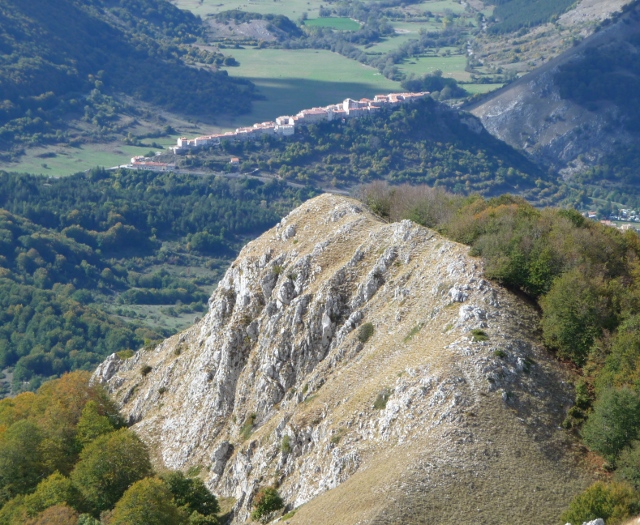
On arriving in Abruzzo, we found that the national park is a beautiful area. The site sits in the shadow of several mountains, with a choice of walking trails heading off from a park centre barely a couple of hundred metres up the road. A very pleasant and knackering Saturday was spent following one trail – barely five or six kilometres horizontally, but over 800m of ascent as we headed up through trees and rocks, before eventually emerging onto a ridge with truly panoramic views.

After returning back to the site, we sat around a camp fire, chatting to the only other people staying – Jonathan and Heather, a British couple who recognised our van from the first site in Assisi. As we arrived, Ellie’s 2cvgb fleece was immediately spotted – it turned out that Heather is a long-term 2cver and club member, too. The evening turned into night, as the pile of firewood shrank rapidly. Wildlife was heard in the distance – logic says that the noises in several directions were almost certainly cows, albeit very unusual sounding ones. Imagination firmly pegged them as some of the park’s wild bears. Before we left, wild boar were clearly spotted running through the trees alongside the site’s boundary wall.

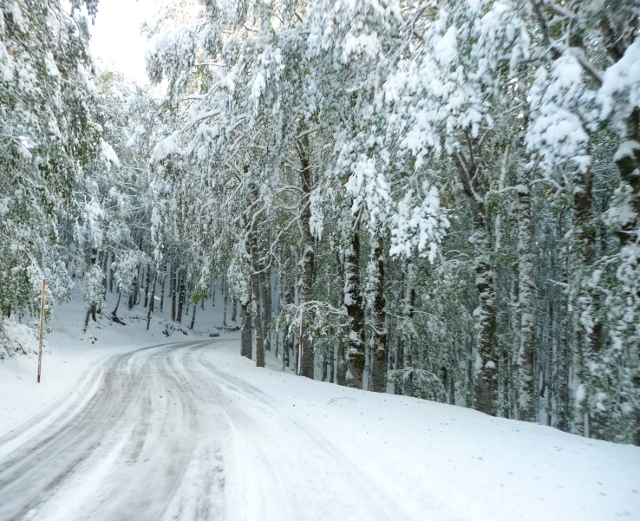
In the morning, we rapidly decided that any plans for walking or cycling that day were not going to happen. The precipitation that greeted us as we sprinted towards the facilities was not entirely liquid. The day didn’t improve, either – and by lunchtime, we were staring out of sleet-lashed van windows wondering exactly what we’d done wrong. The afternoon and evening were spent – for about the first time since we left the UK in May – watching some of the TV and films that we’d downloaded and brought with us on the laptop. The morning dawned more brightly, revealing a light dusting of snow on the grass, with the mountains looking picturesque. The lower altitudes nearer the coast, further south, couldn’t fail to be anything but better than this – but first we had to leave the area. After persuading the van to start – heavy use of heater, stereo and lights had taken their toll on the main battery – the road wound upwards into the mountains, the dusting on the verge turning deeper. Then the road started to whiten slightly. By the time we got to the pass, we were following wheeltracks more in hope than certainty.

Fortunately, the view as we crested was drastically different. Green and blue dominated again, in all directions.

More than any other, this week has affected our short-term plans. We are now seriously starting to plan for winter, mulling our options around and trying to make sense of them.

Posted in By Country - Italy, Personal stuff, Travel stuff, Van stuff | 3 Comments

Assisi (twinned with San Francisco, Santiago de Compostela and Bethlehem)

Assisi’s pale stone buildings in its setting along a hillside can be seen for miles around. Our campsite was around 5 km from the town and we took the walking route there. It felt fitting somehow to approach it on foot, a mini pilgrimage, among vines and olive groves – the town looming ever closer.

Assisi is, of course, famous for Saint Francis, one of Italy’s patron saints and founder of the Franciscan order of monks. Born in 1182, his philosophy is simple and pure – he chose to give up material things and live in humble poverty staying as true as possible to what he felt was the essence of Christ’s teachings. Thus he also had an impact on the church of the time and its obvious wealth. This philosophy strikes a chord for many of us today in this materialistic world and many seek solace at Assisi, in Francis’s words and prayers.

His contemporary, St Clare (Santa Chiara), also from Assisi, founded the female equivalent of the Franciscans, known as the Poor Clares.

It is a touristy place of course, but thankfully this does’t detract too much from Saint Francis, whose presence is felt everywhere. Naturally many of the visitors are from religious orders and we were asked directions by a nun. We arrived in town on the eve of the great celebrations marking the feast of Saint Francis, so there were services in progress and many more people even than usual. Television cameras were being set up for live link ups to some of the religious events.

The most prominent sight to see is the Basilica di San Francesco. It is made up of two large churches – one on top of the other, differing in age and featuring a treasure trove of frescoes by Giotto, Martini and Lorenzetti among others, though the Cimabue ones have suffered due to poor pigment and earthquakes. The ones in the airier upper church illustrate St Francis’s life. The older lower church, is dark and cavern like, mysterious with its lingering smell of incense, with incredible illustrations of the new testament scenes we’ve become so used to, and stairs lead down to Saint Francis’s tomb. We couldn’t help but wonder what the saint would have made of the 10 euro charge that so many were paying to have a mass said for them or a loved one. Or the fact that you could buy a votive candle, but instead of lighting it yourself, you left it in a pile to be lit by a church minion who replaced another only semi-burnt candle. Perhaps this was the only way to deal with the expected volume of candles being brought and to avoid a candle conflagration like the one we saw at Fatima in Portugal. As usual many tourists ignored the loudspeaker pleas for silence and to not take photos. We even saw one of them on his mobile phone near the altar … he was dressed in a habit though so maybe that was all right?

There are a great number of sacred places at Assisi, and after visiting the Basilica, we strolled up through the town via a promotional fair of the province of Molise, with tastings of their produce from flavoured olive oils and truffle sauce to chocolate and biscuits – it made a lovely pre-lunch snack. After our actual lunch on the square, we proceeded to the Duomo with its beautiful exterior. Then it was 2.30pm and time for the church of St Chiara to reopen. A very feminine church in the pinky white local stone, we followed the crowds down to the crypt to see Santa Chiara herself. There are a lot of relics in town, not just the remains of the saints themselves, but their belongings, from habits to hairshirts. We also stumbled upon Saint Francis’s family home, showing the room in which he was supposed to have been imprisoned by his father.

While in the Assisi area, we also visited the seventeenth century church of Santa Maria degli Angeli. Situated in the plain a couple of miles from Assisi, this church is built round a tiny chapel – the Porzuincola – which was the first Franciscan place of worship. The festivities meant the church and the tiny chapel itself were crowded with people. The chapel was a deeply spiritual place where you could feel the power of the prayers being said by so many all around you.

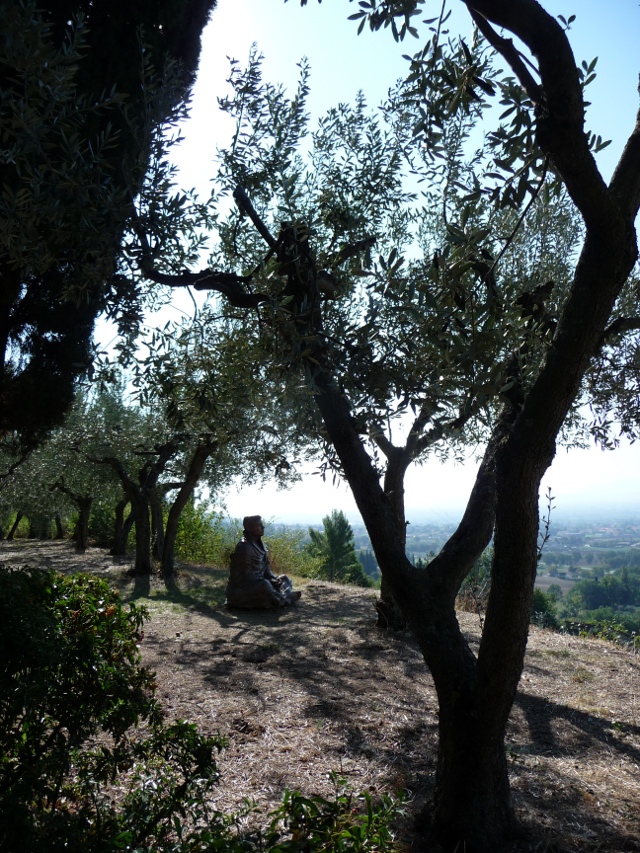
The last sight we visited in Assisi, and perhaps the most evocative of Saint Francis’s teachings, was the sanctuary of San Damiano, where he had spent much time. A truly beautiful and humble setting, and original home to the Poor Clares. The life-like bronze statues placed here and there conjured his presence.

Posted in Art & Culture stuff, By Country - Italy, Personal stuff, Travel stuff | 1 Comment

On to Umbria

We left Siena with mixed feelings – we’d just about had enough of the campsite (as we seem to have had with every site we’ve spent more than a couple of days at – does the perfect campsite exist?), but we’d really enjoyed the city.

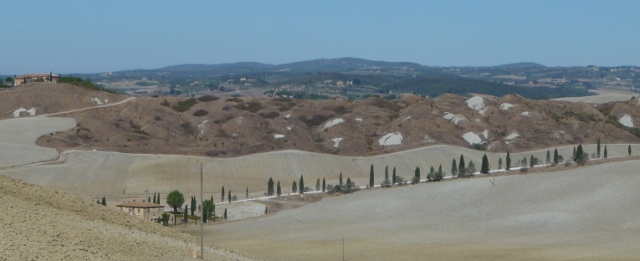
The landscape almost immediately quashed any doubts, though – the “Crete Senesi” is something slightly different. It’s sort of a blend of stereotypical Tuscan, with tall lone trees in almost child’s-drawing-straight-even lines and hill towns against a backdrop of vines, crossed with a moonscape. I have no idea how they manage the fields, since the ground just doesn’t appear to go in the same direction for more than a few metres without diving off at random.

After a couple of hours of gently bewildered bimbling, we arrived at the ancient abbey of Monte Oliveto Maggiore – renowned for the frescoes by Il Sodoma (a nickname that, allegedly, he thoroughly deserved – his other penchant being for exotic pets – “Do you want to come up and meet my badger, young boy?”). Unfortunately, we arrived there five minutes after they closed for a three and a quarter hour lunchbreak. In Spain, we just about got used to the long lunchtime closures. For some reason, we don’t appear to have in Italy – perhaps it’s the lack of predictability. In Spain, everywhere kept very similar hours – and it wasn’t unusual to arrive at a town and find the tourist office closed from 1pm to 5pm. In Italy, there’s just no rhyme or reason to it. Some places close at noon. Others at 1pm. Most are an hour lunchbreak. Some re-open at 3pm or even 4pm. A handful (it’ll never catch on) are even open without a break…

So – after wondering if it was worth hanging around for the Monks to dust the crumbs off their habits and re-open, we decided to head on. After all, next on the road was a wine town. Montalcino had already provided the real highlight of our visit to the Enoteca Italiano in Siena – and that was only their “ordinary” Rosso, not the Brunello they’re best known for. The town was a gem, but none of the wines we tasted there came close to our memory. Was the first one a real belter, or is there really such a wide variety? The latter seems more likely…
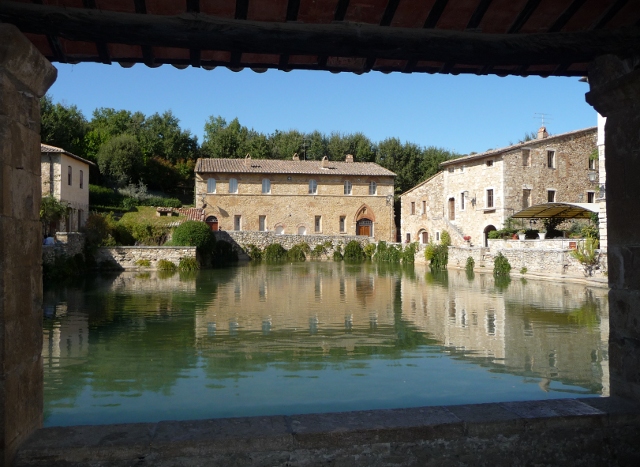
Bagno Vignoni gave us an opportunity to partake of sulphurous hot springwater – not, unfortunately, in the large and beautifully situated pool in the town centre (closed for bathing for the last couple of decades – and unfortunately looking a bit stale and green as a result), but we could at least sit with our feet soaking in the body-temperature millstream as it headed off. The town’s (as usual round these parts) on top of a steep hill, and for centuries the full advantage was taken of both the temperature (closing on 50deg as it emerges from the springs), but also the altitude. After the water had been through the health spas, it then passed through some very cleverly designed channels and mechanisms to power the town’s mills. Now, it’s just the odd expensive-looking (closed for the afternoon) spa that takes advantage.

Pienza was next in the chain – a monument to papal favour, vanity and nepotism. Pope Pius II wanted to turn his home village into an “ideal town” – and only got as far as a huge cathedral and a couple of palaces before inconveniently dying. As a result, Pienza is perhaps the most gloriously monumentally endowed tiny hill village in the country. His nephew didn’t manage to do too much more in his ten days as Pius III – probably most of that time was spent commissioning the wonderful Piccolomini Library in Siena’s Duomo to his uncle’s glory instead… Obviously, full advantage is taken by the tourist trade – in this case, with space in one of the palaces being given over to an exhibition of modern art. It could be a refreshing change – as in Lucca – from the endless beauty of the Renaissance, but not in this case. Splooging a bit of paint on some scruffy old take-away pizza boxes is not – to me, anyway – art. Nope. Ain’t working. It’s funny – we’re really not averse to modern art as a concept, yet virtually all of the various temporary exhibitions we’ve found have been utterly dire. The most beautiful old spaces, such as palaces, crypts and cloisters – but the only contemporary art they can use them for is utter rubbish? It’s almost as if the funding for the spaces required it, yet those managing are trying to prove something…

Popping into the tourist office at Pienza did give us one major stroke of luck, though – details of an agriturismo with camping, just outside town – Podere Il Casale.

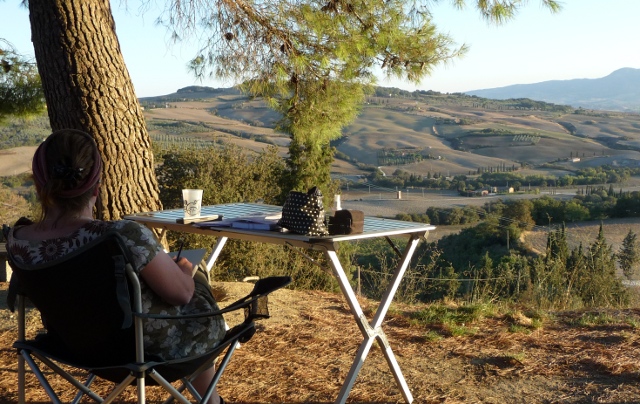
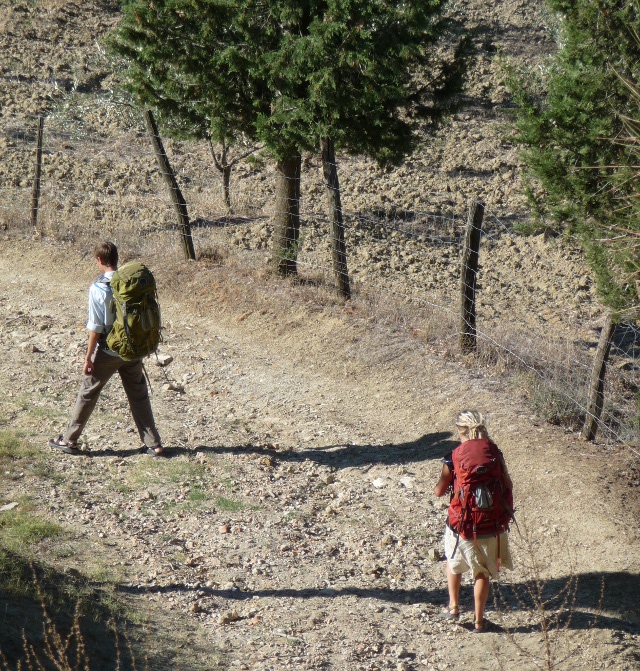
There’s no way we’d have found it on our own – several kilometres off the main road down a dirt track, without a single sign to indicate its existance until you got to the actual gate. We’re immensely glad we did, though. Pointed to a space on the very edge of the steep hillside, with easily the best view we’ve had from a pitch on the trip so far, we started to settle in – with the help of a multitude of wildlife. Cats, dogs and peacocks roamed freely around the site. Below us, the soundtrack of donkeys – one in serious need of oiling – mixed with the sheep and goats. We watched as two backpackers trudged up the dusty track – only for them to turn out to be Zac and Virginia, a pair of Texans we’d got chatting to on the bus in to Siena. A very pleasant evening’s nattering ensued.

Zac & Virginia, heading away in the morning.

In the morning, after the (included!) breakfast of home-baked bread and home-made preserves (pear jam – mmmm!), we said our goodbyes and headed off in the direction of another wine town – Montepulciano – not to be confused with the much better known Montepulciano d’Abruzzo. As we arrived, half an hour later, we mused gently upon the difference between travelling by foot and by car. Zac and Virginia had taken two long, hot, hard days to trek from Montalcino to Pienza, and were looking to get to Montepulciano by that evening. We could have knocked the lot off in an afternoon – and the views from Montepulciano stretched past Pienza all the way to Montalcino. They’d obviously got much closer to the landscape than we had – but we had the opportunity of tasters of a much wider variety of landscapes. One thing’s for certain – chatting to them made us want to get a bit more hiking in.

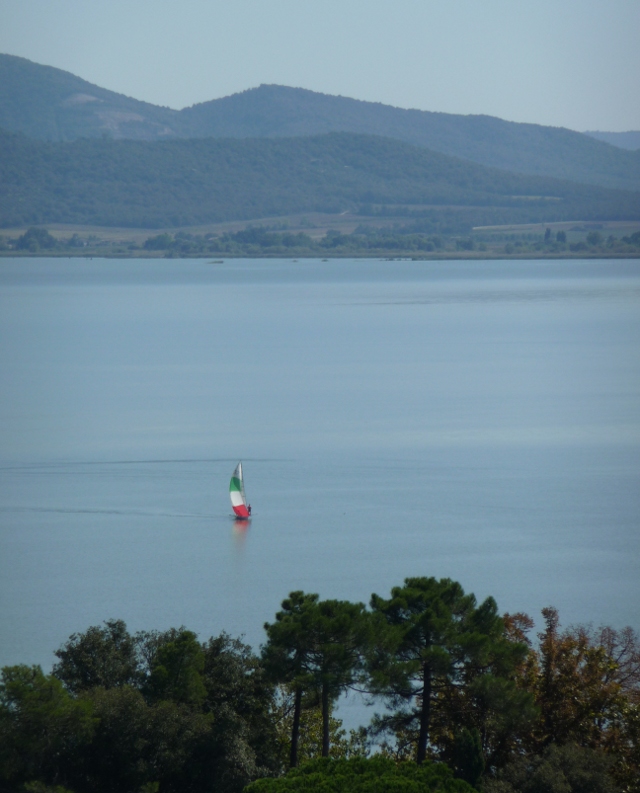
Montepulciano was our last stop in Tuscany. Winding eastwards, we crossed into Umbria. One thing that we’ve noticed in Italy is that there’s not been any indication whatsoever that you’ve crossed between regions. No sign, nothing. You just go to check up on the next town in the guidebook, and find yourself in a different chapter. Castiglione del Lago sits on the shores of Lago Trasimeno, the biggest inland stretch of water on the Italian peninsula, apparently.

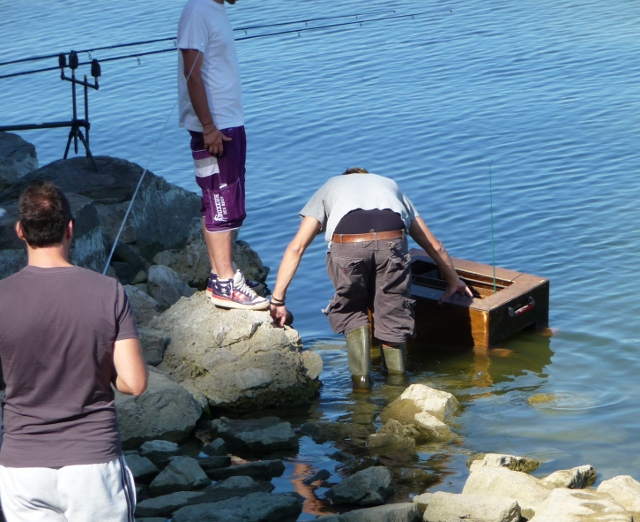
It’s an impressive site, with a fortress rearing up on a chunk of rock – clearly visible from the opposite shore, once we got there. The welcome we got in the town was warm – almost physically dragged into about the first shop we passed, to taste wild boar prosciutto and salami, then an assortment of truffle products, all washed down with a number of different wines and a friendly chat. Effective saleswomanship, too. A picnic lunch down on the shores of the lake was enlivened by watching somebody fooling around with what appeared to be a radio-controlled coffee table, to general hilarity from all around – including those whose fishing lines it was getting tangled in.

From there, we continued past Perugia towards Assisi – of which more later.

Posted in Art & Culture stuff, By Country - Italy, Personal stuff, Travel stuff | Leave a comment

Senese Sojourn

Siena is another Tuscan power house of Renaissance art and architecture with its own key characters – perhaps the biggest names being Jacopo della Quercia and Beccifumo – as well as featuring some of our usual suspects from the Florentine scene, but with a very different feel to that city. It has its own history as a city state and was one of the major players of Europe back in the 1200s. It gained affluence from the wool and cloth industry and dominated the trade route between France and Rome, and was famous for its banks. It fell into decline after the Black Death hit in 1348, when it lost a third of its population and has, even now, a population well below that peak. The city is prosperous again now with its tourism, and also its bank, Monte dei Paschi, started in 1472 and once again at the forefront of the Italian financial world.

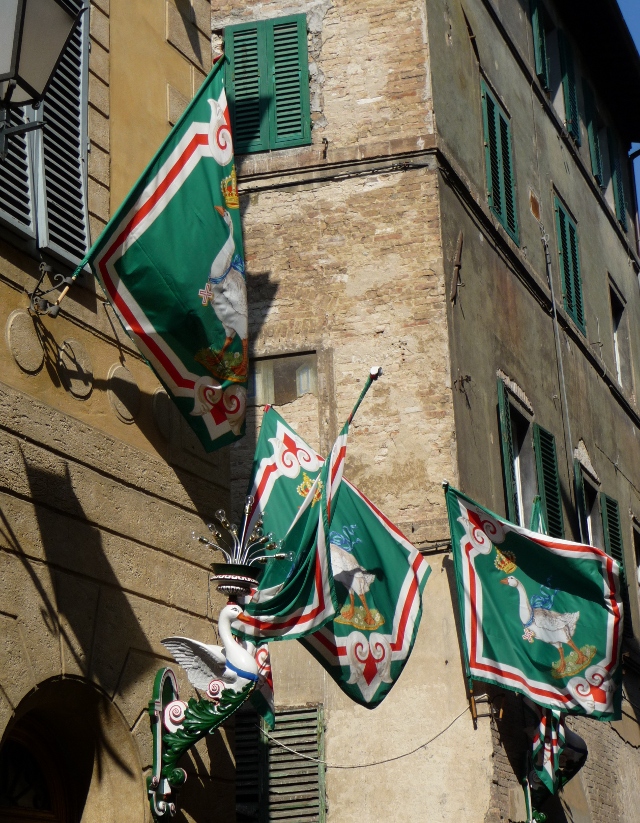
There is plenty to see here. Siena is distinctly drawn into 17 districts or ‘contrades’ – sort of clan areas started in the twelfth century from the different militia groups set up to protect the city. As you wander round you will see plaques on walls, flags or other signs of that area’s contrade, all named after animals or natural features such as porcupine, giraffe, goose, shell, caterpillar, forest etc. Every year the contrades field horses in the Palio, manic bareback horse races round the magnificent central piazza – the Campo – in July and August and Siena’s annual high point. We missed these of course, but the place was still bustling with tourists of every conceivable nationality.

As well as its contribution to world heritage Renaissance art and architecture, Siena has St Catherine. The pure serene-faced white and blue clad saint crops up frequently in artworks and souvenirs. We didn’t visit the house of her birth, but at the church of San Domenico you can see her head. This is guaranteed to be genuine and indeed does somehow look like the person in all the portraits. No peaceful burial then for so many of these saints – the fate of their earthly guise is to be chopped up and bits of them distributed hither and yon, displayed in ornate caskets.

On our first wander round, we were daunted by the sheer volume of sights to be seen, and decided it made sense to stay a little longer than we originally planned. This also meant that some mail we were urgently waiting for could be forwarded to us at the campsite (thanks again to Matt and Ryo for their help with this). We could also try and pace ourselves. Although we’re now into autumn and the mornings and evenings are noticeably cooling down, the middle of the days are still in the high 20s celsius. And this is a place with very steep ups and downs too.

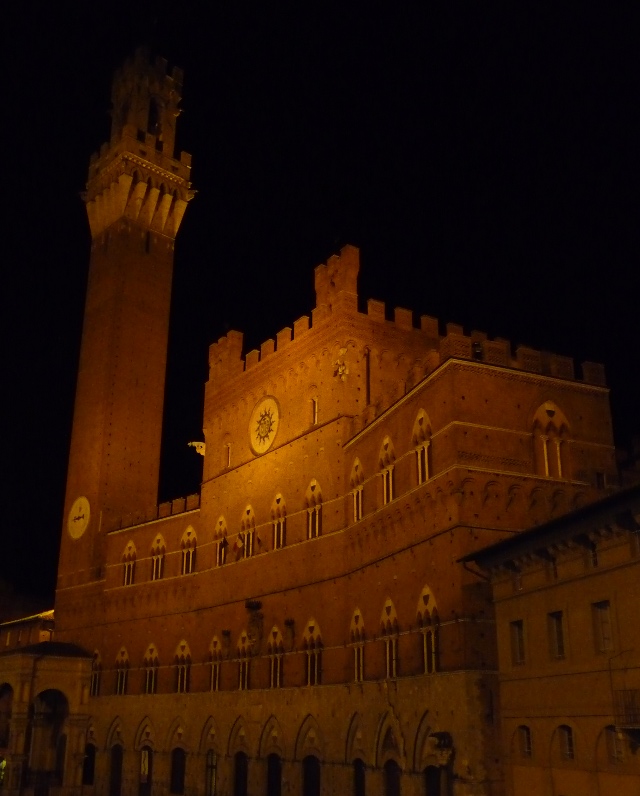
We started by getting our bearings at the Campo. The sloping semi-circular piazza was originally a Roman amphitheatre and is dominated by the soaring tower of the Palazzo Pubblico.

Our first full day in town was a wander round and a chance to plan our stay in the city, and of course to have a late lunch at a reasonably priced and really cool restaurant, Boccon del Prete. Although there were other tourists here, it was above all a locals’ restaurant with a friendly hospital doctor at the next table who had to rush off when his on-call phone went, and a graduation lunch party in the cellar. The food and wine were delicious, the service ever so slightly chaotic.

Wednesday morning is market day and of course we had to pay a quick visit to the sprawling cheap clothes and hardware stalls. Our next call was to buy a joint ticket for entrance to the Duomo (or cathedral) as well as the Baptistry, Crypt, Duomo museum (Museo dell’Opera del Duomo), and San Bernardino Oratory (valid for two days). This made visits to all these a little more affordable.

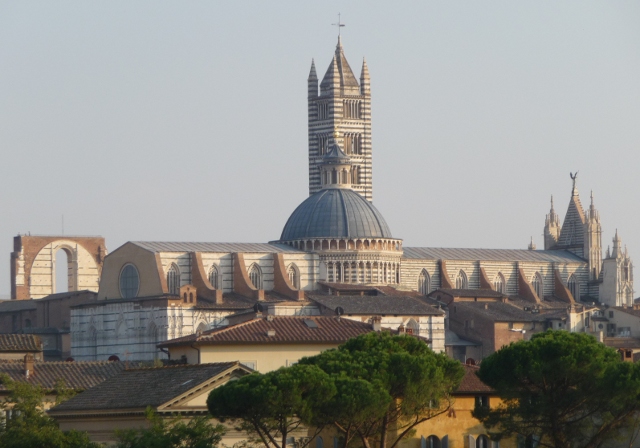
Siena’s Duomo is perhaps the most incredible church of the trip so far – the interior is more interesting than the Duomo in Florence.

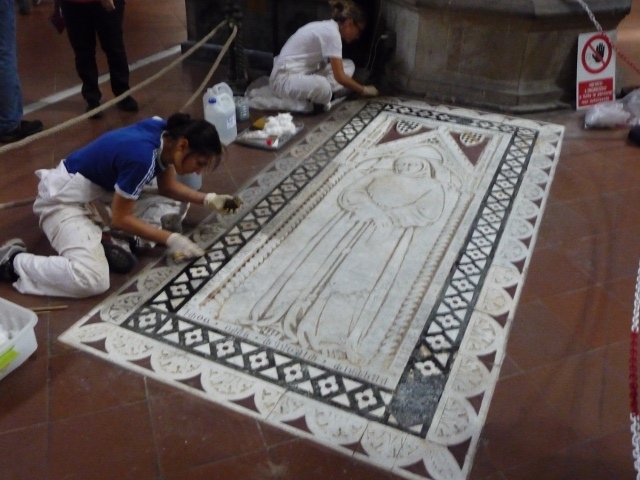
Its extravagant exterior filled with statuary by Giovanni Pisano and his workshop (the originals are now in the museum and replicas fill their places). The artistry and craftsmanship of its marble floor, or pavement, is stunning. Decoratively patterned with different colours of marble, it also features many beautiful images painted in marble by the foremost artists of the time, notably Beccafumi, whose images include dramatic use of lights and darks and drawing-like cross-hatching. It’s kept under wraps most of the year to protect it and only on view in all its glory for a couple of months. For once, our luck was in and we got to see it. It lived up to its reputation.
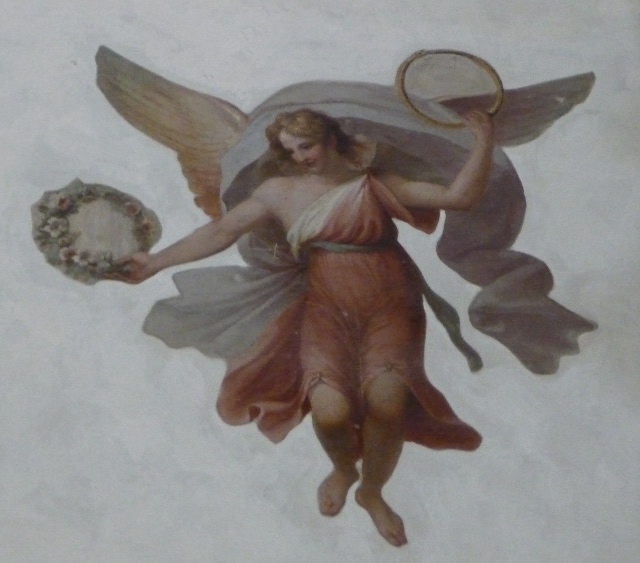
Nicolo Pisano’s pulpit and Donatello’s bronze of St John the Baptist are among many other treasures. Just off the central nave is the Libreria Piccolomini, commissioned by Francesco Piccolomini who was Pope Pius III but only for 10 days, to house his uncle, Pope Pius II’s books. The frescoes that fill the ceilings and walls in this space are Pinturicchio’s and tell the story of Pius II’s life. The multitude of detail and the vibrancy of the colours is so breathtaking I found it hard to leave. I also loved the illuminated manuscripts on display. For once, one could take photos.

As ever though, we narrowly avoided tour group rage, particularly when their guides are giving loud lectures totally ignoring the pleas for silenzio and no flash. The lack of consideration for other visitors and the seeming unawareness that these are sacred spaces continues to astound us.

We still can’t quite grasp why so many people insist on having their photos beside every sight, even places and things you wouldn’t call especially thrilling or appropriate. Half the time they don’t even smile for the camera. Is it that they need proof that they were at these places? In the Duomo in Siena a Japanese couple had their photo taken in the central nave holding up bunny ears behind each others’ heads and grinning broadly. I say no more!

The Baptistry, beneath the Duomo was stunning too, the font featuring bronze scenes by Donatello, Ghiberti and Jacopo della Quercia, and more frescoes mainly by Vecchietta. The Crypt was more interesting as a space, with only fragments of older frescoes.

Lunch was a luscious freshly-baked pizza eaten on the steps of the Baptistry, giving us the strength to embark on the Museo dell’Opera del Duomo. This houses the originals of the statuary from the Duomo’s exterior, and a Sienese master painting, Duccio’s Maestà, the Duomo’s altarpiece until 1505. The highlight of the museum though, was the chance to climb to the top of the only wall built as part of a vast abandoned project to build an additional nave for the Duomo back in the 14th century. This commanded views across Siena and was worth the wait as there is only room for a limited number up there.

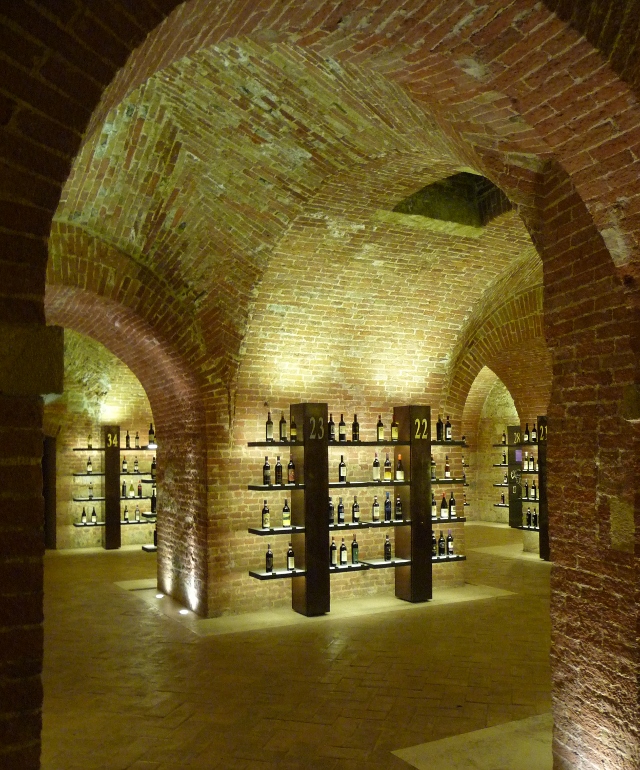
What a lot in one day, and it wasn’t over yet. By now we felt in need of an early evening refreshment and Siena is not big on bars as such. We had read about the Enoteca Italiana though, a sort of state run wine bar and store situated in the fortress and decided to wander back over to this area, where the market had been, to explore. The Enoteca is a great place to try an array of Italian wines by the glass at a stylish wine bar right within the fortress walls with a terrace, there is also a restaurant. Or you can buy from the store. The magnificent display of 900 or so different bottles from all over the country is in the cellar below. We tried four different reds between us, with the Rosso de Montalcino our firm favourite. Feeling suitably enlivened, we headed up onto the walls outside to watch the huge red sun slowly dip below the horizon, dodging joggers running circuits around the perimeter. The sounds of jazz floating out from the practice rooms of the Jazz Association, also based here, added further to the ambiance.

We were tempted back to the city centre to Boccon del Prete again for dinner – a cheese platter of three ages of Pecorino and walnut bread with a fruit mustard, followed by tender rare steak slices over olive oil roasted potatoes, and we went for the same dessert we had at lunch yesterday – the pear sponge in vanilla and sweet wine sauce.

After such a full day, we decided to take it easier on the Thursday, starting off with the final visit of our first joint ticket – San Bernardino’s Oratory. Except that the doors were closed and it didn’t open until one. So we went to the Pinacoteca Nazionale – an art gallery with a fabulous collection of Pre Renaissance, Renaissance and some post Renaissance art. I had to leave my passport for the key to a locker to leave my bag in – I got ticked off in Italian for not knowing this, although the sign was nowhere near the ticket window! The museum is most famed for its fondi d’oro works. These are breathtakingly beautiful paintings on guilded backgrounds, mostly of madonna and child with saints gathered round and variations of this theme. After the umpteenth room of these we were starting to fade out in spite of their wondrousness, and there were two more floors to see. This was a museum too far for us after yesterday and we still had some major things to see in town.

A quick sandwich for lunch – we are learning to ensure we take proper breaks from sightseeing, so we don’t get too much culture overload, and spend head space away from too much visual stimulation. And of course a rest for our weary feet. Then it was back to San Bernardino. Thankfully, a beautiful but short visit. We headed back to the campsite by mid-afternoon for some, we feel, well earned recuperation!

Our final day in the city, and after the cultural overload of the last few days, it was with trepidation that we bought our last joint ticket for the Museo Civico and L’Ospedale di Santa Maria della Scala – two more ‘must see’ sights crammed with artworks. The buildings themselves are worth seeing in themselves, the Museo Civico is within the Palazzo Pubblico – the town hall. The historic ornate rooms are filled with frescoes, some of which feature rare for the time secular subjects, such as Ambrogio Lorenzetti’s Allegory of good and bad government. But where was the rest of it? We ran out of rooms to see far sooner than expected. What was open to the public was far less than, say the Palazzo Vecchio in Florence. It was a secret relief though – we could have a snack and rest and save ourselves for L’Ospedale di Santa Maria della Scala.

Once we found the entrance, being rather mislead by hordings for a forthcoming exhibition of rather soft pornographic illustrative modern art, we embarked on what turned out to be a unique and thrilling museum visit. Our aged Time Out Guide (Florence and Tuscany), describes this as a ‘museum in progress’, and it still is. As its name suggests, this was the city’s main hospital for 900 years up to as recently as the 1980s.

There was a press conference in full swing in one of the ground floor rooms, possibly to do with the new exhibition, but there were Beccafumi frescoes to be seen elsewhere and a sizeable chapel remodelled in the 15th century and recently restored. It also boasts more secular frescoes describing the original work of the hospital by Domenico di Bartolo (1400s), including the taking in and educating of abandoned babies.  But after doing the ground floor, we wondered if that was it? If this was a must see why was no one else here? Then we were ushered downstairs to the first of two floors below street level.

Firstly we entered the dark eery chapels, the Oratorio di Santa Caterina della Notte, where followers of Catherine of Siena and other medieval confraternities worshipped. We could imagine someone stepping out from the shadows – a wonderful location for the telling of ghost stories. We entered the treasury area which seemed to be empty. We followed the lit ancient brick passages and suddenly came across golden objects displayed in cases seemingly suspended in mid air around different corners. What a wonderful way to build intrigue into a museum wander. One gold and glass reliquery held a nail from the crucifixion. As not a lot was made of this, can we assume that thoughts have been given up of it being genuine?

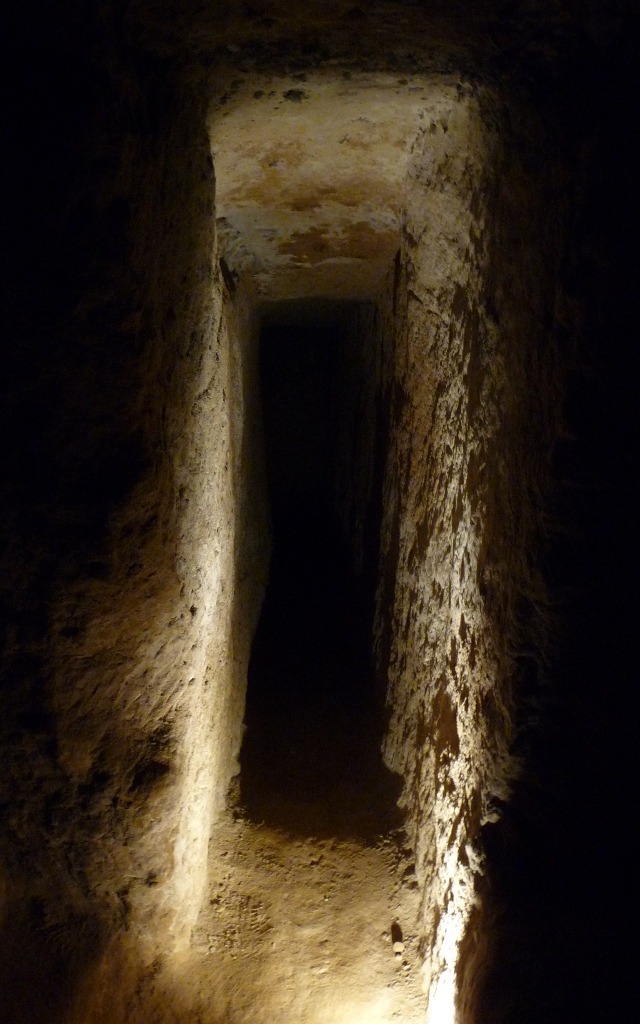
The intrigue wasn’t over yet. We descended an unlabelled flight of stairs to the level below (second level below ground) and found ourselves in an unfinished area of rooms and passages deep in these extensive brick and earth cellars. Empty display cases, incomplete info panels, dust sheets and tools spread around. There was no rope across and no staff or signage to indicate the right way to go, but it was all so beautifully lit and enticing and surely we would eventually find where we were supposed to be. Nothing stopped us so we kept exploring these wonderful tunnels and chambers reaching cavelike right into the earth itself, staircases cut short half way up walls, blind alleys and steps up and down. All the time with the exquisite emotion of doing something illicit. There was a frisson of fear that suddenly the lights would be switched off and we would be left in total darkness in this maze so deep underground. A chill shiver up ran up my spine when I realised that one earth wall contained layers of bones – the original charnel house of the old hospital. What had started out as a lack lustre visit to yet another museum had turned into a unique subterranean stroll of discovery.

After many twists and turns we did find the open part of the archaeological museum with its wonderfully displayed and lit ancient etruscan, hellenic and roman artifacts. We only saw one other visitor and one warden on this whole vast level. We saw that the warden had a bank of screens behind her desk… we had been on camera the whole time!

It was an unforgettable end to our sojourn in Siena, and in keeping with the rest of our stay, was followed up with a late lunch.

Posted in Art & Culture stuff, By Country - Italy, Food stuff, Personal stuff, Travel stuff | 3 Comments

Tuscan Travels

We’ve been trying to hook up with a 2cv mate, Ryo, who moved from the UK to Northern Tuscany a few years ago – and, just as we were starting to think about moving on from Firenze, we received a text from him – he was going to be in Firenze the following day, so why didn’t we hook up there and convoy back home with him?

And so we found ourselves fighting the traffic out towards the airport, to meet up at the Swedish Embassy…

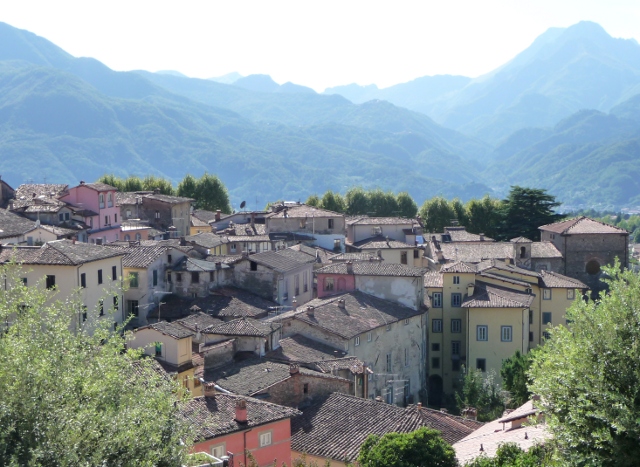
Photo (c) Ryo HayashidaA little light shopping later (tealights & crispbread on our part, a wardrobe for Ryo’s kids), we hit the autostrada towards Lucca, then north into the mountains, towards Barga – an absolutely delightful, beautifully preserved medieval hill town, with quite possibly the world’s best motorhome aire… Just on the outside of the town walls, there’s a big carpark, with a public loo – including hot shower – just around the corner. Great. Even electricity and water points included in the nightly rent.

After a late afternoon and evening wandering the streets of Barga, including a stop at a very pleasant and friendly Osteria for delicious pasta with fresh wild Porcini mushrooms, we’d almost convinced ourselves that what we really needed was the house we’d seen in an estate agent’s window – three properties in one, with two main and joined houses at the top of the hill, all resting on a 13th century Convent with 7m high ceilings…

We did managed to find the house in the end – what can we say, other than “What’s Italian for ‘moneypit’?”…

The following day saw us heading South again, in the direction of Pisa. We’d been warned that it was just about the most heavily touristed place we’d ever see – and all those warnings were right… In a way, it was absolutely dreadful – tat stalls and street hawkers fighting for space with tour groups – yet the sheer magnificence of the Campo dei Miracoli managed to (almost) avert your gaze from that totally. Once away from the hordes of people all trying to get that sparklingly original photo of them holding the tower up (or pushing it over), the banana-bendiness of the tower started to assert itself more than the actual lean. Don’t get me wrong – it leans. It LEANS. But, when they were building it, they tried to mask the lean of the lower portion by building the upper sections assymetrically to compensate. As a result, it’s truly hilarious. The marshy ground that caused the lean extends under the whole area, with the main cathedral and baptistry both also leaning and wibbling – although nowhere near as spectacularly. The tower is open again to the public, after years of stabilisation work – we didn’t climb it, though, due to the timed tickets being priced at a level seemingly intended to pay for that long and intensive work within days.

Along one side of the area lay what, for us, was the most impressive of the “miracles” here – the Campo Santo, a huge rectangular cloister surrounding a central yard allegedly laid with earth from the Holy Land. The cloisters themselves were the site of what Ruskin described as the “most important” frescoes in Italy –  until a WW2 incendiary bomb (ours) turned the roof into a boiling lead coat of whitewash over the already deteriorating and fragile frescoes.

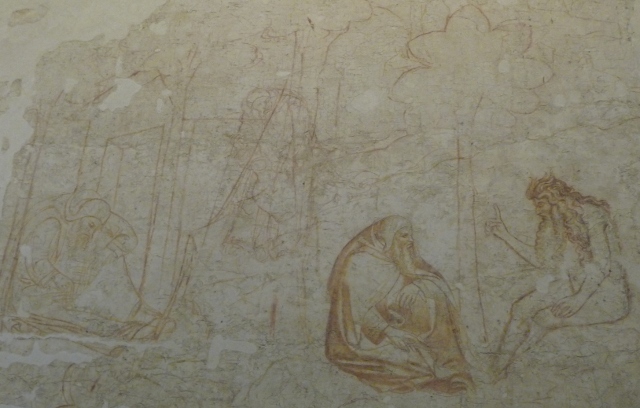
As a result, the surviving frescoes are a mere shadow of what they must have been once – but are still impressive. However, the destruction of the frescoes has enabled the Synopias underneath to be seen – the preparatory sketches drawn in chalk on plaster then painted over. Don’t ask me how, but a huge number have survived and are displayed in a dedicated museum on the other side of the square. The detail that went into these sketches was absolutely astonishing, and – in some ways – they were more evocative and resonant than the surviving works.

Including the separate museum of artworks from the cathedral – fascinating and beautiful, and with easily the best views of the tower – Pisa was a long and very knackering day. We meandered our way back to the van, in one of the pay carparks just outside the walls, to find that the group of good-natured Senegalese tat-hawkers hanging around were sat nattering in the largest shadow they could find – that of our van… Although we’d run out of time in the day, Pisa did seem to offer a lot outside the touron circuit – a wander down any of the streets away from the tower finding a city with plenty of life in it.

Lucca, by contrast, was one of the gentlest, slowest, most easy-going places we’ve been to. Another beautifully preserved walled city, containing numerous churches and towers, we spent two days wandering around just doing not very much – and loved every minute.

Amongst the highlights were a total antidote to the Renaissance – Lucca’s Contemporary Art museum is currently housing an exhibition of “revealing works on paper” from the Peggy Guggenheim Collection, a varied miscellany of most of the big names of surrealist, cubist and other contemporary art styles from the 20th Century. The walls of the city themselves are preserved as a park, with their broad tops providing a tree-lined circular walkway and cycle path around the whole centre. One of the towers in the centre, the Torre Guinigi, can be climbed for wonderful panoramic views above the rooftops – complete with mature trees growing on top of the tower. This was a town we could definitely see ourselves living.

Whilst in Barga, we’d been along to a meal at a local Pizzeria – 20 minutes of hooning up, down and around twisty back mountain roads with Ryo in his 2cv (Oscar) – to celebrate a family birthday. Ryo’s wife, Annalisa, belongs to a Barga dynasty – so their move back here really had been coming home. We’d also been invited to spend the Sunday with Annalisa, Ryo, Luigi and André down at the seaside at Viareggio – a resort east of Lucca which grew up around Royal patronage early in the 20th century. As a result, it’s full of huge art deco villas and gently fading grandeur. Beach-idling isn’t normally our thing, but this was a really lovely day – just pootling gently on bikes, back and forth around the town, past the shipyards where Superyachts are built, all wrapped up in delicious fried mixed fish served from a boat on the canal, and later quite possibly the best ice cream we’ve ever tasted.

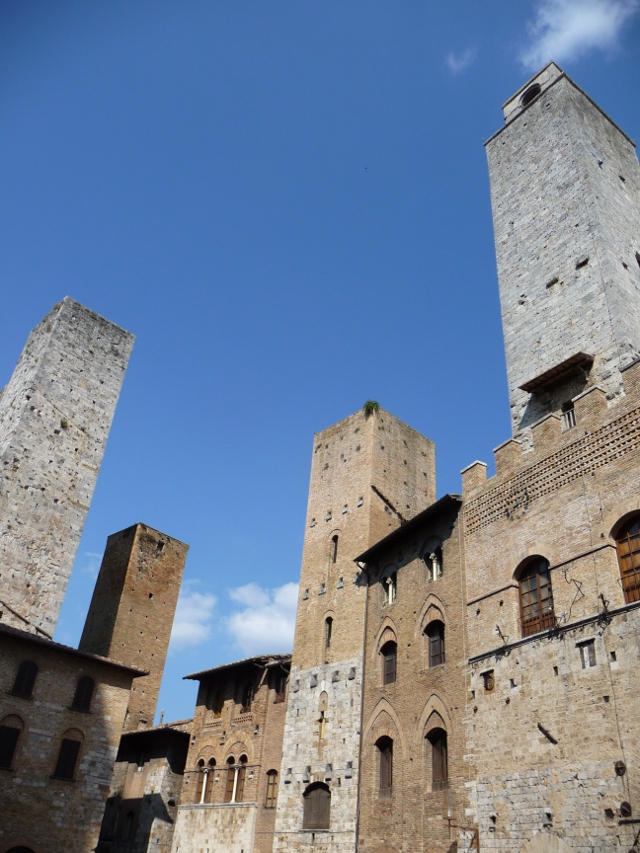
Time, then, to head onwards to Siena. En route, the hilltop towns of Volterra and San Gimignano were brief stopping points – San G’s Collegiate church being one of the most frescoed churches in the whole of Italy, with the rest of the town spending sudden wealth from being a stop-over on a pilgrim trail on building towers. Lots of towers…

The landscape of Chianti slowly slid by us, rolling hills and vineyards merging seamlessly with umpteen roadside adverts for English-speaking estate agents.

Posted in Art & Culture stuff, By Country - Italy, Travel stuff | 1 Comment

A quiet place on the banks of the Arno

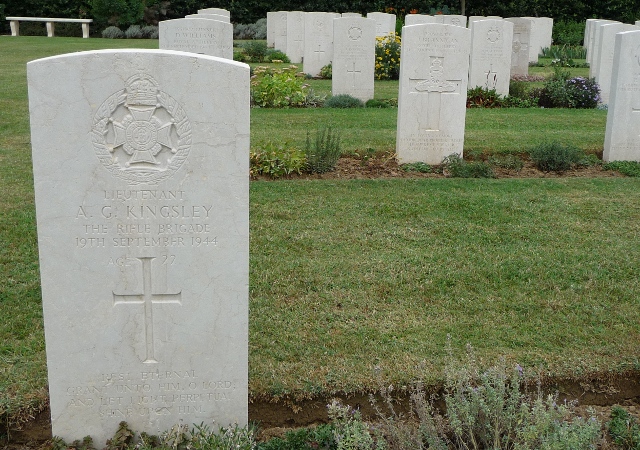
Adrian Garraway Kingsley was my father’s cousin, someone he had looked up to during his youth and spoke of fondly. We visited Adrian’s grave in the Florence War Cemetery for British and Commonwealth forces killed between 1943 and 1945. It was an even more poignant interlude for us when we realised that we were visiting on the eve of the 67th anniversary of his death in September 1944. Adrian Kingsley died helping to liberate Florence from its occupiers, and his is one of more than 1600 graves in this beautifully kept cemetery just outside the city by the river.

Posted in By Country - Italy, Personal stuff | 1 Comment

A van with a view

In order to give our heads a little space before hitting Florence, we headed to the edge of the Appennine mountains, towards Parma and Modena, taking us into Emilia Romagna. Yet more fantastic mountain scenery – nothing, of course, on the scale of the Alpine passes that we’d gone across, but still dramatic. Our campsite gave us a great view of Pietra Bismantova – according to the effusive welcome we received, one of the eight monolithic flat-topped mountains of the world. Cape Town’s Table Mountain and Australia’s Uluru being the best known of the other seven.

So we dived into Firenze. We were heading for a campsite on the Northern edge of town, in a small hill town called Fiesole – Panoramico by name, and very definitely Panoramico by nature – to the point that whilst actually in the pool, you could see the Duomo rising above the city centre. We found a superb spot, overlooking a fold of the valley (but unfortunately not the city), and girded our cultural loins in readiness.

What can we say about Firenze that hasn’t been said before…? It’s incredible. It’s packed to the rafters with artistic and architectural treasures that would be individual stars in any other surroundings, but are so easy to overlook here. The bus into town took us to close to the San Lorenzo church – the Medici family’s local – so we figured we may as well start there. To be honest, that wasn’t the best plan. We quickly figured out that this is a town with an aim to take as many pennies off each and every tourist as possible. In San Lorenzo’s case, that was achieved by the simple expedient of charging separately for entrance to the church itself, to the Medici family tombs, and to the Medici library. In total, about €12 each – for just one church… The church was a good intro to the city’s artworks for me – Ellie’d been to the city before, with the added bonus of staying with Cate, a postgrad art student friend whose part-time job was as a Duomo tour guide – but probably not a lot more than that. In retrospect, skipping the church and going for the tombs would probably have been better than vice-versa. Hey-ho.

So off we wandered, past the Duomo, the Palazzo Vecchio, and the legendary queues to get into the Uffizi. Except there weren’t any. A quick double-check reassured us that, yes, the gallery was open – and, yes, this was the entrance. But there wasn’t a queue at all. Interesting… A quick look at the Ponte Vecchio and some lunch later, we headed back to the Uffizi. Still no queue. In that case, let’s not bother paying the extra to prebook, and just dive in there. Again, what to say? Room after room after room after room of masterpieces. Cultural overload set in at about the same time as utter fatique…

Following day, the Duomo was still there – and so were we. The queue turned out to be much quicker than it looked, so by the time Ellie got back from checking something with the tourist office, I’d not only got to the front but had to stand aside. In we went. This one was a freebie – and just as well, too, since literally half of the interior was barriered off. Unfortunately, it was the half with the dome itself. That’s right – you can’t even stand underneath the dome and gaze up into it unless you pay and queue separately to do the full interior tour, including several hundred steps up to the top. Hmmm…

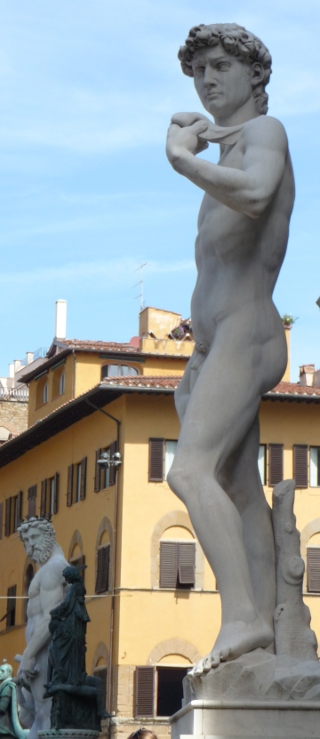
Anybody else would just have an Atlas. Not the Medicis.

A longer wander around the city afterwards took us to the Palazzo Vecchio, originally a Medici palace, and backdrop to Savonarola’s “bonfire of the vanities” (and, a year to the day later, to another bonfire – this time, of Savonarola himself). Room after room of the most sumptuous decoration, including the huge Chamber of the Five Hundred – for a while after Italy’s unification, the parliamentary chamber. The wander continued. Eventually, we came to the “lesser” sight of Santa Maria Novella. A whole stack of “big names” to tick off, and enough other sights to set off overload again. A roasting afternoon when we left, we grabbed an ice cream without checking the price first – fortunately, we misheard him, since it was “only” €8 for the two, instead of the €18 we initially thought he’d said! They were, admittedly, very very good ice creams, but…

Sunday saw us having a break from the city itself, and going to the outskirts to see Ellie’s father’s cousin Adrian – more on him in a separate post – then a bit of a bimble round the northern stretches of Chianti, before heading back in to a different campsite. The Fiesole one was very pleasant, but expensive and on extremely steep terrain, and with a long walk to the bus to town. We’ve been using an out-of-season site discount scheme run by the Dutch ACSI organisation – and their local entry was on the other side of the city, so we thought we’d get a change of scenery. It’s a nice site, not quite as nice as the Fiesole one, but the bus in is just as quick and with a much shorter walk. Don’t even ask about the prices in the campsite shop, though – we overheard one American girl asking the staff if they’d heard the phrase “Highway Robbery”. Strangely, they had. Probably quite frequently…

A little light housework

This, of course, put us to the dreaded Monday though. A quick check on the tourist office list of opening times showed that the main museums and churches we still wanted to see were closed on Monday. However, thanks to the Genoan train times mix-up, we’d learnt that Italian footnotes are rather important. In these cases, Monday closing only applied to the 2nd and 4th Mondays of the month…

Just one small fragment of one small fresco...

So back in we went. Santa Croce was our first destination – again, utterly wonderful, and with the side benefit of housing a leather-working school, workshops and shop – founded by the Franciscan Monks after WW2 to give war orphans a trade. Then, in the cloisters, a small sign for the museum of the church’s restoration work gave us another gem. Santa Croce is close to the River Arno, and was one of the worst hit by a devastating flood in 1966. Some of the works are only very recently back on display after extensive restoration, and the museum gave an insight into the work required. Several painted boards and panels had even required the layer of paint to be removed from the original boards and re-affixed to new boards…

Saved from ruin under layers of mud, oil and filth after the flood.

By the time we’d finished wandering around Santa Croce, and headed towards the next on our list – the Bargello sculpture museum – it was early afternoon. Unfortunately, it turned out that the Bargello might well be open on the 1st, 3rd and 5th Monday – but only in the morning. Next on our list, San Marco, was also AM-only… <groan> So off we wandered again – this time, just diving into a couple of random smaller churches. Santa Trinita and Orsanmichele were both absolute gems – Orsanmichele, in particular. Originally a marketplace with grain store above, it was quickly walled off and turned into the church for the guilds, with the biggest requested to commission statues of their patron saints to fill niches on the outside walls. After a slow start, they pulled out the stops with style. With hindsight, the statues produced are now recognised as being one of the major kick-starts of the Renaissance. As well as the church itself, there’s a little sign in one corner to a staircase, signed as the museum. Up we went, expecting not much more than a slightly dingy attic space. Nope. The very few exhibits (the originals of the statues, since the ones outside are now replicas – some of the originals are in other galleries, leaving more copies to the museum) were great, but the real jaw-dropper was the space itself. Two floors of beautifully light and bright airiness, with fantastic views above the rooftops. For free.


Today’s been our last day in town – this time, we’ve finally managed to catch the Bargello. Very well worth it, with some utterly beautiful statuary on display in a wonderful fortified palace formerly housing the judiciary and jail cells… If anything, though, it seemed a bit as if there was an imbalance between the amount of “stock” and the amount of space – leaving several rooms full of rather mis-matched miscellany, some very poorly displayed with an abysmal lack of information. San Marco was our final stop – the monastery, now converted into a museum, where Savonarola and Fra’ Angelico both resided. The monk’s cells were utterly sublime – one wall of each cell bearing a fresco, mostly by Angelico himself, all underneath exquisite wooden rafters. Various other rooms in the monastery – the Pilgrim’s Hospice, the Refectory, the Library – housed displays of related frescoes and paintings. Quite probably, this was the best single site we went to – a great way to wrap up the stay.

As well as all that, the city itself charmed us. Narrow streets, bustling with life. Everything you could possibly want, but you might have to hunt a bit to find it. We even managed – eventually – to change some old Italian Lire into Euros, at the branch of the Bank of Italy itself – more than a bit intimidating, under the glare of several Carabinieri shouldering submachine guns guarding the multiple layers of entrance before you managed to find the sole cashier… No problem at all, though, once in. We even managed to find some superb and good value food in proper “local” establishments, yet barely a street or two off the main tour-group packed areas.

Oh, yes – and those artworks themselves? Where to start… Donatello, Michaelangelo, Brunelleschi, Ghiberti, Giotto, Lippi, Fra’ Bartollomeo, Fra’ Angelico, Verrochio, Leonardo, Botticelli, Ghirlandaio, della Robbia (several of ’em), Gaddi, Masaccio, Cimabue – and many many others. Then there were the Medicis and their various rivals, and other key figures. As we wandered around, we quite quickly started to figure not just the names and styles but the interrelationships between them – who’d trained with who, how styles had developed, influences and commissions – and the rest, including the political framework that made it all possible.

It’s been a fantastic few days, and we’ve seen a huge amount – there’s still a huge amount we haven’t seen, though – we’ve barely scratched the surface. Do we stay for a few more days? There’s so many more places to see…

Posted in Art & Culture stuff, By Country - Italy, Travel stuff | Leave a comment

Cinque Terre

Cinque Terre refers to the area around five villages which are wedged into coves or perch on cliff tops along the dramatic coastline between Levanto and La Spezia, east of Genoa. They are largely only accessible by train, boat or on foot, and supposedly keep their local skills and traditions going. It sounds so appealing and we’d long wanted to visit them. Unfortunately so has everyone else … We were surprised by the volume of tourists in this so-called off season period and from all over the world, particularly lots of Americans and Australians. Previously on the trip we’ve only really come across other European tourists.

We took the train from Deiva Marina to the furthest of the five, Riomaggiore, a village rising up the steep hillsides from a tiny harbour, with multicoloured houses – most now being gift shops.

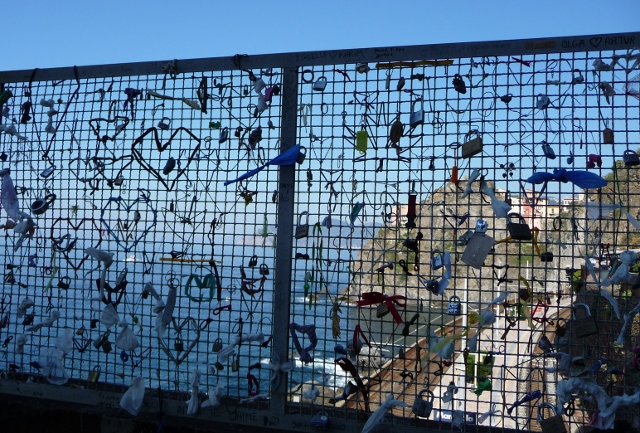
We walked westwards from here to Manarola. This was the most crowded stretch as it is the easiest, the coastal path being largely paved and flat. It is known as the Via dell’Amore, or lovers’ path, and it features many padlocks. We first came across the phenomenon of people putting padlocks on public railings, to symbolise their relationships, on a bridge in Seville a few years ago. Here they’d even erected extra wires to cater for this craze. However, it looked rather tatty in places as those who had forgotten to bring a padlock had tied bits of plastic bag to the wires.

The path from Manarola to the next village, Corniglia, was closed due to landslides, but we could walk far enough out of the village to see that they weren’t joking and a large section of the path had disappeared. So we, together with many hundreds of other tourists, waited for the one train an hour to take us those very few kilometres. It was very hot. And the train was packed, recalling life as a commuter on the London tube. Some of the older people in the tour groups were obviously finding it difficult to cope with crowds, heat and gradients involved.

From Corniglia station you have to climb either a stairway set into the cliff up to the village or reach it via a steep winding road.

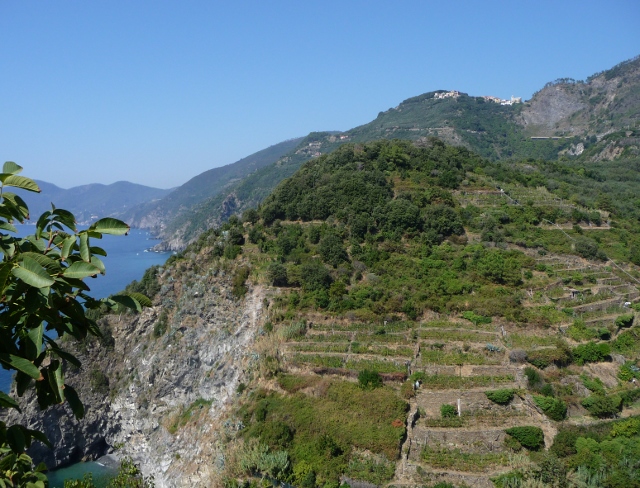
We took the latter option and found ourselves amongst the gardens and terraces where grapes for the local wine are grown, as well as vegetables. A tiny scarily makeshift monorail has been set up in order for the growers to reach these precarious parts of the hillside.

On reaching the village a welcome shop selling cold beers was our first stop and we picniced outside a pretty little church with a simple blue-washed interior. Because it is less readily accessible, there were far fewer visitors here and it had a relaxed sun baked ambiance. We later sat for a while in an outdoor cafe trying the local wine. This was definitely our favourite village.

From Corniglia the path wound out of the village through passageways and into olive groves, up and down hill around several headlands on uneven steps and stones. There was a lot of uphill and a lot of downhill too and it was heavy going at times.

The reward was the incredible views over the sea and coastline – spotting the villages in the distance.

We took the prescribed 90 minutes to get to the next village of Vernazza. Hectic with sightseers, its castle presiding over the harbour crowded with people swimming in the water, this provided a welcome ice cream break.

The last leg, from Vernazza to Monterosso was the most strenuous, starting with an steep 180 metre climb out of the village and finishing with a painful descent of hundreds of uneven steps into Monterosso which seemed to take forever. There were long stretches where the path was incredibly narrow – barely an average person’s width – with a sheer drop on one side. Late afternoon by now, and we were grateful that there were far fewer walkers. Again, in spite of being comparatively slow, we took the prescribed time of two hours to cover this short 3 km distance. We pretty much hobbled into Monterosso and found a lovely restaurant for dinner. We had to rush for our train afterwards though, and we had cycled to Deiva Marina station from the campsite and it was uphill and dark on the way back. Free hot showers have never felt so good.

Sadly, only Corniglia came close to the promise these villages held for us – a remote gem of a place tucked high on its dramatic rock, still with its people eking out a living from the hillsides as well as from tourism. The other villages, or towns as they really are now, seem solely tourist hot spots. It’s hypocritical to be a tourist and yet hate the extremes that tourism has created and you can’t blame villagers for cashing in on tourism. We’ve touched on these themes before and will explore this further. In spite of being so touristy and receiving so many visitors, there is little attempt to provide adequate information such as a decent map of the walking trails – and you pay to use the trails. And, as ever, there are few public toilet facilities. As the Eagles sang ‘call someplace paradise, kiss it goodbye‘.

Posted in By Country - Italy, Personal stuff, Travel stuff | 1 Comment