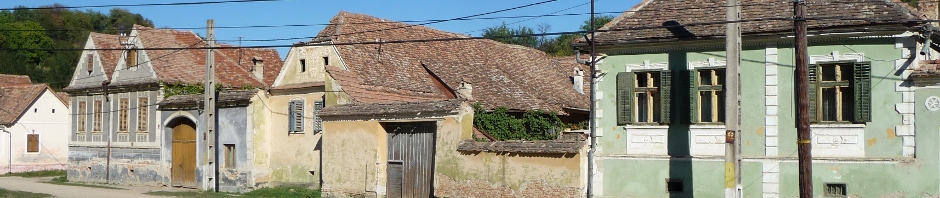
A tale of icons, apples and the perfect camping place

We left Ohrid via the internet café, which luckily wasn’t affected by the powercut that seemed to be blacking out most of the town. The day had dawned sunny, but clouds were rolling in. Our first foray was to Sveti (Saint) Naum, a monastery along the south eastern bank of the lake – close to the border crossing with Albania where we’d been turned away a couple of days before.

Judging by the amount of souvenir stalls along the pathway to the complex, which is now more hotel than monastery, it’s a very pretty spot that is a tourist magnet in summer. By the time we reached it though, it had started raining.

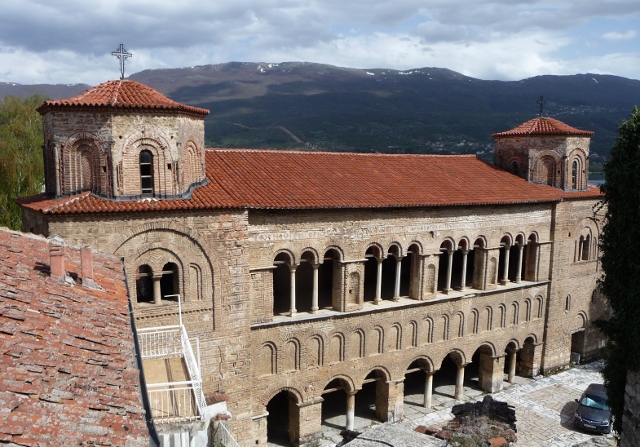
Although it is guarded by a fierce flock of peacocks, the place is tranquil, and the 17th century church we’d come to see was hidden away in a courtyard. It was a really special place, originally founded by Sveti Naum in the 10th century. One of the villagers was ploughing with two oxen one day, when a bear attacked and killed one of them. He sought help from Sveti Naum, and was amazed to see that the bear had been put into the harness and was ploughing alongside the remaining ox. This story is just one of the illustrations shown in the marvellous frescoes in the charming small church, with the inside of its dome typically painted with Christ Pantocrater. As we left the church the guardian passed us glasses of rakia. A welcome warming burst of mellowness on a miserable day.

We managed to escape without molestation by the noisy peacocks and drove up into the mountains on the route across to Lake Presper, and part of the Galicica National Park. As we ascended, the cloud closed in and although we were still within the treeline, we found snow on the road. We got around the first patch or two, but then there were sizeable remains of a drift right across our path. We’d have had to do some digging and who knew what else lay ahead further up into the clouds. There was just too much for us to risk going through.
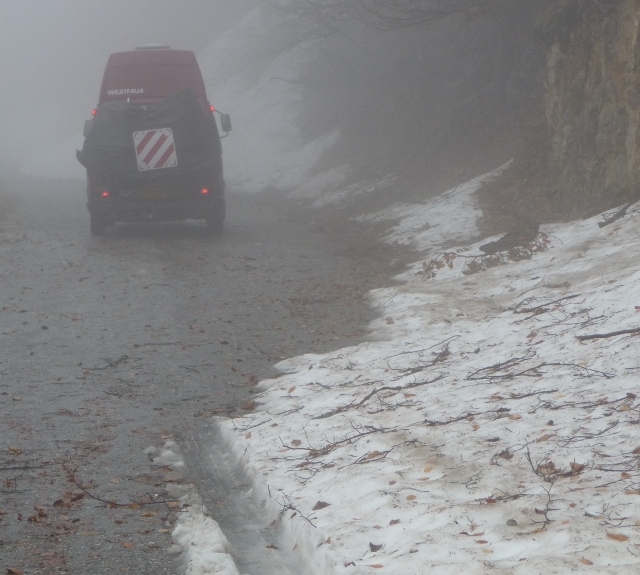
Reluctantly and very gingerly, we turned the van round. Bear in mind that there was a sheer drop onto the steep wooded slope below. It was a little tense, especially when we skidded on passing the rest of the snow piles and were seconds away from potential calamity. We’d made the right decision to turn back.

Our choice then was a longer route, north again up the east bank of the lake via Ohrid town and then further eastwards. By the time we reached the eastern bank of Lake Presper, the weather had changed again, and the lake and its villages were bathed in sunlight.

Lake Presper is slightly smaller than Lake Ohrid and is split by three borders – Macedonia, Greece and Albania. One of the first villages we came to was Kurbinovo, which sits back from the lake shore on a foothill of Mount Pellister. We had read about a church above the village with magnificent frescoes. The village straggles upwards and has a gushing stream through it. This area is prime orchard territory and used to export a lot of its crop to Greece. The border down the road is closed though now. Greece refuses to recognise Macedonia as a country. Alongside a barn by one of the orchards there seemed to be a party in full swing. A couple of chaps were loading up boxes of apples on top of, in and around an old Albanian registered Mercedes sagging at its seams.
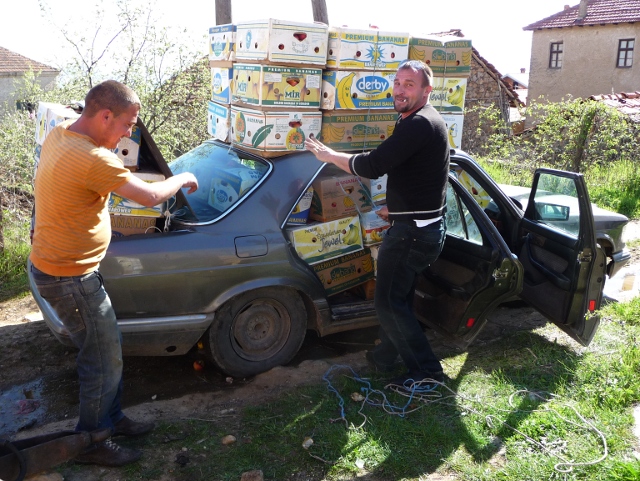
To cement the deal it appeared that quite some rakia had been consumed and they were in high spirits.

It was a sight to behold, and they were ecstatic that some Brits in a red camper van, who could speak a few words of Albanian wanted to take pictures of the spectacle!

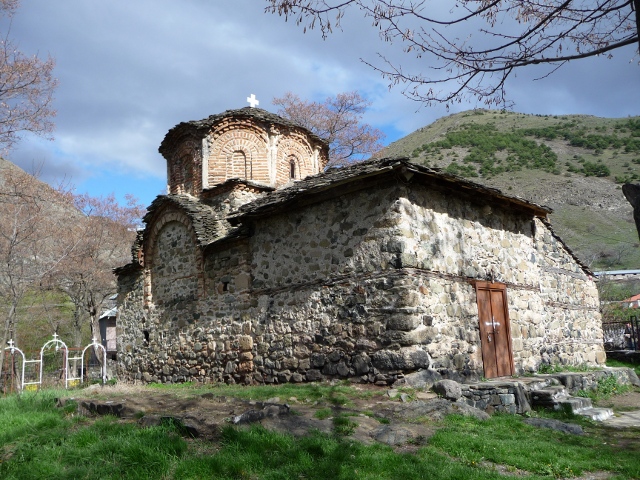
We continued up into the countryside beyond in search of Sveti Gjorgi (St George’s) a kilometre or so further on. We drove about two kilometres, no sign of it. Turned around, but then thought better of it and turned around again determined to find it. Another kilometre or so on and there it was tucked into a rise above the fields – a warm-stoned barn-like building.
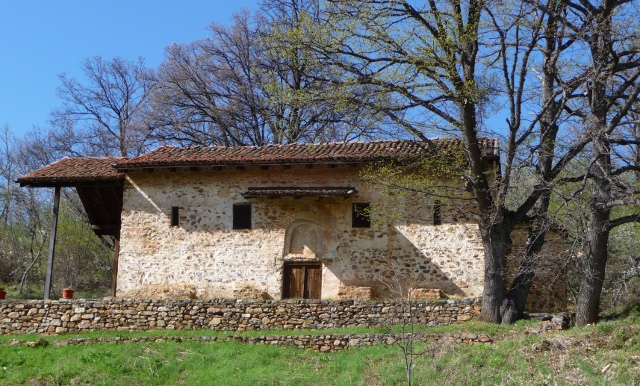
The setting was magnificent, the silvery shimmer of the lake, snowy mountains beyond it, wooded hills all around and the snowy cap of Mount Pellister behind, and the sound of the rushing water of the nearby stream.

What more could you want – the perfect place to spend a night. Of course we should have asked in the village for the key as the church was locked.

We trundled back down, past our Albanians, and various waving villagers – and were pointed in the direction of the keyholder. The lady was happy to trust us with the key as long as we brought it back straight away. We asked if she thought it would be ok for us to spend the night in the car park up there. All this was done with very limited Macedonian and miming skills. Once she’d established that we didn’t plan to sleep in the church itself, she was happy for us to spend the night there. We promised to return the key as soon as we’d finished looking inside the church.

So back up through the village, more bemused smiles and waves. The church was relatively simple inside compared to some, and was apparently originally thought to have been built in the 18th century, but then the frescoes were dated to 1191. They are tremendously decorative, one of the country’s treasures and featured on the 50 Denar note.
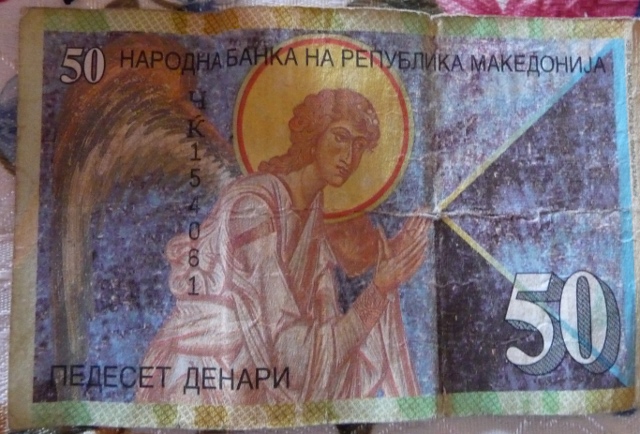
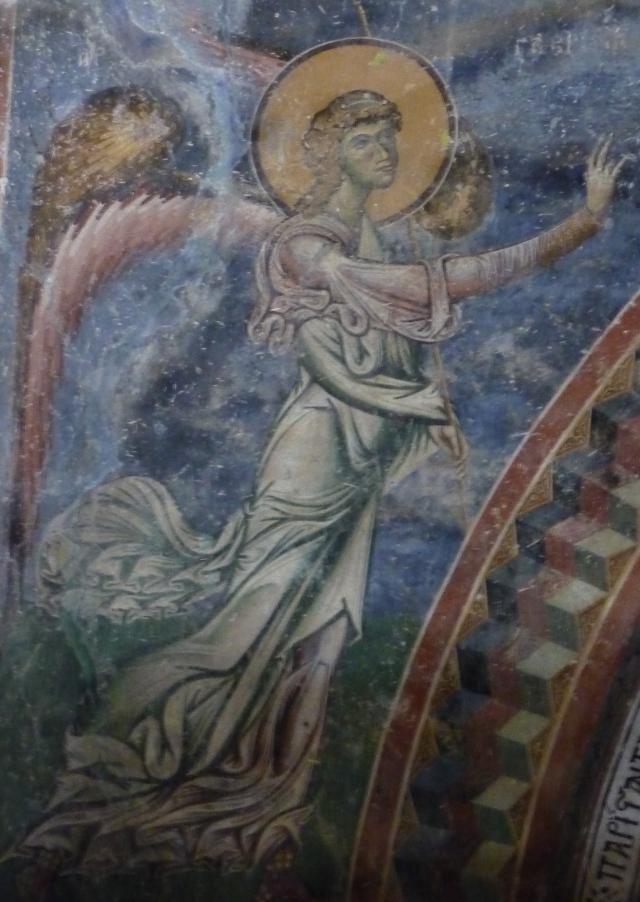
We felt honoured to be trusted with the key. In Macedonia, the tradition is to leave money by the icons, and it looked like it hadn’t been collected in a while.

After returning the key, and with goodnight wishes from the lady in the village, we turned down an invitation to drink coffee in Albania with our apple chaps and went to make ourselves at home in our exquisite camping place. We couldn’t believe our luck on finding such a perfect wild camp location, one of the best of the trip so far, and to have the local seal of approval felt appropriate too. All you could hear were the natural sounds, the rushing brook, birdsong and the breeze. The sight of the sun’s last rays casting a rosy glow over the mountains, and two eagles soaring and swooping along the valley. I even got around to doing some sketching. It was also a chilly night of a billion stars – we were a long way from the nearest town – and quite high above sea level. It is these special places that make our hearts sing and encapsulate the best moments of this trip … such a far cry from being squished into a delayed tube train and dealing with the other stresses of modern city life.

On our waking, we enjoyed that magical early morning light, the fresh air and birdsong, that heralds a beautiful new day. It was sad to leave such a perfect place, but there was more to see! In the village, we assured our key lady that we’d had a very good night and she waved us on our way.

Further down the lake were several more villages, all apple centres, with more Albanians loading up. We saw one of our chaps again, evidently he’d been back to Korça overnight and had returned to Macedonia first thing. He looked a little the worse for wear either way.

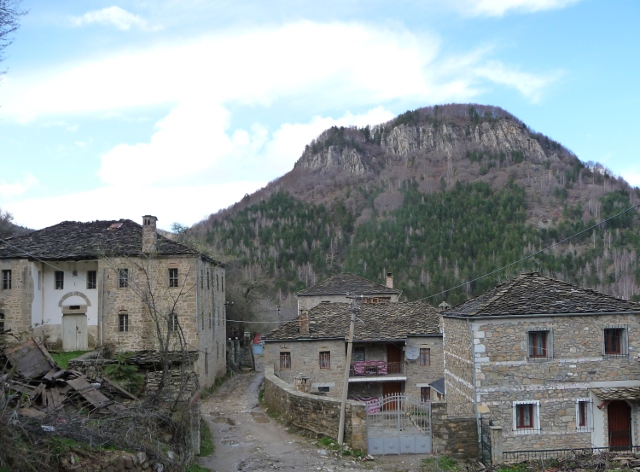
The villages of Brajčino and Ljubojno were also picturesque with pretty houses scattered up wooded valleys, some of them quite large and there was quite a bit of new building going on too. Perhaps they’d recovered their fortunes in spite of the Greek border being closed. After exploring their narrow by-ways, we were on our way to the other side of Mount Pellister, to an old Vlach village. The Vlachs are an ethnic group that exists in pockets around the Balkans, speaking a language more akin to Romanian. The village of Malovište is within the Pellister National Park, and once we’d found the right turning for it we wound steadily up a steep valley. We already felt like we’d stepped back in time coming to this region, but Malovište seemed yet further back. As we approached the village, this lady with her donkey and ponies very kindly allowed me to take her photo.
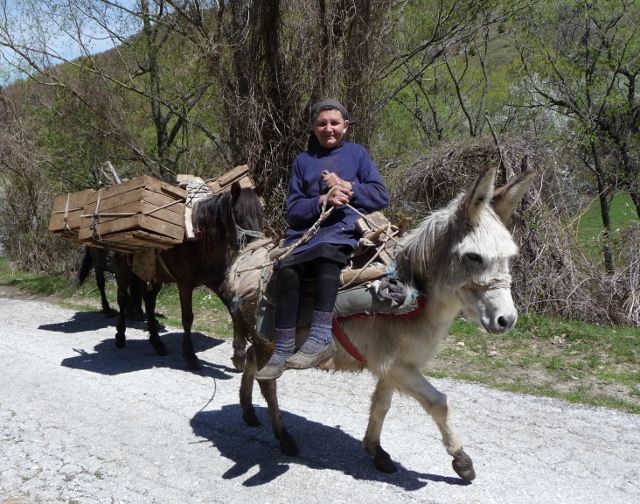
The village was rugged, its main drag was cobbled – huge stones grown rough and uneven over time. Someone had draped a powerlead low over the road at the start of it, so we parked before entering the village proper. This was a good thing!

Again there was a gushing stream right through the centre, this time wide enough for small bridges to criss-cross it, and the mixed collection of stone cottages and larger houses followed its course. At one time, Malovište was an affluent settlement, its fortunes stemming from its livestock.
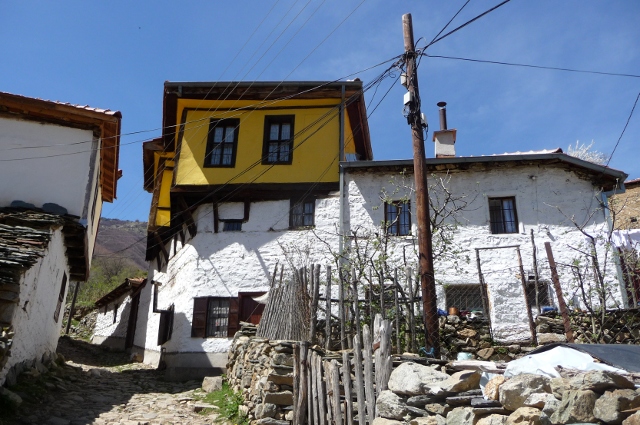
Its large main church Sveti Petka was 19th century and beautifully decorated. Once again we played hunt the key with the help of some old ladies. The church contains masses of icons, but unfortunately it was quite dark inside so we couldn’t see them very well.

We started to walk out of the village towards Sveti Ana, a monastery high in the forests at the top of the valley. The scenery was magnificent as we jumped back and forth over the stream. We turned back before finding Sveti Ana though – it wasn’t clear which way the paths were going and we’d been going at least an hour longer than the half hour the guidebook had mentioned … that’s our excuse anyway.

So an amble back to the village and into the van to find Bitola and somewhere to stay.
Posted in Art & Culture stuff, By Country - Macedonia, Personal stuff, Travel stuff | 2 Comments

On the Macedonian side of Lake Ohrid

As we drove around the northern edge of Lake Ohrid from the border crossing we felt less than inspired. It was overcast, threatening to rain, and any campsites we could see not only looked closed but terminally so. As we reached the sprawl of the town of Ohrid itself, supposedly the gem of Macedonia, we weren’t further invigorated.

A quick stop at the friendly tourist office, started to put matters right. We bought a map of the country, and a walking tour map of Ohrid itself. They thought there was a campsite open on the edge of town and welcomed us to the country. Having got the basic polite everyday phrases off pat in Albanian, we now had to work hard to do the same in Macedonian, and to navigate the local version of the Cyrillic alphabet.

We headed in search of the campsite and found it was in the process of being built on. Lovely wooden houses by the lake, but no more camping, just the last few dying caravans gathered together in a corner, as if in mourning. We decided to see if any of the dead looking sites we’d passed earlier could be revived, and followed signs for what we thought could possibly be one down a narrow lane towards the lake. The gate was closed, but we could see a couple washing up at some sinks just inside and they pointed us in the right direction for Lubko, evidently the man who ran the site. He ushered us in and brought us on a circuitous route round all the fading huts and caravans, and across the beach, to a newly mown grassy patch by the lake. It would do as a one-nighter anyway, and with that it started to rain.

Next morning the sky was magnificently clear and the lake sparkling. We’d got through a wet night, and I’d spied a  washing machine in the utility room beside Lubko and Mrs Lubko’s shower which we were using. Although we had been eager to press on to see the town and drive further into the country, the lure of a clear sky, a huge washing machine and handy trees for a washing line was too much. Especially with Adrian a day or so away from crisis point on the boxers and t-shirt front. So Mrs Lubko supervised the putting in of clothes into the  machine, with its detailed instructions in Swedish on the front, ensuring I was keeping coloureds and whites separate. While it churned away, Lubko asked us to join him, Mrs and one of their pals in their messy front garden for coffee. He gestured towards the large plastic water bottle on the table. No we were ok for water. Ah, not water at all, but rakia. Just after breakfast, but it would have been rude to refuse. Suddenly it all felt very Eastern European. Bar a few words there was no common language, but England seems to be synonomous with football here, and Lubko fetched out his Man U shirt with Rooney on its back to show us.

After two enormous loads of washing were out on the line, and a quick picnic lunch consumed, we got on our bikes and cycled into Ohrid, through the pedestrianised shopping streets and on down to the lake front – locking the bikes up in the square. Our walking tour map in hand we followed the route into the older part of town, and discovered why Ohrid is so highly thought of by Macedonians. For one, Lake Ohrid is their seaside, secondly it has some pretty, if very done up, buildings, and it has some amazing old churches. Being a popular town, the churches charged entrance fees, but this was fine because it did mean they were open and we didn’t have to play hunt the key.

After paying a quick visit to a handmade paper workshop and gallery, we entered the large Sveti (Saint) Sofia church with incredible frescoes and icons and more brightly lit than some we’ve been to so you could see clearly the golden magnificence. Unfortunately few of these churches allow photography inside.

We then followed paths upwards and around the headland to Kaneo. A small outlying fishing community tucked into a cove – only reachable by boat or foot.

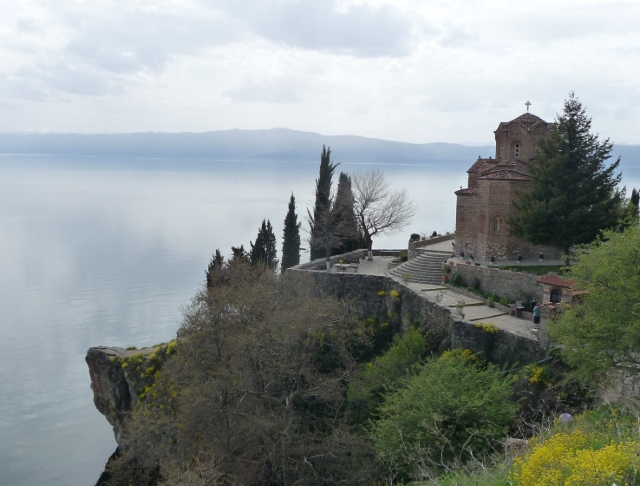
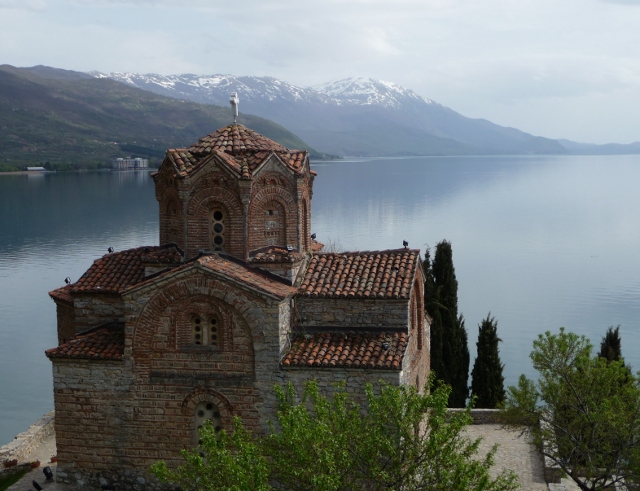
Above this on its own point, is the delectable tiny but beautifully formed Sveti Jovan (St John the Theologian). We had a tour of the wonderful frescoes in French from the custodian, and strolled around looking at the magnificent views across the lake.

From here it was a climb up the hill, towards the castle. Unfortunately, the Sveti(s) Kliment and Pantelejmon at Plaosnik were closed for a major overall of the church itself as well as obvious archaeological work on the remains of the early basilica beside it. All we could do was gaze longingly through the fence and continue upwards.

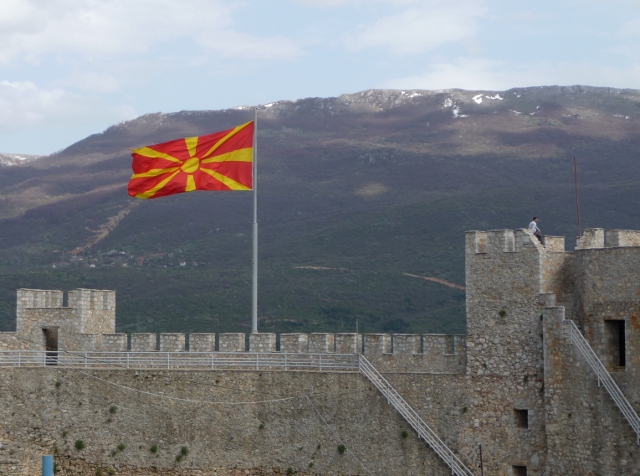
The castle sits magnificently above the town – the walls all still remaining and open for walking on. Topped by the brightly coloured sunburst of the Macedonian flag, it’s an impressive sight.

From there we walked back down towards the town, stopping at another gem of a church also undergoing some restoration to its exterior, but thankfully its interior was open for visits. Another beautiful spiritual space with the wonderful carved iconostasis gateway to the altar area, with the icons themselves, and more stunning frescoes. We really love the style and the spirituality of the Balkan churches, deceptively simple and intimate in feel. It is a refreshing change from the imagery and decoration of the Western European Catholic churches.

A few more alleys of meandering lead us back to the square and our bikes, and we cycled back to the campsite via the vegetable market which was still going on in the late afternoon. We were in time for a leisurely sundowner by the lake before preparing dinner – our impressions of the country had improved greatly over the course of the day.

Posted in Art & Culture stuff, By Country - Macedonia, Travel stuff | 4 Comments

An ongoing Balkan border post

As we did for the entry to Tunisia, we’ll be giving a handy how-we-did (promising nothing as generic as a “how-to”) for the borders we encounter. This post will be updated after each one – hopefully, with good news of how easy they all were…

Albania
Entry via ferry from Brindisi to Vlora, arriving 7am on a Sunday.

Our major concern was getting insurance – and that’s going to be a repeating concern, since our UK insurer won’t cover us for any countries bar those in the EU, plus Croatia. In the event, it was very straightforward. As we returned to the van on the car deck of the boat, we were approached by somebody asking if we needed to buy insurance… One very official looking A4 certificate was quickly filled in, and cash handed over. As we exited the boat, other sellers were standing around, and there was a branded insurance office next to the port exit. We paid €51 (but €44 is written on the certificate…) for 30 days, or were offered 15 days for €27.

Other formalities were straightforward – just a straightforward passport and vehicle registration document check, passport stamped (nothing extra for the vehicle) and done.

Macedonia
There are two main road crossings from Albania to Macedonia by Lake Ohrid – one at the south (Tushemisht), near to Greece, one at the north (Qafë Thanë). Of these, the northern is by far and away the more major.

Formalities are straightforward – passports & car registration, although the Macedonians also ask for the insurance Green Card.

Tushemisht does NOT have an insurance sales point. If you do not have a Macedonian Green Card, you will be refused entry, and have to go to Qafë Thanë.

Qafë Thanë’s insurance sales point is inside the country. We passed through the Police checkpoint and were told to park the car, walk in and buy insurance, then return and take the car to the Customs checkpoint and in. Our passports were held whilst we did this.

The insurance sales point (€50/15 days) does NOT take Albanian Lek or plastic. You will need either Macedonian Denars (there is no ATM at the border, and they aren’t exchangable outside the country) or Euro cash.

Montenegro
As of the start of 2012, Serbia is now within the normal EU vehicle insurance agreements, so is automatically covered in the same way as any other EU country. Or, rather, it should be if only UK insurers weren’t so pathetic in their small-island mentality. But that’s another story. Our insurers (Allianz, via Swinton) finally agreed that the Foreign Office website and several foreign insurance industry websites were correct in explaining this, and issued us with the Green Card that we don’t actually need any more. However, before Feb 2012, Montenegro delegated their insurance paperwork to Serbia – so the older Green Card form explictly includes Montenegro (MNE) under Serbia (SRB). If you have a Green Card for SRB which does not specify MNE separately, it’s valid for Montenegro until the end of Dec 2013. The one Swinton issued us with falls under this, and was accepted (even though just a colour printed PDF, not an original) with no problem at the Sukobin/Vladimir crossing west of Lake Shkodra.

If you’re not so lucky, then there are insurance sales huts on the Albanian side of the border, but I didn’t see any on the Montenegrin side. Other than that, formalities were a doddle – the two countries have their huts right next to each other, so you don’t even realise immediately that one’s out and one in, just thinking they’re Police and Customs for Albanian exit. The one entertainment was wondering what your chances of ever seeing your own documents again were, after handing them to the Albanian policeman wander up the queue of vehicles collecting car documents and passports from everybody, then wander slowly back with a fistful.

Croatia
Almost too easy. Really, the border south of Dubrovnik was like crossing a “proper” border. Just a nice civilised little queue, and a nice civilised little check of the proper papers – and that was it. Where’s the fun in that?

Bosnia & Hercegovina
The Croatians wanted to check the registration document on leaving the country, but the Bosnians weren’t at all bothered on entering. They were, I think, too busy having fun and sharing a joke amongst themselves – I’ve never had to interrupt laughter before to have my passport scanned… We had no green card, and had to raise the subject of insurance ourselves – once the surprise cleared off their faces, they pointed us to the freight management hut. We asked around the companies in there, and were pointed backwards and forwards until somebody came back from the loo and admitted that, yes, he was responsible for selling insurance.

He rummaged through his paperwork, admitted that he could only do 16 day policies, and reached for the calculator. €122. Are you having a laugh? For a car, it would be €32. Come with us. THAT is our van. Oh. Back in we go, and the paperwork is written out for €32. Yes, it was that easy to save €90. Croatian Kuna were perfectly acceptable, at a better Euro/Kuna exchange rate than most places in Croatia charge.

We’ve heard from another traveller that they were told (at a different border crossing) €55 for five days or €75 for fourteen, for a much bigger motorhome. They’d also spoken to somebody who was charged €25 for three days for a car. Go figure.

Posted in By Country - Albania, By Country - Bosnia, By Country - Croatia, By Country - Macedonia, By Country - Montenegro, Officialdom stuff | 4 Comments

Something fishy

As we entered Korça, our first impressions were less than enthusiastic. It seemed to have very few redeeming features indeed – certainly not the road surface… We found somewhere to park, conveniently right by the (modern but beautiful) Orthodox Cathedral, and went for a wander around. We think we found the reputedly beautiful older areas of the town. They were certainly older. We found the brewery (whose products we’d already decided we liked), but the tour was only available by advance appointment. We found somewhere for lunch – and ate a stack of utterly delicious charcoal-barbecued Qoftë (meat kebabs), served with bread that redefined doorstep. The city started to grow on us a bit.

We headed out, to the tiny village/suburb of Mborje, to have a look at their miniscule 13th century church. Which was, of course, locked. Our guidebook suggested we ask in the shop down the road for the key, so we did precisely that – fending off the (slightly simple) teenager who seemed to be asking for money to stop his aimless hanging about and find it. The women in the shop had lots of suggestions, but we didn’t understand a single one, so they barked an order at the lad, who headed off at a sprint. Eventually he returned, shrugged, and started to just hang about again. A while later, he was still there, unlike the key. Some smaller kids appeared, and joined him in hanging around. They spoke a bit of English, and offered to take us to find the key. Deciding the alternative was to give up, we did, and went on a guided tour of the village, gaining and shedding some of the gang on the way. Eventually, we found the keyholder, just sitting down to his lunch in the local taverna. The key was handed to the oldest of our gang, along with some VERY stern admonishments on what would happen to him if any misbehaviour happened, and we were in. The tiny interior was barely lit, but the beautiful frescoes covering every inch of the walls shone brightly even through a thick layer of candle soot and mould.

Guzman and Ilva had suggested the nearby village of Dhardë as a good sight to see – and they were right. Way up above the snowline, at the end of kilometres of steep potholes, the village spills – utterly unspoilt – down the far sides of the mountains from the city.

We found a spot to park the van, and after a wander round, found a little taverna to sample the local speciality – Lakror, a thin round filo pastry pie about 18″ in diameter and baked in the ashes of a wood fire. Probably for the better, we didn’t end up being served a whole one – just pieces – but the accompanying salads were as good as we’ve come to expect here. As for the pear Raki which washed it all down…

The end of a cold but incredibly peaceful night was signalled by several cockerels only just over a stone’s throw away (we know – we tried), and we fought our way back up the track out of the village and down to Korça again, heading for the National Museum of Medieval Art, where – despite the sign giving opening hours – the keyholder was eventually phoned to come and open up for the tourists. The collection was small, but simply stunning – mainly icons, but with some beautiful beaten metalwork – silver cups and Bible covers – and carved woodwork. Whilst we were there, a couple of tourgroups (Greek, we thought, one led by two Orthodox priests in full garb) passed through briefly and loudly, barely glancing at the contents. As we left, the doors were locked behind us.

Deep in the mountains on the other side of Korça lies Voskopoja, once the largest city in the Balkans, now a tiny village. The road out of Korça was the usual game of hide and seek with the tarmac, but it soon opened into a wonderful smooth newly surfaced stretch into the hills, where we branched off onto a steep and badly rutted dirt track up into the forest, searching out the monastery of St Prodhomi. After giving up and abandoning the van just as the track worsened dramatically, we walked the last stretch. Eventually, we found the caretaker – or, rather, she found us as we gave up and left – but again the frescoes and carvings were absolutely worthwhile. The church of St Nicholas in the village itself was much easier to get into. We were pointed towards a house carrying a B&B sign – where the priest was leaning over the back garden fence, chatting to his neighbour… At this point, the bit of Italian we’d learnt started to come into it’s own, as he gave us a guided tour, explaining the frescoes, both inside and in the covered porch down the outside.

Painted in the 18th century by the Zografi brothers and by David Selenica – some of the biggest names in the museum – they were again utterly stunning, but again in rapid decay. Quite simply, no money’s available for restoration or even basic preservation apart from that which UNESCO gives to the places on their heritage list.

Leaving Korça, we headed north to Lake Ohrid. Nearing Pogradec, on the southern shores of the lake, we started to weave our way steeply down. One layby on the outside of a hairpin bend was taped off by the police, with a couple of bikes and cars parked up inside the tape and people standing around. A single tyremark going straight on from the bend, through the dirt and over the edge told the rest of the story. From further down the road, we looked up to see what appeared to be a dull glint from somewhere in the trees, almost vertically down from that bend.

Pogradec’s central streets are brick paved, and as we pulled away from having briefly parked, we thought the road noise appeared to be louder than usual, accompanied by a bit of creaking from the back, but everything felt good through the seat and steering. A good look in the mirror showed, though, that one rear wheel had different ideas from the rest of the van as to which way to head, wobbling wildly. It turned out that all five wheelnuts had worked themselves very loose, to the point were all were about to fall off their threads, leaving the wheel free to pursue those different ideas. Could have been worse, but a salutory lesson in checking up after some of the road surfaces. Once we’d fought the curious kids back to the point where I could re-tighten it without tripping over them, we headed off again.

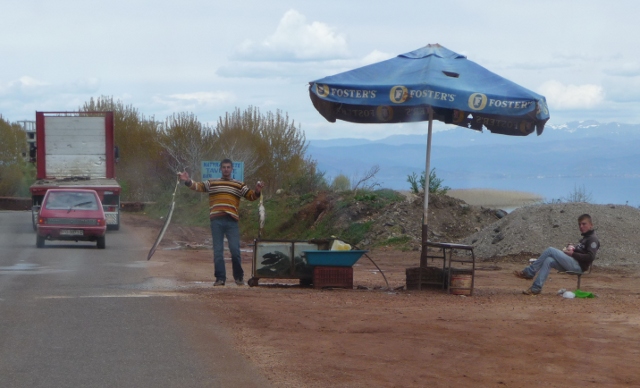
The shores of the lake, just a few km north of town, give a beautiful location to a fish farm and restaurant with camping field. Ohrid is famous for several unique species of trout, now endangered – not that you’d have known it from the guys hanging around at the side of the road, enthusiastically waving large fish and eels at passing traffic in the hope of selling some of the contents of their large tanks. We don’t know how good the wild fish is, but if it’s anything like as good as the farmed…

And so on to the border with Macedonia. The geography of the region means that, if we’re going to see Macedonia at all, now’s the time to do it, so over the border we headed. Or, rather, we tried to. We were refused entry to the country.

Fortunately, this was only due to the fact that the small crossing point we’d chosen, round the south of the lake, didn’t have anybody to sell us the car insurance we needed, so we had to return through the kilometre or so of No Man’s Land to give our passports back to the Albanian borderguard who’d just stamped our exit into them… After a brief moment of confusion at the northern entry point, resulting in being briefly shouted at by the very rotund, florid-faced and unamused Macedonian policeman we’d just driven straight past, we were let in – pausing only briefly to be thoroughly robbed for a fortnight’s worth of insurance.

Posted in Art & Culture stuff, By Country - Albania, By Country - Macedonia, Food stuff, Officialdom stuff, Travel stuff, Van stuff, Wildlife stuff | 1 Comment

Into the heart of the land of the two headed eagle – the road to Korça

We left Gjirokaster under leaden skies wondering if we’d ever get to see Albania fully sunny. Our first stop as we drove north was Tepelene, home of Ali Pasha who ruled southern Albania and much of mainland Greece in the late 18th and early 19th centuries, building aqueducts, bridges and castles in the region.

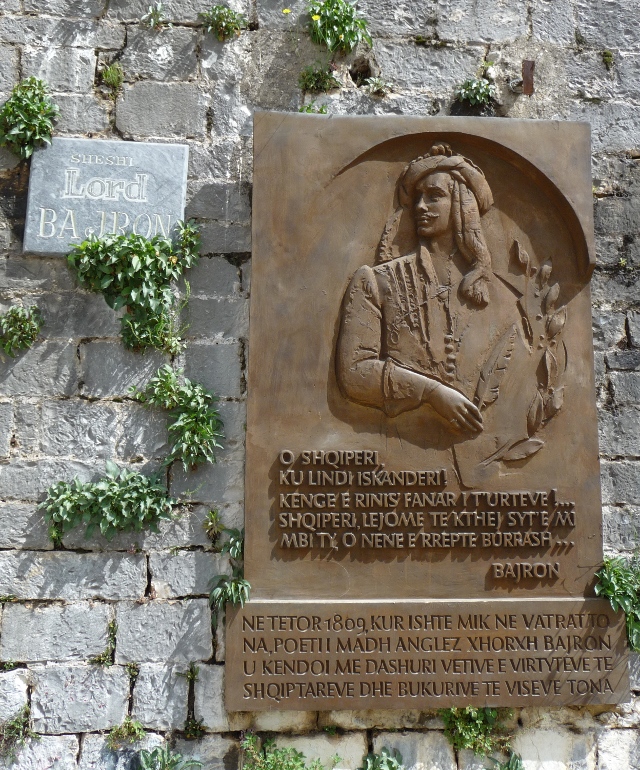
Lord Byron visited the court of Ali Pasha at Tepelene, and we tried to visit the castle.

The quote is from Byron’s ‘Child Harold’s Pilgrimage’ and is in English as follows – I include the whole reference to Albania:
Land of Albania, where Iskander rose,
Theme of the young, and beacon of the wise,
And he, his namesake, whose oft-baffled foes
Shrunk from his deeds of chivalrous emprize.
Land of Albania, let me bend my eyes
On thee, though rugged nurse of savage men!
Where is the foe that ever saw their back? …..”

We were let off from having to pay for parking after intervention from an English speaking passer-by in our discussions with the attendant about how much. Our guidebook (Bradt’s Albania) said the castle was still inhabited and that it was free to wander round inside. A bit misleading, as when we did find our way in through the walls, we found rough tracks leading through a housing estate and you would barely have known you were inside the walls of a castle at all.

On our way out of town we stopped to peer over the side of the valley to see Ali Pasha’s bridge below spanning the Vjosa river, and still in use … sort of.

Doubling back on ourselves, we headed south to the turning eastwards and the road to Korça. This numbers among the most scenic routes in Europe. It is the main trunk road to the east of the country, and most of it is little more than an uneven paved lane hardly wide enough for two vehicles to meet, with potholes for long sections and sometimes little more than a rough track.

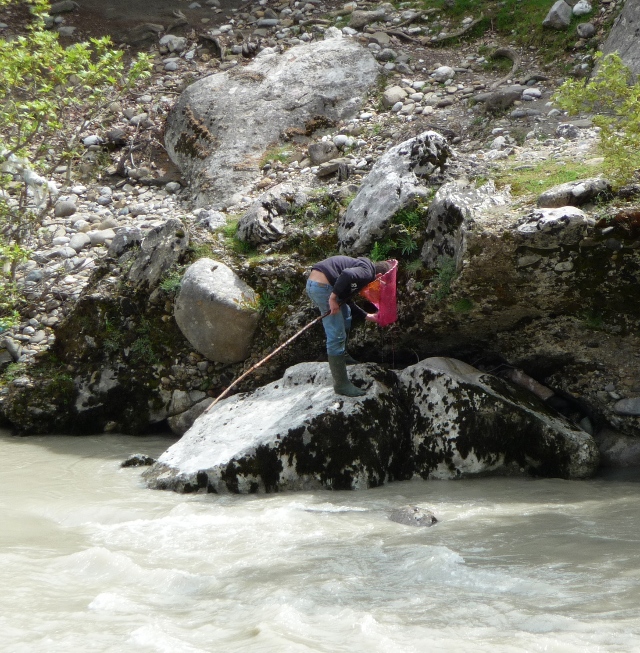
We enjoyed every minute of it though and the sun even graced us with its presence now and then. Dramatic mountains, lush meadows, rushing river torrents and waterfalls crashing down sheer mountainsides, more rickety bridges, eagles swooping in front of the van as they plunged off the side deep into the valley below, ponies and donkeys with their wooden-framed saddles trotting along, cheery waves from their riders. Parking up to take a picture and being greeted by a young boy fishing off a rock on the opposite side of the river. The countryside grew ever more remote and stunning views met very bend.

We passed through the busy town of Permeti in its lovely setting among huge rocks along the river where school was kicking out and children were meandering haphazardly along its streets. Then more wilderness and as we wound through ever more remote mountains, the weather started to close in as we slowly neared our destination for the night.

There was a turning off towards some thermal baths a few kilometres away and we decided to have a look. This minor road was very new and perfectly smooth, it lead gently along a valley with abundant pink blossom and forested hills until it ran out into roadworks and a couple of pools of what could be called bubbling water, but we weren’t quite sure. Nothing fully developed then, in spite of the brown sign and new road.

On the way there, we had spotted a lovely looking village up in a fold of the hills, but the rough track that seemed to be the only way there started with a gushing stream it would have been impossible to ford.

Farma Sotira is a family run trout farm and taverna with guest chalets and camping located north of Leskovik as the road to Korça turns north and runs parallel to the Greek border a few kilometres hence. It is a peaceful beautiful place to stop in the heart of the Gramoz mountains and when I first found it on the internet, I’d envisaged us spending a few days there enjoying the fresh air, doing a bit of hiking and so on. We arrived in torrential rain, low on petrol, the station at Leskovik with its hut and indoor petrol pumps had been closed. The ground was sodden as were our spirits. Inside the taverna though, there was a roaring fire to sit and dry off by and we were served one of the most exquisite fish dinners ever with the freshest possible trout, chips and a whole range of beautifully presented salads, all washed down with their own wine. Dinner and camping combined came to about £12.

There were just two other guests, staying in one of the chalets, and luckily for us they spoke English. Ilva is a lawyer from Tirana and Guzman is from Spain, and we spent a very pleasant evening chatting to them. Ilva had studied in Spain, something that wasn’t available to Albanians before the early nineties. Her uncle had been imprisoned for 26 years for trying to leave Albania to study in Rome. Ilva spoke of the zeal of the Albanian people in rebuilding the country after the fall of communism and the following anarchy. She had never been to London though – the high cost of applying for a British visa (around 100 euros), plus the expense of translating accompanying documentation is prohibitive, especially when visas are often turned down with no reason given and no refund of the fees. Freedom of travel can still come at a price. We as British subjects need no visa to enter Albania, and Albanians don’t need a visa for the Schengen countries.

This cosy evening of good food and new friendships set us up for spending the night in a damp van that had sprung new leaks … and the rain kept on pouring.

The morning started brightly though with a short but welcome sunny interval and after a good breakfast we set off again towards Korça. The high mountains were snowy and the hillsides were covered in young oak trees with their autumn garb on – spring had yet to begin here.

It was about 40 slow kilometres to Erseke, the nearest place likely to have petrol. The road was as erratically rough as ever.

At 900 metres, Erseke is Albania’s highest town, it seemed a dreary place, but we found petrol at the third station we tried, having enjoyed the brand new asphalt of the by-pass, overshadowed by the huge dilapidations of former factories, past people chasing various runaway livestock … horses and cows.

We had our first brush with the police, being pulled over at a checkpoint. The officer greeted us formally and then casually lent through the open window and flicked on our lights, and sent us on our way. Headlights are required at all times, we had forgotten…

As we approached Korça, the valley opened out to a plain in the lea of the mountains, and we passed through the deeply potholed streets into the bustle of this large town.

Posted in Art & Culture stuff, By Country - Albania, Food stuff, Officialdom stuff, Travel stuff, Wildlife stuff | 3 Comments

Gjirokaster

‘It was a steep city, perhaps the steepest in the world, which had broken all the laws of town planning. Because of its steepness, it would come about that at the roof-level of one house you would find the foundations of another; and certainly this was the only place in the world where if a passer-by fell, instead of sliding into a road-side ditch, he might end up on the roof of a tall house. This is something which drunkards knew better than anyone.’
Ismail Kadare, Kronikë në Gur (Chronicle in Stone), Onufri 2000

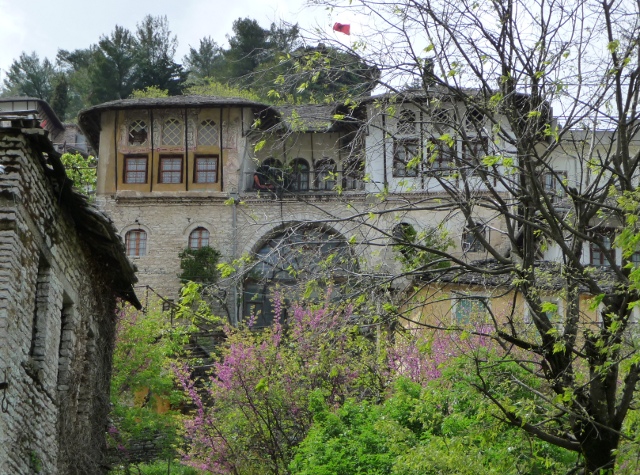
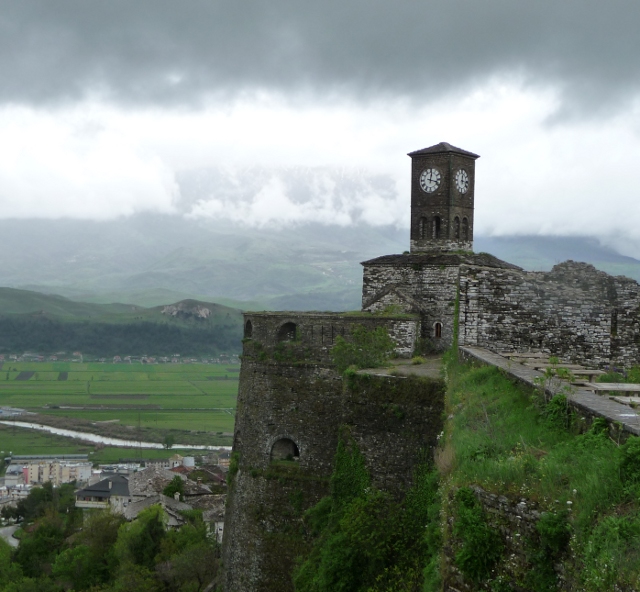
A UNESCO World Heritage town described as a ‘museum city’, Gjirokaster climbs several steep hillsides and is topped by an austere grey stone fortress. It is famed for its wonderful 17th century vernacular architecture – large family houses, some of them partially fortified, with uneven slate roofs. Its pink and black stripey steep cobbled streets glisten beautifully during and after torrential rain, which also makes them treacherous to navigate. It was pouring as we drove in and the surrounding mountains were all but obscured by low hanging cloud.

It was the weather coupled with a lack of campsites or anywhere flat to wild camp in the area, that lead us to discover the family run Hashorva guest house in one of the historic houses. We were shown a huge room (around 10m long) with a beautifully carved wooden ceiling, cupboards inset into the walls and other details for not much more than the average campsite. They managed to squeeze the van through their gates onto the drive and after moving plant pots and pruning a few plants, we managed to pull forward just enough not to drop onto the path below and to shut the gates.

Driving rain that looks set in for days is not pleasing to the spirit, but the lovely look and feel of Gjirokaster with its tall houses and long climbs, cheery cafes and shops made us venture out to explore. We followed intriguing paths and alleys at all angles between the beautiful houses as we started to get our bearings. In spite of its protected status, many of the houses are partly derelict long-term renovation projects, and quite a few have been lost completely.

Albania was officially a very secular country under Enver Hoxha’s dictatorship, and religious worship was banned for many years. Now though, it’s returned to its mix of religions, and the call to prayer from the mosque beneath the fortress carried a musical fluidity that was totally different from those we’d heard in Tunisia, and the church bells rang out prettily too.

We were enticed out of the rain into a souvenir shop by an enthusiastic proprietress, selling Enver Hoxha mugs among other delights. Enver Hoxha was born in Gjirokaster, as was writer Ismail Kadare, who won the inaugural International Man Booker Prize.

Before too long it was time to eat, and we found ourselves in a charming formica tables style eatery sampling several utterly delicious freshly cooked local specialities, including Borek – spinach and feta pastries and qifqi (rice ball dumplings) and (unsurprisingly) several glassses of the local firewater, Raki, ordered for us by the people on the next table – and for which the proprietor refused any payment…


The weather the next morning didn’t look very promising with the rain still continuing to fall. We made a steep ascent to the fortress and entered the dark dripping tunnels housing old artillary and a rather cute tank. We spent some time exploring the place – although most of the current building is from Ali Pasha’s time, in the 19th century, there was a settlement up here from the third century BC. It was also a one-time prison holding political opponents, used by King Zog, the Nazis and the Communists. The star attraction, however, is an old delapidated US plane. Heralded as a spy plane ‘captured’ back in the 1950s, it is now thought to have been forced to land on Albanian soil with engine problems during a training flight from an Italian base, the pilot was returned to the US.

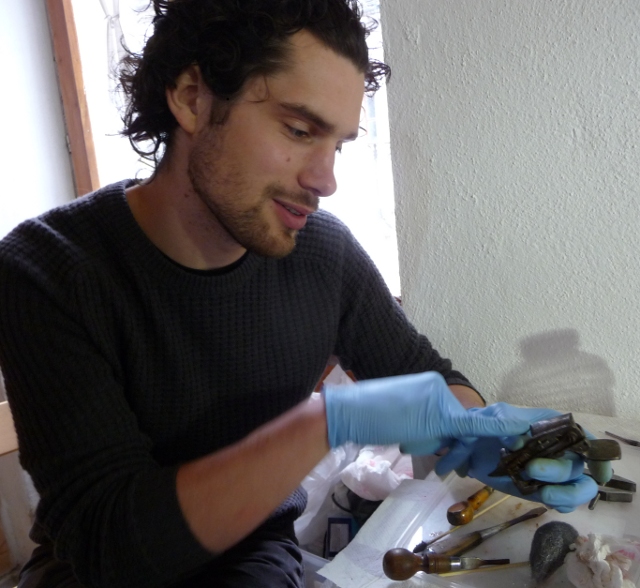
Strolling back down into town in search of lunch, we passed a woodcarver and a stonecarver at work in their neighbouring shops. We stopped to watch and admire their work. The next doorway had a flight of stairs leading up and it looked like more crafts people at work. It was much more than this. We had inadvertantly stumbled into the marvellous energetic work space of a UNESCO project bringing volunteer conservators from Britain, Italy and Bulgaria to look at the wealth of artefacts housed in the fortress, mainly firearms and textiles, and to start cataloguing and conserving them, while simultaneously training local people to carry on this important work. British textiles conservator, Janie Lightfoot, explained to us how the wonderful costumes had been kept in poor conditions, and had mice and moth damage, so there is an immense amount of work to be done. Dedicated local staff have long been struggling with a total lack of resources.

There is to be a new museum opening in a couple of months where a lot of the pieces will be shown. The volunteers had set up the work space, and helped to purchase most of the conservation materials locally – recording where they bought them so that this knowledge isn’t lost.

We were recognised by our enthusiastic souvenir shop lady from yesterday, her face hidden behind a mask as she got stuck into cleaning a metal embroidered velvet jacket. Alma and her daughter are some of the local volunteers. Two arms conservators from London were working on beautifully carved guns, making them safe for display is one of their responsibilities.

The enthusiasm and hard working atmosphere was palpable and we feel privileged to have been allowed to wander round and watch as the team got on with their tasks. The foreign conservators would only be in place here for a week, so were working round the clock to ensure they got as much as possible done, and they had already been interrupted and filmed by a local TV crew.

After lunch the rain had eased and there were even some sunny intervals. We found the wonderful Zekate House high above the town, it didn’t seem to be open to the public though so we zigzagged our way down to the Skandulli House, a 17th century family home which is open to the public.

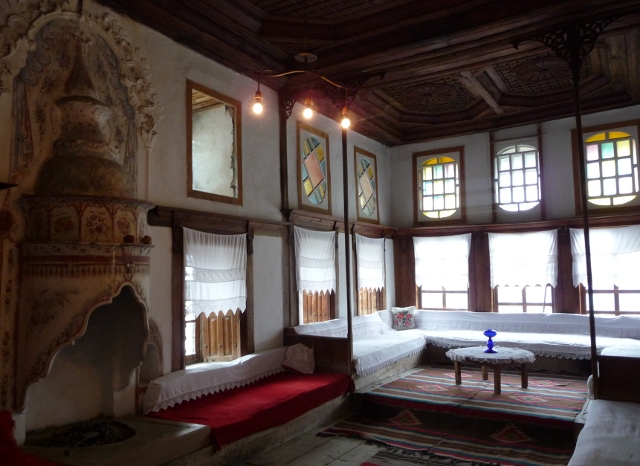
The current owner of the house gave us an vibrant tour in a blend of French and Italian and we would have been happy to move in. The lowest level had former bunkers and food storage cellars and also a water cistern which collected rainfall piped down from the roof. The living quarters were on the upper floors behind the open wooden framed veranda giving views of the town below and the mountains beyond. The rooms were light and airy with beautiful lace curtains, pretty fireplaces and low seating around the edge, the guest sitting room having more ornate decoration.


The feel and style of the rooms wasn’t dissimilar to houses we’d visited in Tunisia, particularly the one in Nefta. There were several different stairways up and mezzanines in some of the rooms for storage. The house had been commandeered from the family during the Communist era, and returned to them after its fall.

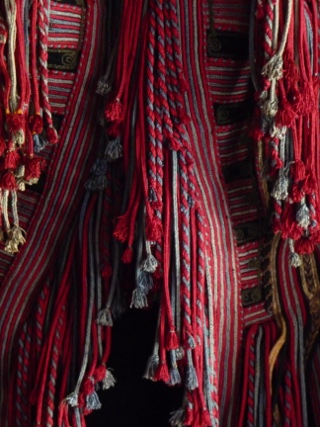
The Ethnology Museum nearby was in a converted traditionally built  house on the site of the house where Enver Hoxha was born. It has some lovely costumes and furnishings on display, and the rooms were laid out in a similar way to the Skandulli House, but it paled in comparison and lacked the soul of a house that is cherished by the family that lives in it. I was particularly taken by a red woven cloak with tassles – see photo. The conservators at the UNESCO project blanched when they mentioned how the costumes are nailed to the walls …  There were several broken panes of glass too and a cold damp breeze was blowing in. It was another pretty house to look at though.

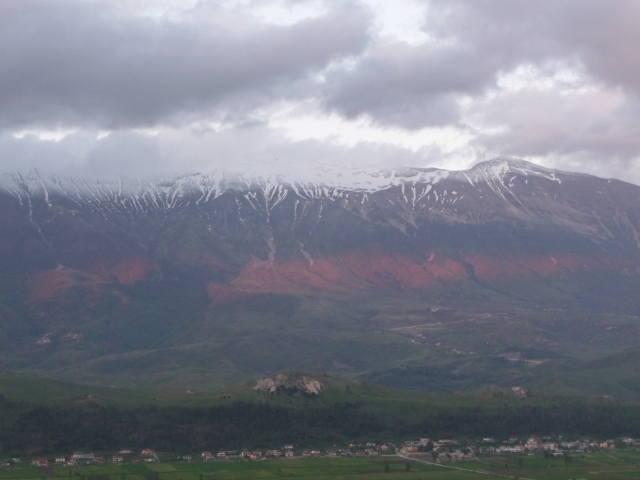
We had a pre-dinner stroll out to a viewpoint of the distant and now visible snow topped mountain ridge where the sun cast its dying rays in an auburn stripe along the mountain side.

We ate at a charming restaurant, Kujtim’s, where the maitre d’ was also the chef and waiter. As a result We had to wait a little while, but we were served with a mouthwatering feast of fresh mussels, grilled marinaded chicken, crisp arranged salads, toasted herby bread, grilled cheese and good local wine. The quality, freshness and variety of Albanian food has been a delicious surprise. We got talking to Lucy and Julia, travelling friends from the UK and Germany respectively. They were spending a week touring Albania by public transport and had been very taken with Tirana and Berat, but had been disappointed in their visit to a very off-season coastal resort where they had had some clothes go missing from their hotel room.

After our meal we strolled back through the main crossroads of Qafat e Pazarit in search of a bar to have a raki nightcap, and spotted Lucy and Julia at a cosy place we’d had a cups of tea in earlier in the day. They asked us to join them, together with an Albanian travel guide they’d met at their B&B. Raki flowed and interesting discussions ensued.

Posted in Art & Culture stuff, By Country - Albania, Food stuff, Travel stuff | 4 Comments

Përshëndetje, Shqipëria

In the last post, we mentioned the ticketing for the ferry briefly, but left out one important detail. This was deliberate, because – frankly – we didn’t want to tempt fate. The price we’d been given over the phone was a full 20% cheaper than the price online, and we didn’t quite believe it. We got to Brindisi docks early, and went in search of the ticket office. The young guy behind the counter turned out to be the exact same guy we’d talked to on the phone – and, yep, the price was right…

After our farewell pizza, we passed through the Italian customs, we were pointed towards a line of about half a dozen cars in a wire-fenced compound, with the back end of a ferry facing us. As our boarding time approached, and the queue had barely doubled in length, the guy in the car in front got out and wandered back to talk to us. Unfortunately for us, he assumed that anybody on a ferry to Albania must be Albanian, so lauched straight into utter impenetrability. Eventually, we figured that he was muttering about the fact we’d been dumped and forgotten… That was when we twigged that the boat which was sat way off to our left was our boat. One car left the queue. We paused, thought, and decided to go for it, too. Everybody else followed us… Fortunately, we’d got it right, and boarded almost immediately – but since our motley convoy turned out to be virtually all the cars and vans on the boat, I suspect they’d have found us sooner or later.

As we wandered in search of the reception to get our cabin key, the next surprise hit us. For a Greek boat plying an Italian-Albanian route, there was a surprising amount of Swedish signage on board! A couple of smaller signs carried another language which looked vaguely Latvian or Estonian, so our guess was that the Ionian Spirit used to be more of a Baltic Spirit.

By the time the boat moved off, we were already cosily installed in our bunks. Very cosily, since the cabin was about twice the width of the bunk. Still, that meant that there was something to brace yourself against, as the rolling of the boat threatened constantly to eject me from the top bunk onto the floor. I gather Ellie’s lower bunk was similarly precarious, but she had a much shorter fall ahead of her…

After the tannoy woke us to tell us to hand our key in, we headed for the outside deck to see what was ahead. The answer – MOUNTAINS! Lots of ’em, with snowy caps. But first, we had the bureacracy to fight. Or – as it turned out – to gently play-wrestle. Our big worry was car insurance. As with Tunisia, we were going to have to buy a local policy for the van, since our usual UK insurer whimpered gently at the thought of such dangerous destinations. A conversation with our Austrian neighbours at the Manfredonia campsite suggested this was yet another symptom of British fear of Johnny Foreigner, since their insurer automatically gave them a green card for countries that ours seemed not to even have heard of. Hiho. In the end, it turned out to be ridiculously easy. As we walked back to the van on the car deck, a chap in a scruffy anorak and baseball cap wandered towards us. On about the fourth attempt, he found a language that we were both comfortable with, and proceeded to flog us a mildly crumpled insurance certificate, which he then vaguely scrawled something resembling our details onto.

We exited the boat and drove through a throng of scruffy car insurance salesmen towards the customs desk, which was utterly straightforward. Out of the port we drove, past a scruffy car insurance office, and into Albania. A country which was the European equivalent of North Korea within the last two decades.

The road took us south, following the coast through mountainous terrain. The scenery was astounding. The roads were quiet – and much, much better condition that we’d expected. Sure, there were some dodgy stretches, where the road surface seemed to have gone on holiday, but they were the exception. We’d decided to start with the south and work our way north through the country. Our first port of call was Butrint – originally a Greek city, later Roman, eventually an outpost of the Venetian empire before being central to the 19th century realm of an Ottoman warlord, Ali Pasha. Now, it’s a UNESCO World Heritage site, with the ruins of the various stages of civilisation peering through lush vegetation, giving you a real impression of what it must have felt to be an explorer tripping across these places for the first time.

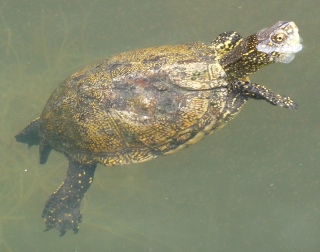
The site sits opposite a triangular Venetian fortress at the mouth of a channel leading through to an eponymous lake, and occupies a roughly circular bulge of land, with a central hill crowned originally by the Greek Acropolis. Beneath that, the theatre sits with the seating – disrupted by earthquakes – climbing away from the stage, currently the exclusive preserve of terrapins gliding through the water to an almost deafening chorus of frogs.

As we wandered around, we met remarkably few other visitors, save for a Swede visiting his 103rd country and a Polish monk. As you walk around the promontory, you follow the line of the fortifications.

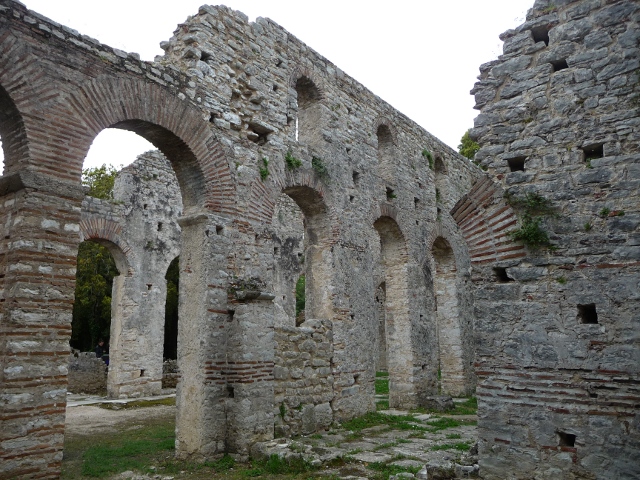
Still remarkably intact in many places, they also enclose an early basilica and baptistry (renowned for the quality and condition of the mosaic flooring – but which, unfortunately, is semi-permanently covered for conservation reasons), as well as residential quarters, including a Senatorial palace. After the Romans left, and most of the site fell into disuse and disrepair, the palace was used for a variety of purposes – including a fishing village and market place. At the top of the hill, the Venetian fortress keep is now in use as the museum, reopened recently after being badly looted in the chaos and anarchy following the fall of communism. Much of the site remains unexcavated, but that just adds to the sense of drama and wildness.

The only way across the channel is by a small chain ferry, rickety and decrepit – but strong enough to take our van across, towards the Greek border only a handful of kilometres away.

We weren’t going there, though – we’ve seen a lot of the mainland and Peloponnese, and wanted to focus on places new to us – so we curled round the far side of the lake. A couple of small diversions took us to the 11th century church of St Nicholas at Mesopotam (totally unrelated to Mesopotamia…), a squat domed building with many of the stones reused from earlier structures, some featuring crisply carved creatures, real or mythical.

As we wandered around the outside (the inside’s closed, due to restoration), I climbed up some stone stairs onto a wall for a photo. At the top, a quick look down spotted movement as a well-camouflaged snake, maybe three metres long and a good few inches across, dived for cover after basking gently in the sun… The wildlife here seems to lean towards the dramatic, as a power cut at our campsite the previous night gave us a good view of dozens of fireflies circling lazily around despite strong winds. There don’t appear to be that many campsites in the country, and – as with Tunisia – those that do exist are often clustered together around “holiday areas”. Which, of course, means that many of them are closed outside of high summer. Barely 4km away from the gate to Butrint, Ksamil camping was the only one open in the entire SE corner of the country, but was perfectly located. It’s not exactly your huge resort – there’s room for maybe four or five vehicles to park up in Alexander & Linda’s front garden. The loo and shower cubicles in the garden are immaculate, with one very novel feature – or, rather, lack of… A ceiling. Still, anybody on the neighbour’s balcony can’t quite see into the shower. Not below shoulder height, anyway. Probably.

The “Blue Eye” was our next stop, a deep underwater cave from which water pours from a still unknown source. From the right angle, the resemblance of the water’s surface to an eye is visible, although the rain over the last few days had probably resulted in the surface being a bit too lively for it to be more obvious. It was a very beautiful spot, though, and it really wasn’t a great surprise that the Communist era had seen it accessible only to those who were More Equal enough to be deserving of it…

Our lunch stop, underneath an allegedly 600 year old tree in the village of Libohovë, saw us handed a menu which – although short – was way beyond the scope of the food section of our phrasebook. Despite a quick guided tour of the kitchen, our order remained a tad unclear – but there was an easy solution apparent to the nice lady who ran the place. Bring us one portion of everything. After we finally cleared it all, we headed off to try to find the 6th century church of St Mary in the next village up the hillside. Eventually, we found what we thought was the right road, but made the fatal mistake of checking directions with a passer-by.  It was, it seemed, the right road (if that’s the right term), but she seemed to be trying to dissuade us from heading that way. Maybe it was also closed for restoration, maybe the road just got a LOT worse. Who knows? We gave up, anyway, and headed on through to Gjirokastër.

Posted in By Country - Albania, Travel stuff, Wildlife stuff | 3 Comments

Last few days of Italy

On our return to the campsite after our Fracchie outing, we knew we’d missed the curfew and the gates were closed. We slept outside on the road, waking up briefly to drive into the site when it opened again at 6.45am. I could get used to being driven around while lying in bed!

We lingered at the site for several more days, firstly to bide our time over Easter, and then it seemed silly not to take advantage of the seven nights for six offer. As well as doing some bits of research and vague planning for the next part of our trip and catching up on laundry, I changed the spark plugs on the van, and we made several other forays into the hills of the Gargano peninsula – the fetlock of Italy. It is a beautiful area and we explored Monte Sant’Angelo, a busy but freezingly windy town at the top of the mountains. The warm spring had dropped many degrees and snow had fallen on the mountain tops. We took loved its spectacular views and visited a cave church where the Archangel Michael is said to have appeared a few centuries ago. A service was in full swing but they didn’t seem to mind people milling around and coming and going. It all added to the atmosphere.

We drove around the coastline – limestone coves, turquoise waters and wooden fishing  platforms, called ‘trabucchi’ an old practice back in use – and visited picturesque Vieste.

A quiet Easter Sunday wander round what would be a tourist hotspot in the summer high season. We enjoyed a lovely pizza in the sunshine of a sheltered back street, entertained by a huge joyous gathering of friends at the next table, which included singing along to corny pop songs and all of them bidding us farewell when we departed. Driving down through the centre of the Gargano, the scenery became anything but typically Italian. It felt very like home … the beech trees with their gentle spring foliage set against a snowy dusting in the hills of the Umbra Forest, or ‘forest of shadows’, wound through by tiny lanes.

Another outing westwards took us into the rolling farmlands of the Tavoliere plain, the breadbasket of Puglia, where a large percentage of the durum wheat for pasta is grown. We sauntered around the small sleepy town of Lucera, which couldn’t seem to even muster an open restaurant, although we were just in time for a slice of pizza from an old backstreet bakery, and then to Troia with its pretty rose-windowed church, where we were guided around by a local chap looking for a diversion on a quiet afternoon, and a chance to practise his English.

Back at the site we socialised with some more Brits, Austians and Germans. Germans Martina and Hubert who were with their purple VW T25 with Westfalia interior, had been placed in the pitch next to ours and we swopped notes on travelling in a small van over some wine.

We had finally decided to sail out to the port of Vlore in southern Albania. The sailing leaves from the port of Brindisi, and on the way there we spent a couple of days with Jochen, Sylvia and Jacob, a Germany family we first met at Ksar Ghilene in Tunisia, who live in Bari. It was great to see them again and they made us very welcome. It was good to have a glimpse into real life.

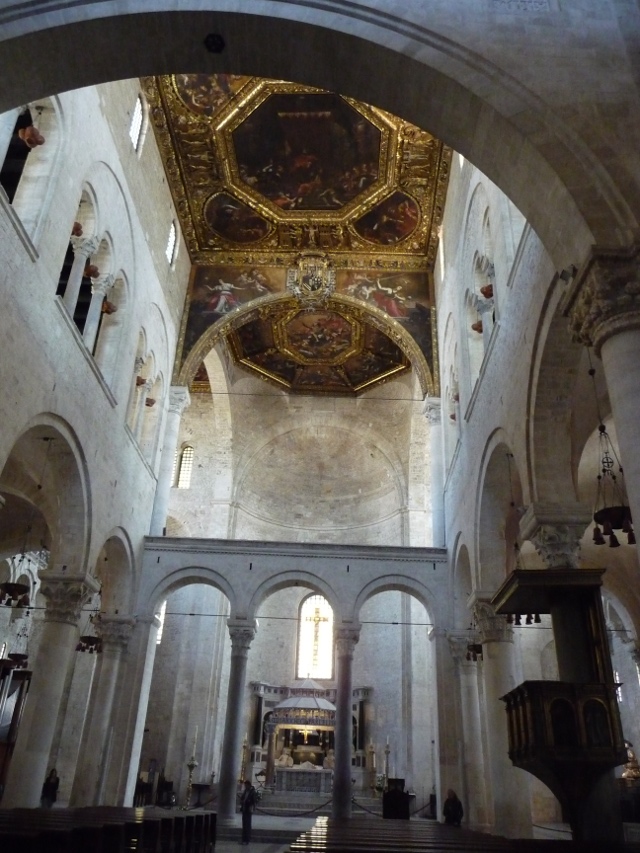
We explored the wonderful old town of Bari, where the narrow streets in light coloured stone feel airy rather than hemmed in as we were expecting. The churches too are simple romanesque structures, with wonderful crypts beneath them.

There was an orthodox Easter ceremony taking place in the crypt at San Nicola, which houses a wonderful icon presented by the King of Serbia. On the way to Bari we had also stopped off at Trani, where the church was also high and light inside and which had two more churches in its crypt areas.

It took a few phonecalls to make the ferry booking, as the site we normally use wasn’t accepting bookings for this crossing, (to the broker site in the UK, to the ferry company in Greece, and to the agent in Brindisi) but we got there eventually. It was sad to say goodbye to our German friends, but we headed off into a rainy day to see a bit more of Puglia before finally catching our ferry.

The weather worsened as we headed into the picturesque countryside around Alberobello, known for its charming buildings, called trulli, which are conical shaped oast house like structures with pointy roofs like gnome hats. Unfortunately, even they couldn’t lift our spirits, and these were further dampened when we found out we couldn’t park for less than eight euros an hour …   We drove onto the next town – Locorotondo – where we arrived soaking wet at a lovely restaurant and our moods lightened. We decided not to stay in the locality but to press on to the town of Lecce, further south. After a few false starts we even found a camper stop site that was open. We’d bought lots of food at a local market, so set about making a rather larger than planned dinner. And it kept on raining in the night.

Next day, dawned fine though, and we went off to explore Lecce, a light coloured Baroque town with wonderfully ornate churches and elegant buildings. We were glad we’d made the push to see it before leaving Italy. We had another lovely lunch of local cheeses and a good wine, in a quiet square. Puglia is specially known for its wonderful food, which is going some in Italy. The weather changed again though as we were finishing lunch and the afternoon saw more torrential rain as we did our last bits of shopping before leaving the country.

We have spent much longer in Italy on our return than originally intended. What was meant to be a week or so’s drive through the country to catch a ferry across the Adriatic has turned into nearly a month. The country just can’t relinquish its grip on us! It’s been a relaxing few weeks, but now we are ready for new experiences, tastes and cultures and look forward to the next eastern phase of our journey, as we sit here on a rainy dock at Brindisi.

Posted in By Country - Italy, Food stuff, Travel stuff | 2 Comments

The Long Good Friday

San Marco in Lamis, a small town in the hills of Puglia’s Gargano peninsula, is the home of one of Italy’s longstanding Easter traditions.

There are three parades through the town on Good Friday – one in the early morning (5.30am – I’m ashamed to admit, we couldn’t be bothered to get out of bed for it…), one in the afternoon, and one in the evening.

For San Marco, there’s no penitents, anonymous beneath pointy hoods. The afternoon procession leaves the church of San Antonio Abate, in the busy but narrow thoroughfare of the Corso Giacomo Matteotti. A crowd has gathered expectantly for the parade, amongst them the dozens of Boy Scouts and Girl Guides who are to take part. Eventually, the doors of the church open, and a group of men, immaculate in dark suits and sunglasses, carrying crisply folded white cloths, head in. They soon emerge again, considerably later than the advertised 5pm start – with the cloths padding the shoulders of four of the men as they carry a bier bearing a statue of the body of the dead Jesus, the other four similarly bearing a wooden statue of the Madonna Addolorata – Our Lady of Sorrows.

At a slow pace, the procession heads up the road, taking an hour or so to perform a loop around the old part of the town. The ladies of the town lead, dressed all in black. Behind them, a group of nuns preceed the statues, then the scouts and guides. Finally, the men head a larger congregation. All the while, the Miserere is sung, with the women taking one part, the men the other.

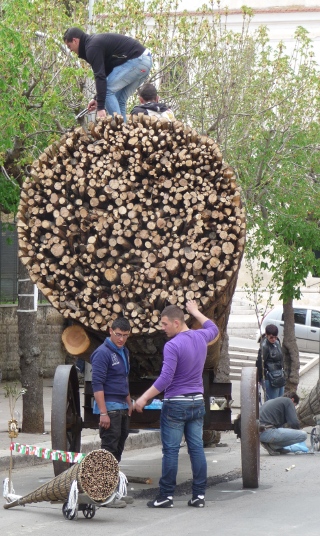
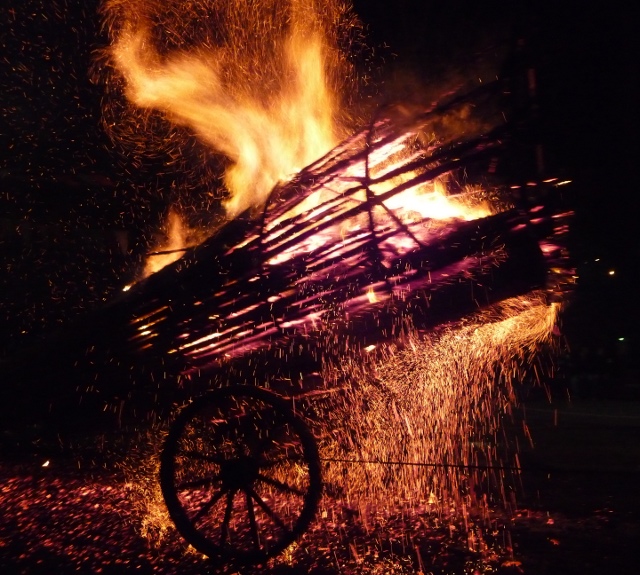
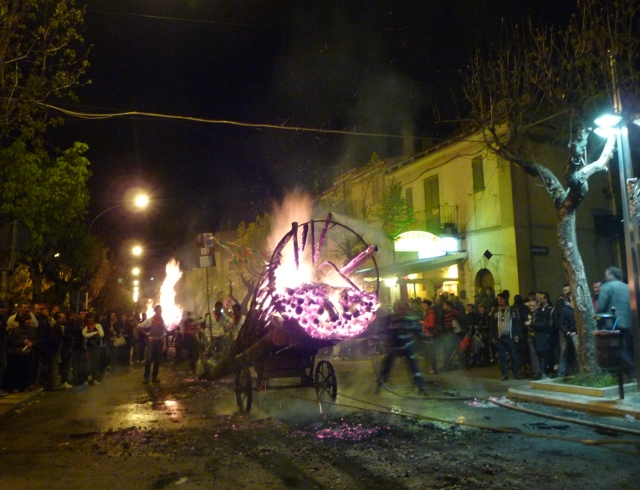
Meanwhile, the main streets through the town are being closed to traffic. Dayglo is being worn everywhere, with the volunteer Protezione Civile forces of most surrounding towns busying themselves checking hydrants and moving fire tenders into position. Along the Viale della Repubblica, climbing an incline from the church of the Vergine Addolorata, “fracchie” – large, wooden torches made of a single split tree-trunk – are parked in ever increasing numbers, as a JCB drags them out of the back streets and garages where they’ve been being built.

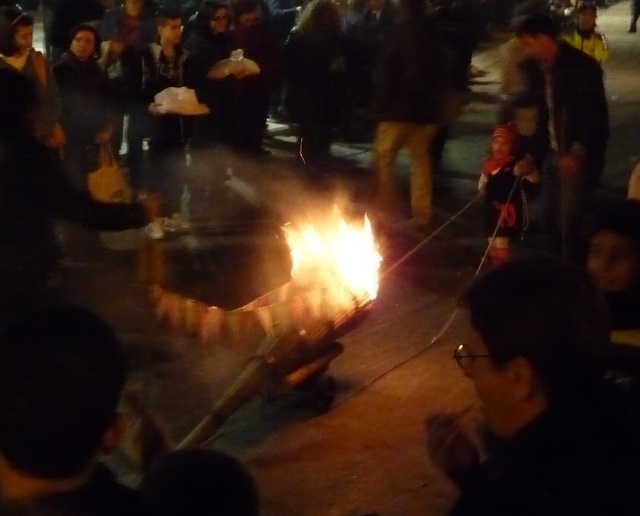
Eventually, once the light has started to fail and the evening passeggiata has become a thronging crowd lining the roadsides, smoke starts to rise as the first, smallest fracchie are lit. The first one to come through is barely larger than some of the models outside shops in the town, and is towed by a single tiny girl (with a bit of help and encouragement from her father).

Haltingly, they file past. From our vantage point, standing on the lower steps of the roundabout, the gentle glow of the first few is quickly replaced by flame, then clearer views, as the larger fracchie start to appear.

Within the hour, a gap in the flame gives the reason for the torches – lighting the route for the Madonna Addolorata, preceded and followed again by the strains of the Miserere.

Behind her, a throng of local dignitaries in their tricolour sashes and a major celebrity – Albano, famous as a singer from the late ’60s through to today, just about visible under a Panama hat in the middle. We’ll gloss over his apparent preoccupation with his mobile phone call.

It’s not over yet, though. There are still more fracchie to come. LOTS more. For the next three hours, the big torches are lit, pulled and steered by heaving, panting and sweating teams of up to twenty men.

Waiting for the procession to start, we’d got into conversation with an older local couple, who explained some of the history to us. The fracchie used to go down the same narrow Corso Matteotti as the afternoon procession. Originally hand-held torches, they’d grown to the stage they needed to be dragged on wheels. Then they’d continued to grow as rivalries and competitiveness crept in. Eventually, after a set of wheels collapsed under the weight one year, and as damage to the road surface and overhead wires grew ever worse, regulation crept in.

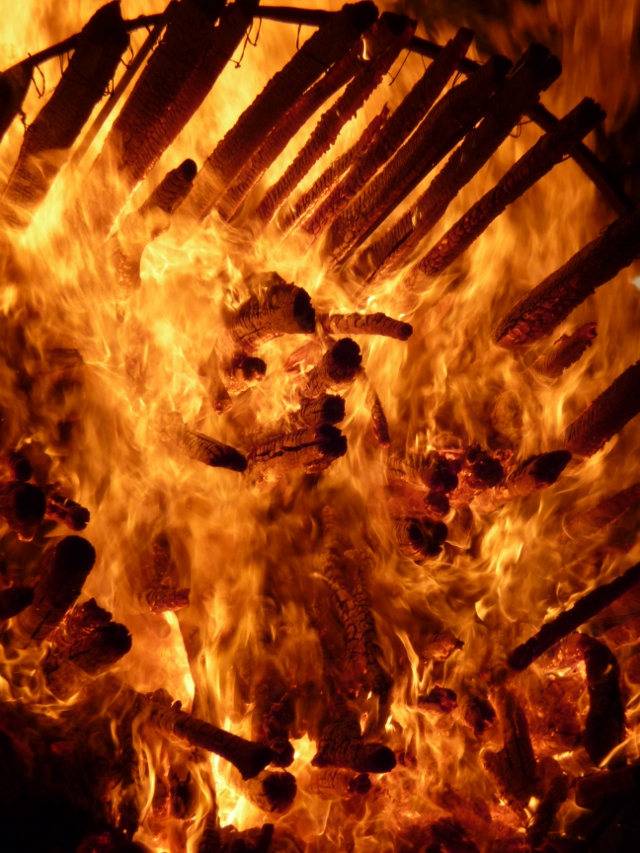
Now, there’s a maximum to the size to be pulled along the less-enclosed route. The largest torches must be about ten metres long, and at least a couple of metres in diameter. Made from a single solid tree-trunk, split at one end, with wedges of Oak and Chestnut driven in to flare them out, bound with iron rings and firmly attached to iron undercarriage, they apparently weigh up to ten tons.

Lighting them is accomplished with the help of generous helpings of accelerant – two litre water bottles full of red diesel, larger bottles of used engine oil, and seemingly endless amounts of enthusiasm. One team seemed to be having difficulty getting theirs to catch properly, despite the generous amounts of diesel being slooshed at it. Eventually, the inevitable happened – the flame caught the bottle’s neck. Quickly dropped, it rolled around on the road surface in the middle of a small pool of fire, being kicked out of people’s way. When the torch was dragged up hill again, it got caught and squished underneath the trunk’s tail-skid, leaving a long line of flame behind.

The next team were determined that they would have no such problems, with one lad standing on top of the torch as the fuel-soaked rags stuffed between the stakes were lit, pouring engine oil down the face of it all.

As the earlier, more restrained, torches had been taken down the road, teams from the local council had used metal rakes to clear the ashes and embers away from the road surface, leaving it clear for the next to come. Once the Madonna had passed, though, that was deemed unnecessary. As the torches paused, and were thumped, shaken and prodded to keep them properly ablaze, the amount of burning wood built up.

As the teams stumbled over and through precarious levels of debris, the volunteer firemen stepped in with high pressure hoses to disperse it and spray the road down. Periodically, an over-lively torch was damped down a bit, amidst friendly jeers, in a vain attempt to try to keep it under control.

By the end of the town, a distance of no more than a few hundred metres, there was precious little of the torches left. The first couple of iron hoops hung forlornly, with the remains of a handful of stakes reminiscent of the skeleton of a crashed aeroplane.

Another team of firefighters were ready with hoses to extinguish them, a huge pall of smoke rising as they succumbed, then were dragged off to join the stubs of those which had gone before.

We left at midnight, with the last torch just lit and starting the journey. The impeccably behaved crowd were all but gone, the last few milling around cheerfully, but the enthusiasm of the teams was undimmed. Perhaps it was the knowledge that, this year, their efforts were immortalised in a commemorative postage stamp. Perhaps it was the knowledge that the tradition has been nominated for UNESCO world heritage status. Perhaps it was just – well, just because.

Click here for a short fracchie video.(YouTube)

Posted in Art & Culture stuff, By Country - Italy, Uncategorized | 3 Comments

Back to the mainland

Heading back to the Italian mainland from Sicily was never going to be easy, so we found one last distraction to put it off for a day – Taormina. The Greeks had built a theatre here, on top of a rock next to the ocean, with a stupendous view of Etna. The Romans, when they came along, liked it all so much that they took it over and remodelled it – putting a chuffing great big building just behind the stage, totally blocking the view. Fortunately, that building’s a bit decrepit now, so the view’s back.

The town itself is a bit touristy, but we did manage to say goodbye to Sicily properly in another respect, too – we found a superb Arancini shop! We probably mentioned this already, but they’re balls of sticky rice, classically filled with meaty ragu (think SpagBog), but often with ricotta and spinach or various other scrummy mixtures, then given a crispy crumby coating and deepfried – delicious. Here’s a YouTube vid of how they make them. My mouth’s watering watching…

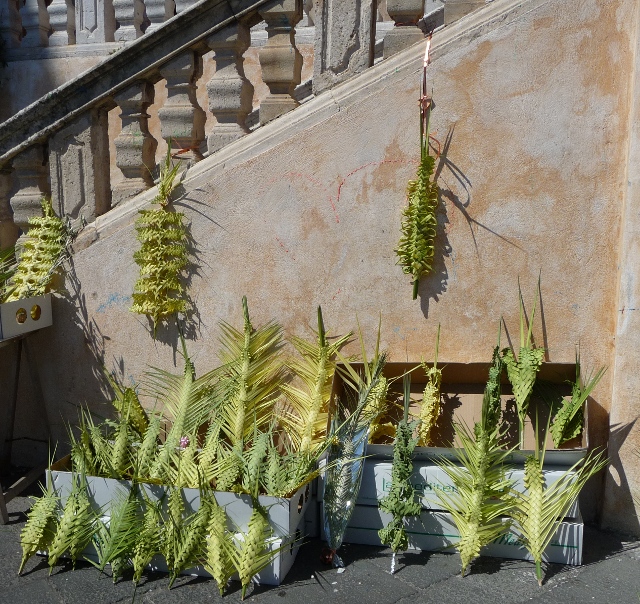
Being Palm Sunday, Taormina was full of little stalls selling woven palm leaves, but – of course – we’d managed to miss all the parades. Hiho.

We’d even managed to miss the eruption that Etna had had overnight, despite being camped half-way down the slopes! Our Swiss neighbours did say they’d seen an orangey glow against the clouds… Anyway, ignoring the visit to the top of Etna, we’d ticked off all the things we wanted to return to, and could leave with a clear conscience.

Whilst we were on the boat, we had a look at the map to choose which way to head towards Puglia – north up the coast then across or south round the southern tip of Calabria. We decided to go straight inland and over the Aspromonte mountains instead. The tail end of the Appennines, their remote interior means they have a reputation as a favourite place for the ‘ndrangheta (Calabrian mafia) to hide their kidnap victims… Not at all hard to believe, as the road twisted and turned up narrow, steep valleys, with spectacular views all around. Olive groves covered most of the lower slopes, netting covering the ground to aid harvesting.

Gradually, we got more and more lost – the signage in one town was in such short supply that we left by every single available road, always returning to the centre sooner or later, as a group of old boys watched us with increasing interest from a street corner… One of the roads was a 20km detour up into the natural park covering the peaks of the mountains. We thought it’d take us over and down the other side, but the distant snow gradually got closer and closer, right up to the sides of the road and eventually the full width as the road petered out into nothingness.

By contrast, once we dropped back down to the coast, we were on a fairly bland curl around the arch of the foot. Eventually, as we approached Metaponto, we started to figure that this was as good a place as any to stop for the night. Off the main road we turned, and stopped in a layby just off the junction to see if we had any information on nearby campsites. Something yellow caught my eye, attached to a pole just at the end of the layby. A sign pointing to an agriturismo campsite, only a few km away. Perfect! Time to start to plan for where in Puglia the best Easter parades were likely to be. We decided on the Fracchie festival on the edge of the Gargano peninsula, not far from Bari, and headed that way.

Posted in By Country - Italy, Food stuff, Travel stuff | 1 Comment